


Ricky Mason remembers his first introduction to what was then known as the Boy Scouts.
His mother told him when he was 7 years old that he would join scouting four years later and become an Eagle Scout.
“My mother told me I was gonna do it, and so that was sort of enough for me,” Mason told JNS.
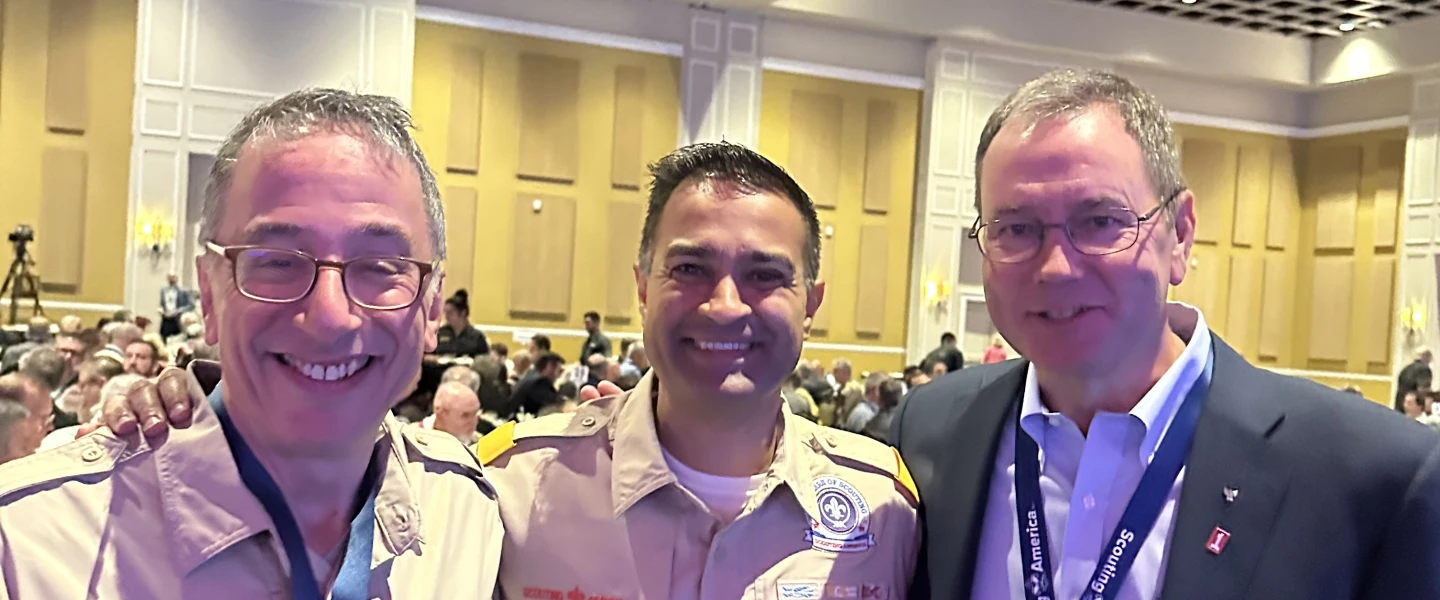
He’s embarking on another scouting adventure 60 years later. Next month, Mason will become chair of Scouting America’s national executive board, the first Jew to hold the volunteer post in around 50 years.
Mason, 66, will become part of the triumvirate that runs the iconic organization, alongside a paid chief executive and a national commissioner, another volunteer post.
“I decided to become chair first because I was asked,” Mason, a resident of Hoboken, N.J., and a member of the Conservative congregation United Synagogue of Hoboken, told JNS.
“It wasn’t something that I had really thought much about, and I said yes for several reasons. One is because of the impact that scouting had in my life,” he said. “Without it, I wouldn’t be the person I am today, and that’s important for me.”
The first Jew to lead the Boy Scouts was investment banker Mortimer Schiff, whose daughter Dorothy was publisher of the New York Post. Mason said there might have been another Jewish leader in between Schiff, who died in 1931, and him, but records are unclear.
Like scores of other Jewish families, Mason’s grandparents came from Europe and wanted their grandkids to grow up as Americans. “What more American thing to do than to join the scouts, right?” he said.
So Mason followed his mother’s order and, at age 11, joined the Boy Scout troop at Temple Beth-El, a Conservative synagogue in his home city of Richmond, Va.
He learned all about camping, hiking, reading maps, leadership and other skills and earned his Eagle badge three years later.
At the time, Richmond, the former capital of the Confederacy, was under court-ordered desegregation orders, and one of the scout retreats was part of the first desegregated unit.
“They said, ‘You’re an experiment, and you need to make it work,’” Mason told JNS. “We did so. Scouting really taught me about a lot of the aspects of diversity, through action in 1974 in the south.”
“That’s a lesson that kind of stuck with me,” he said.

As plenty of other kids did, Mason drifted away from scouting. He got involved in the Jewish youth organization BBYO. The lessons he learned from the scouts served him well, he thinks.
“I never would have met my friends in BBYO had it not been for scouting,” he told JNS. “Scouting gave me the confidence and the leadership skills.”
He dropped out of college at 17 after his mother died. He later returned to school, graduating from Virginia Commonwealth University, where he met his wife, Beth and then from New York University School of Law.
He joined the firm of Wachtell, Lipton, Rosen and Katz, settled in Hoboken, made partner, raised two children and served on his synagogue’s board of directors. (He is now of counsel at the firm.)
About 20 years ago, at the encouragement of one of his mentors at the firm, he decided it was time to volunteer, and his attention immediately turned to scouting.
“For 30 years, I didn’t think about anything about how I got there,” Mason told JNS. “I was just focused on the work, but I started to think about what was important in my life and what helped me to get where I am, because you never do any of this yourself.”
“I realize scouting was a critical factor—the lynchpin, however you want to describe it,” he said.
A friend, who was also a partner at a big law firm and an Eagle Scout, recommended that Mason join the board of the regional councils overseeing the various troops in the New York City area. He became chair of the councils.
“I like to joke that when you become an Eagle Scout, they surreptitiously plant a chip in your wrist, and then flip on the master switch at the national headquarters 20 years later,” he told JNS.
Mason was there when, after the case of whether the Boy Scouts had to admit gay boys went to the U.S. Supreme Court, the organization opened its doors to gay boys and girls. It changed its name to Scouting America.
He was there when the scouts declared bankruptcy after facing thousands of sexual abuse claims, setting up a $2.5 billion fund for survivors.
Mason recalled meeting with the Boy Scouts’ general counsel, Steve McGowan, who asked him to come on board and work on the abuse claims. Mason had handled bankruptcy and restructuring issues for his law firm.
“The gentleman looked across the table at me at lunch and said, ‘You’re an Eagle Scout. You are the volunteer chair of one of our largest councils. You are a senior restructuring professional with a nationwide reputation,’” Mason told JNS.
“He said, ‘God put you on this Earth for a reason,’” he said. “When Mr. McGowan believes something should be done like, I guess, me creating and sharing a committee, he leaves no ambiguity about that.”
“I went home that night and kind of laid this out for my wife,” he said. “She cut me off and said, ‘You have to do it. This organization meant a lot to you and means a lot to kids and families and the country, and this is what you need to do.’”
The project took three years.
With Mason’s involvement, the Boy Scouts reached a settlement with insurers and representatives of the survivors of abuse.
“The purpose of the bankruptcy was a dual purpose, to recognize and equitably compensate survivors of abuse and scouting and to allow the scouting mission to survive and go back to what it does and thrive,” he told JNS.
“I think it accomplished both of those purposes,” he said.
Mason said he was asked to join the national board and, about a year ago, became chair-elect. He acknowledged the visibility he will receive as a Jewish scout leader.
“Scouting is a faith-based organization, and as a member of the Jewish faith, I’m very proud of my Jewish identity,” he told JNS. “It also allows me to reach out to other faiths that sponsor scout troops to have a common sort of communication, interest and goals.”



