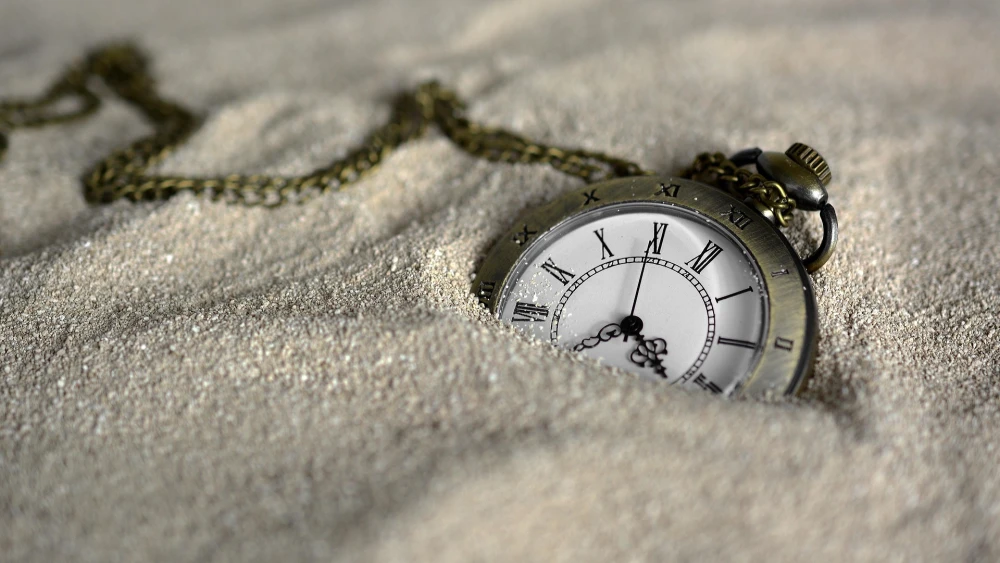

We have clocks, wristwatches, phones and more to tell us exactly what time it is. We have all those devices that come with alarms to wake us up. But these days and weeks between Passover and Shavuot, we actually count time in what is known as Sefirat Ha’Omer.
Every night we count one of the 49 days from the Exodus from Egypt leading up to the Revelation at Sinai seven weeks later. We do so in anticipation of God giving the Torah at Mount Sinai. We literally count the days until we can again experience this traditional, spiritual phenomenon.
Of course, “the inexorable march of time” is indeed relentless and unstoppable, whether we take notice of it or not. Time is indeed a significant subject, but let’s focus on what it says about our priorities.
What is the most common excuse for everything from not doing our homework to not making it to synagogue? “Sorry, but I had no time.”
If you think about it, what the person is saying is that while they did manage to get a number of things done that day, this item was not quite on the top of their agenda, so they didn’t get around to it. It’s not only an excuse, but is, in fact, somewhat insulting. Because what they are really saying is, “You are not important enough for me to make the time for you.”
So, the next time your spouse asks you to do something and you don’t manage it, don’t respond that you ran out of the time. Because, effectively, what you will be saying is that while you had 10 different things to get done that day, the request from your husband or wife came in at number 11.
We prioritize what is important to us. So not making the Top 10 says something.
People make time for what is important to them. That is true even when it comes to something like entertainment. How many hours do we sit in front of the computer or TV? And how often, after a particular program, did you say to yourself: “What a waste of time!”
And what about going out to a movie or show? We all do it, some more often than others. It’s part of our social life. But it takes hours when you consider getting ready, transportation to and from the event, the length of the event itself, etc. Do you know how many business meetings you could have had in the hours you spent on it?
Of course, relaxation and entertainment are necessary diversions to take our minds off the day-to-day rat race and the pressures of busy lifestyles. I’m not arguing that we must all sit home and read a book. We need a balanced life.
And if we are completely honest with ourselves, we will acknowledge that if we thought going to shul on Shabbat was important and that we might enjoy it, we would be there more often. Same with the rabbi’s lessons, a Torah classes or a Jewish holiday program.
My late father would tell the story of the guy who was always late. When people demanded that he get his act together, he responded: “Actually, it was about 10 years ago that I once overslept, and I simply haven’t been able to make up the time I lost since then. So I’m still running late!”
There’s more truth to that than you might think. As American founding father, author, scientist and inventor Benjamin Franklin said, “Lost time is never found again.”
The saintly Chofetz Chaim (Rabbi Yisroel Meir Kagan, 1838-1933) once asked a wealthy man for some help with a project, and the man replied, “Sorry, rabbi, but I have no time.” The Chofetz Chaim looked at him sympathetically, and said, “You really have no time? What a shame. How absolutely impoverished you must be.”
One man who clearly appreciated the value of time was Rabbi Sholom Ber of Lubavitch (1860-1920). He once remarked that “a summer’s day and a winter’s night is a year!”
So, back to the beginning: Why count time? To sensitize ourselves to the absolute preciousness of every day, every hour and every minute. We know this intellectually, but when we make a point to mark every night for 49 days, it must surely influence our thinking and mindset.
Let’s hope we can prioritize what is truly important. Let’s try and value time—our time and those of others. Indeed, that is one of the lessons of the season.
Sefirat Ha’Omer reminds us not to pass the time, but to make the time.