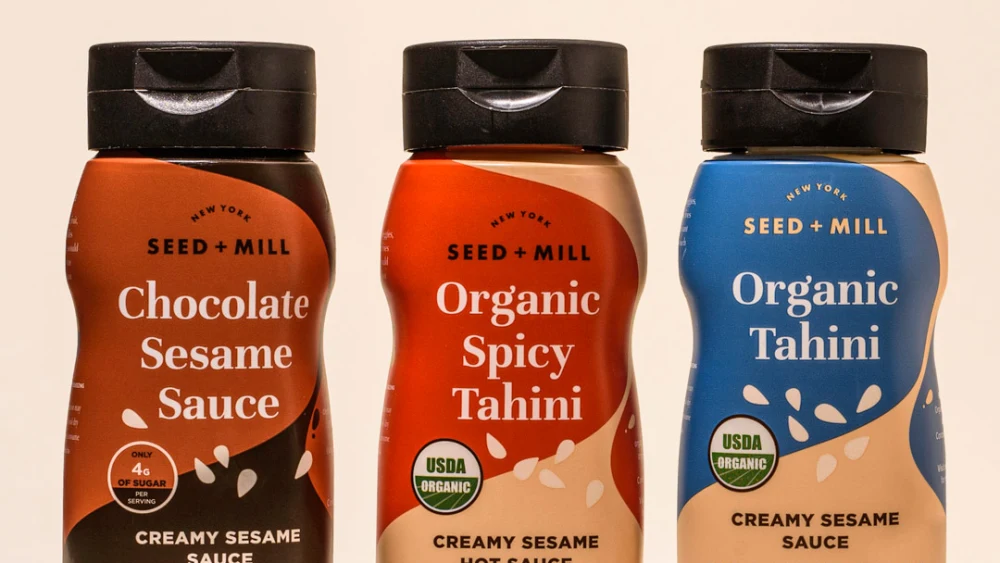
Those who say that they support Palestinians have praised Park Slope Coop’s decision this week to boycott Israeli products. But the Brooklyn co-op has also banned the wares of at least one Arab-owned factory, according to Rachel Simons, who sells tahini at Park Slope Coop.
Simons told JNS that her tahini products are produced by a company that Israeli Arabs own in the northern part of the Jewish state.
“On a whim, I decided I would start a little business around sesame seeds, and with the simple goal of just enjoying people, food, the culinary industry, interacting with people from all around the world,” she said.

Some 20,000 people a day walk through Chelsea Market, where Simons, a Jewish native of Australia, set up shop 10 years ago selling halva, tahini and other products.
On Tuesday, Park Slope Coop voted to boycott Israeli products after separately voting to lower the 75% threshold required to institute such a ban.
Simons’ company, Seed + Mill, sources its products in Israel, where she lived for a year. It does so “not necessarily for ideological reasons but simply because they make excellent tahini and halva, and their products and ingredients and conceptions that are difficult to source and produce domestically,” she told JNS.
Her New York team handles sales, marketing, consumer education and recipe development.
Over time, her products became popular enough to be sold in hundreds of stores around the United States, including the Park Slope Coop for the last six years, Simons told JNS.
That has produced “meaningful revenue” for Simons, who told JNS that she has dealt with a “fair share” of emails, comments and social media engagement after Oct. 7 that “wasn’t particularly pleasant.”
She has otherwise avoided efforts to boycott Israel until now, she told JNS.
She is generally sad about the co-op’s vote and is disappointed that “I’ve had no opportunity to talk to the co-op membership,” she said.
“If I had been given that opportunity, one of the things I would have loved to have shared with them is to put a face and names and stories to the people who make our products,” she told JNS.
She declined to name the factory in northern Israel which produces Seed + Mill’s products and which she said is owned by a family of Muslim Israeli-Arabs. (JNS independently verified the company and its connection to her company.)
The company “works extremely harmoniously” and hires Jews, Christians, Druze and Muslims, Simons told JNS.

“They work together, they put food on their families’ tables, they are running a food business,” she said. “For the co-op to have put in place a boycott that is supposedly intended to address allegations of apartheid, I just can’t think of a better example of how Israel is not an apartheid state when you look at the people who are actually making our products.”
If she could have addressed co-op members prior to the boycott vote, she would have told them that “my partners in Israel are a combination of all sorts of colors and religions and faiths and geographic history,” she told JNS.
“That is exactly what Israel is, which is a diverse multicultural country,” she said. “That’s the way I’ve always appreciated Israel.”
She would have made her view clear that “I don’t see this as a constructive or as a meaningful way to deliver peace and prosperity to people of all faiths in Israel,” she told JNS.
“My passions in life are just talking to people about food and recipes and cooking at home, not talking about how little, tiny tahini brands are going to solve a complicated war in the Middle East,” she said.