


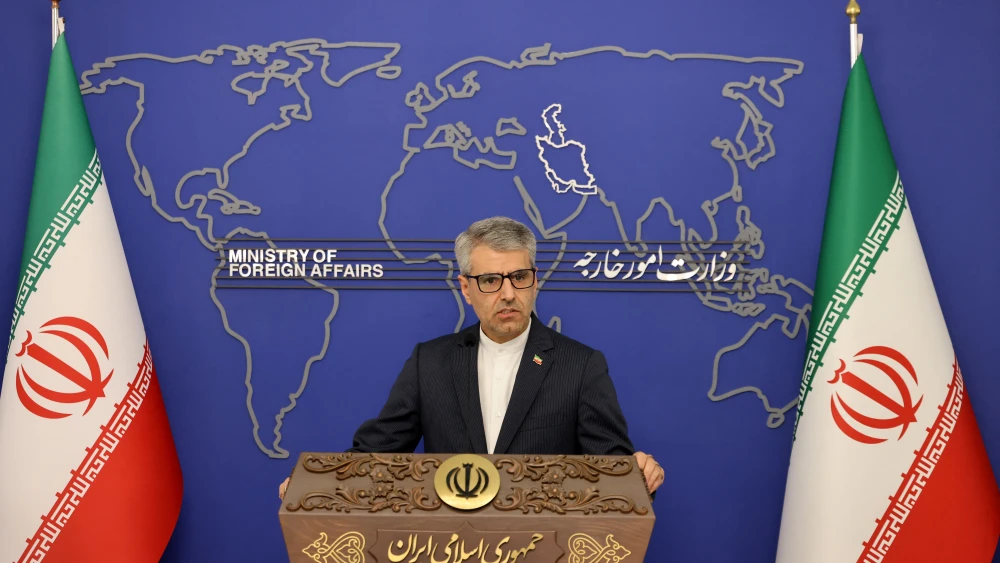
A spokesman for Iran’s Foreign Ministry said on Wednesday that Tehran’s participation in ceasefire talks with the United States “must be reviewed” following U.S. retaliatory strikes against the Islamic Republic.
Esmaeil Baghaei said Washington harmed the ongoing talks “through the contradictory messages it sends, its repeated shifts in positions and demands, and, worst of all, through repeated violations of the ceasefire,” according to the state-run IRNA news agency.
“The Zionist regime [Israel] is also damaging the current process by violating the ceasefire,” the ministry spokesman said. “Any diplomatic process is damaged by the use of force and by resorting to unlawful actions on the ground.”
Baghaei said the Islamic Republic “would not hesitate for a moment” to take military action whenever necessary. He added, “Diplomacy and the battlefield are not separate matters; rather, they exist alongside and complement one another in safeguarding Iran’s interests and security.”
The U.S. military on Tuesday completed a wave of retaliatory strikes against Iran in response to the downing of one of its helicopters over the Persian Gulf.
United States Central Command said it struck Iranian air defense systems, ground control stations and radar sites near the Strait of Hormuz “with precision munitions from U.S. Air Force and Navy fighter jets.”
“The operation was a proportional response to recent attacks on U.S. forces and international commercial ships transiting regional waters,” it stated. “U.S. forces remain vigilant and postured to defend against unjustified Iranian aggression.”
Following the U.S. strikes, Iran’s military and its Islamic Revolutionary Guard Corps launched attacks on American assets in the region, including in Jordan, Kuwait and Bahrain.
The latest flare-up in hostilities came after Trump told reporters on Tuesday that Washington and Tehran were “in the final throes of what will be a very, very good deal,” saying the agreement being negotiated with the Islamic regime “will not allow in any way, shape or form nuclear weapons, etc., and that the Strait [of Hormuz] will open up right away.”
The deal could be signed within two or three days, Trump declared, speaking with reporters after attending the NBA Finals in New York late Monday night.
“We should be doing it in one hour—I don’t think there are any sticking points,” he stated. “We will have a signed document that is stronger than doing the bombing.”
“If we go and bomb, which we could do very easily if we want, and we spend another few weeks bombing, they will have nothing left whatsoever,” the American leader said, warning that “a lot of people will be killed.”



