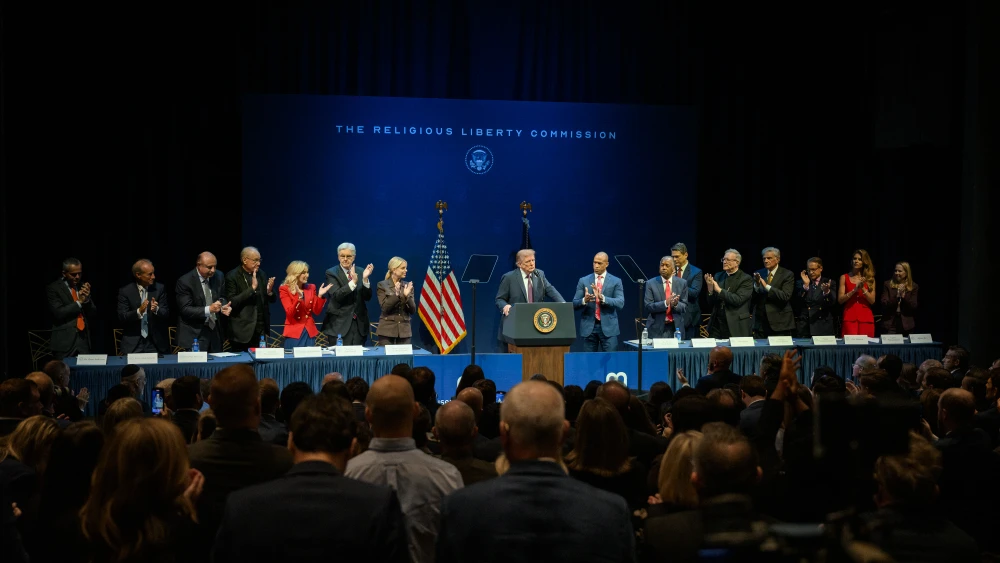
The U.S. Religious Liberty Commission advised U.S. President Donald Trump to expedite federal investigations and prosecutions of “credible allegations” of Jew-hatred and “tie future federal funding to prompt remediation.”
Texas lieutenant governor Dan Patrick and Dr. Ben Carson, chair and vice chair of the commission respectively, and other members of the panel delivered a final draft report to the president in the Oval Office on Friday.
The report is based on findings of seven commission hearings over the last year on religious liberty in the military, education, healthcare, parental rights, faith-based institutions and antisemitism.
It advises Trump to direct the U.S. Department of Justice to investigate whether antisemitic attacks are being financed by terrorist groups and for the department’s Jew-hatred task force to work with the FBI and state and local governments to track incidents of antisemitism, allowing policymakers to respond effectively.
Created in May 2025, the commission advises and reports to Trump on opportunities to “identify emerging threats to religious liberty, uphold federal laws that protect all citizens’ full participation in a pluralistic democracy and protect the free exercise of religion.”
In the report, the panel recommends that the Justice Department and Equal Employment Opportunity Commission offer training and guidance in both the public and private sectors to detail best practices on religious accommodation and identification of modern forms of Jew-hatred.
The commission drew its recommendations after hearing testimony from experts and other witnesses, including Yeshiva University President Ari Berman, Liat Cohen-Reeis of the Christian and Jewish Alliance in San Diego and Bruce Pearl, a renowned Jewish former basketball coach.
The report, which is now subject to a 15-day public comment period, also cited the case of Moshe Glick, a New Jersey-based congregant who was indicted for defending a fellow Jew, whom a protester assaulted outside their synagogue.
Glick was later pardoned by the outgoing governor. The commission noted the chilling effect such cases can have on religious freedom.
The panel also addressed religious discrimination in the military and recommended that the Pentagon update instructions on how recent Supreme Court decisions and the Religious Freedom Restoration Act should be applied when it comes to areas like religious dietary needs, observance of holy days and wearing a uniform while participating in religious services.
A JNS report in April detailed the struggles and challenges of Jewish service members.
While calling for the religious accommodation process to be streamlined and improved, the panel said that the Pentagon “should conduct religious liberty impact assessments as part of operational planning” while providing stronger rights and support for military chaplains.
Rabbi Meir Soloveichik, director of the Zahava and Moshael Straus Center for Torah and Western Thought at Yeshiva University and rabbi of Congregation Shearith Israel in Manhattan, is the lone Jewish commission member.
Rabbis Mark Gottlieb (Adelson School in Las Vegas), Yaakov Menken (Coalition for Jewish Values), Eitan Webb (Chabad House of Princeton) and Chaim Dovid Zwiebel (Agudah) are on the commission’s advisory board of religious leaders, and Alyza Lewin (Combat Antisemitism Movement) is on the advisory board of legal experts.