
Something remarkable happened in Philadelphia last Sunday, and it had very little to do with bicycles.
A group calling itself Philly Bike On Your Left, in collaboration with Boycott CookNSolo and Philly Solidarity Calendar, organized a ride through Center City to boycott six Jewish- and Israeli-owned businesses—Huda, K’Far Café, Mac Mart, Dizengoff, Goldie and Schlesinger’s—all of which serve varying cuisine. Their promotional materials declared that these establishments needed to go.
The demonstration was scheduled for Nov. 8, the eve of the anniversary of Kristallnacht, when Nazi mobs attacked Jewish businesses, synagogues and homes across Germany and Austria in 1938.
The organizers insisted that their protest was about Israel, not Jews. But targeting neighborhood restaurants because of their owners’ identities or perceived political beliefs is a peculiar way to advance an international political cause. The owners of Philadelphia restaurants do not determine Israeli government policy. They prepare food, employ people, pay taxes and contribute to the city they call home.
What happened next deserves attention far beyond the city of Philadelphia.
Instead of issuing another round of statements and hoping the controversy would disappear, the Jewish community organized. The National Jewish Advocacy Center (NJAC), the NAGEN Project, StopAntisemitism and other Jewish organizations helped mobilize a response that became known as the “Philadelphia Playbook.” Jewish organizations, community leaders, activists and ordinary citizens came together around a straightforward proposition: Jewish businesses would not face intimidation alone.

The response was extraordinary.
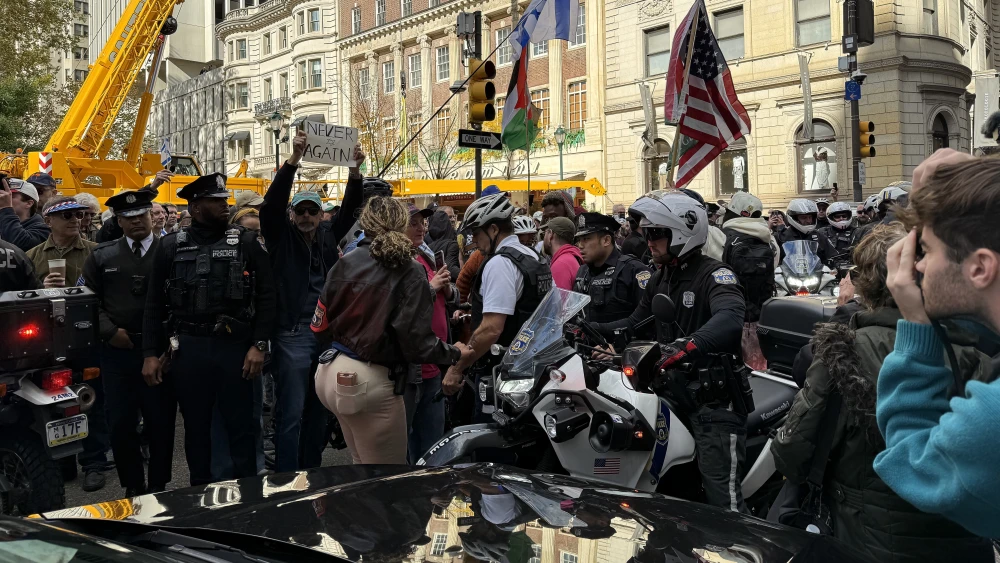
As many as 2,000 people filled the streets surrounding Rittenhouse Square, where the boycotters were set to begin. Customers lined up outside the targeted restaurants before they even opened, sometimes waiting hours to get inside. Israeli flags appeared alongside American flags. People sang, celebrated, purchased meals and demonstrated their support for business owners who had suddenly found themselves at the center of an international political dispute.
Some traveled considerable distances to participate. Others simply walked over from their respective neighborhoods. They weren’t just Jewish, either; neighbors showed up. What united them was the conviction that a community’s response to intimidation should be visible, confident and unmistakable.
The cyclists arrived expecting to make a statement. Instead, they encountered a community making a much larger one.
The original ride ended early; organizers cited safety concerns. Then came Thursday’s announcement that a planned second ride, scheduled for Nov. 15, was canceled altogether. Here is where the story takes an almost absurd turn.
The very people who organized a campaign to boycott Jewish businesses, publicly identified the six particular establishments that they wanted people to avoid and encouraged others to join them are now claiming to be are too frightened and intimidated to organize a second ride. They say they have received death threats and fear for their safety. The Philadelphia Police Department said in no uncertain terms that was not the case.
The most encouraging part was not the cancellation of another protest. It was watching Jewish pride become something tangible.
Think about that for a moment. They set out to make Jewish business owners uncomfortable in their own neighborhoods. They wanted customers to stay away and businesses to suffer, with the goal of making their targets feel the consequences of being singled out. But when hundreds of people showed up to support those same businesses, the haters themselves suddenly discovered the language of intimidation and fear.
The irony is difficult to miss.
To be absolutely clear, any credible threat of violence should be investigated and condemned. Nobody should face death threats for expressing an opinion, however objectionable that opinion may be. But there is an enormous difference between being threatened and being confronted by a peaceful, determined community that refuses to accept your message—and that was there mainly to eat.
The organizers apparently expected their boycott to proceed without meaningful opposition. Instead, they discovered that Philadelphia’s Jewish community was neither daunted nor interested in remaining silent. If their cancellation reflects genuine safety concerns, those deserve appropriate attention. But peaceful counterprotests and overwhelming public disagreement are not acts of intimidation. They are expressions of the very freedoms the cyclists claim to exercise.
What makes this episode especially significant is the manner in which the response came together. Too often, Jewish communal advocacy becomes entangled in organizational boundaries, competing priorities and endless discussions about who should lead. The “Philadelphia Playbook” demonstrated what becomes possible when organizations concentrate on the objective rather than the organizational chart.
NJAC brought legal expertise and a clear understanding of the boundaries between protected protest and unlawful conduct. NAGEN and StopAntisemitism helped rally attention and support. Other Jewish organizations added their voices and encouraged the community to support the businesses. Different organizations brought different capabilities. The result was something none could have accomplished as effectively alone and the people who showed up were the essential ingredient.
I have spent much of my professional life working with Jewish organizations. I understand the value of institutional leadership, philanthropy, education and advocacy. But I also know that organizations are only as effective as the people willing to translate their missions into action.
Last Sunday, Philadelphia’s Jewish community did exactly that.
The most encouraging part was not the cancellation of another protest. It was watching Jewish pride become something tangible. Supporting a restaurant became an expression of solidarity. Standing beside a neighbor became an act of communal responsibility. People who might never attend an organizational meeting found a meaningful way to participate.
The cyclists arrived expecting to make a statement. Instead, they encountered a community making a much larger one.
There is a lesson here for Jewish communities throughout America.
We cannot expect antisemitism to disappear because we condemn it eloquently. We cannot assume that someone else will defend our neighbors, our institutions or our right to participate fully in American life. And we should never underestimate the influence of ordinary people acting together with purpose.
The “Philadelphia Playbook” offers a model worth studying and replicating: prepare early; coordinate organizations; engage legal resources; mobilize the community; support those being targeted; and respond with confidence rather than fear.
The organizers of the canceled ride say they intend to continue their boycott campaign. That is their decision. Philadelphia—its Jewish community and their supporters—has already demonstrated that it intends to continue showing up, too.
Sunday’s events should not be remembered merely as a confrontation between cyclists and counterprotesters. They should be remembered as an example of what happens when a community recognizes its collective strength—and then chooses to exercise it.
The second ride may be canceled. The “Philadelphia Playbook” is just getting started.