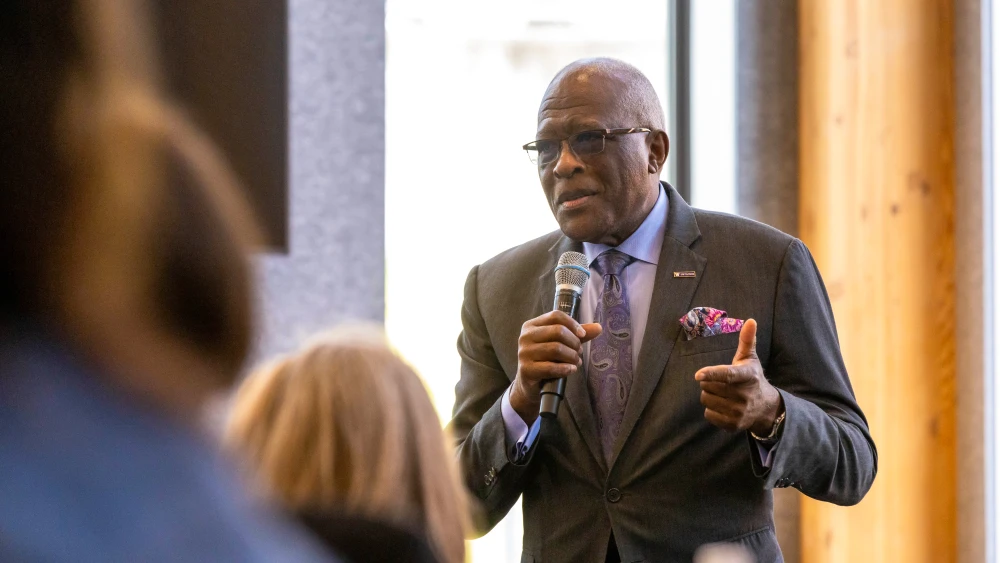
The University of Washington is reviewing and revising its student conduct code amid rising Jew-hatred on campus since Oct. 7, Robert J. Jones, president of the Seattle public university, said at a town hall at an Orthodox synagogue on Sunday.
“Our student conduct code was not written for this moment in time,” Jones said at Bikur Cholim Machzikay Hadath in Seattle. “It just absolutely was not written to deal with the contemporary issues.”
“We don’t have to wait for a mandate from the Department of Justice or the Department of Civil Rights to tell me what needs to be done to move this university closer to being that welcoming environment,” Jones told JNS after the event.
JNS asked Jones what other steps he plans to take to curb Jew-hatred on campus.
“It starts with education,” with an “upstream strategy rather than trying to manage behavior downstream,” he said.
The university president told JNS that he isn’t worried that the Trump administration will sue the school—as the federal government announced on Friday, for example, that it is doing with Harvard—while he fixes the problem and makes the public university a “model” for other schools nationally.
He knows that federal lawsuits are possible but is focusing on “advancing the university and fundamentally addressing the issues of antisemitism and the violations of civil rights,” he said.
The synagogue co-hosted the event, which drew about 125 people, with the local American Jewish Committee and StandWithUs chapters, Sephardic Orthodox synagogue Congregation Ezra Bessaroth, Reform synagogue Temple De Hirsch Sinai and Northwest Yeshiva High School.
Jones told the audience that the prior week he met with an “outside entity,” which the University of Washington enlisted in November, to ensure that the student code is “written in a way that we can hold people accountable.”
The university president has been in his current role for about seven months, after serving as the University of Illinois Urbana-Champaign chancellor and the president of State University of New York at Albany.
Jones told the audience that “one of the most disappointing days” in his career came last May, before he assumed his role but some three months after he was named to replace Ana Mari Cauce, who led the university for a decade.
“I want you to know what happened last night,” she told Jones, as he recalled it.
Cauce told him that 33 anti-Israel protesters, who were part of the student group Super UW, called on the school to divest from Boeing and caused about $1 million in damage to an engineering building.
“To go into a brand-new facility and to do the damage that was done is just something that I still have trouble getting my arms around,” he said at the event. “What was the intentionality? What was supposed to be achieved by that?”
That call, he told the audience, was “one of the reasons I was very interested in changing that code,” he said of the rules governing student conduct.
The 33 agitators were suspended and now face formal charges of first-degree criminal trespass.
‘Slippery slope’
The university president responded to about half a dozen questions, which were all pre-submitted by the audience.
One asked about phrases like “globalize the intifada” and “from the river to the sea, Palestine will be free.” Those statements were made frequently at an anti-Israel encampment at the university in April 2024.
“There’s different perspectives on the issue in the context of free speech,” he said. “I know the historical context of the phrase, and for a lot of people, it is viewed to be essentially very antisemitic and very threatening to individuals.”
“I have a responsibility for making sure people have the ability to exercise their free speech rights,” Jones said. But it’s a “slippery slope” for administrators to try to “define and redefine and characterize chants,” according to Jones.
“I’m more concerned about the behavior that I know is threatening—that’s unequivocally inappropriate—and that’s where I have to spend my time,” he said.
After the hour-long event, Jones spent about 20 minutes talking one-on-one with participants. Several attendees told JNS that they had more questions for him and were not fully satisfied with his answers.
“It’s a good start,” one audience member told JNS.
Randy Kessler, executive director of StandWithUs Northwest, told JNS that he appreciated that Jones “came to the heart of the Seward Park Jewish community to have an open dialogue with us.”
“I think that he said a number of things that I appreciated,” Kessler said. “He said a number of things that mean we have work to do to build a better future for Jewish students and Jewish faculty at the University of Washington.”
The anti-Israel group Jewish Voice for Peace stated prior to the event that Jones “must withdraw from his town hall on antisemitism” at a “Zionist” venue. It alleged that it had tried to meet with him “for nine months” and said that he should meet with the group instead of attending the event.
JNS asked how he would respond to the group. Jones said that he would “meet with anyone that wants to spend time and is interested in hearing my perspective.”
“There’s no way I could not come here, because it’s all about having a conversation,” Jones told JNS. “Change starts with the conversation, and I have an obligation as a president of the university to show up where people feel there’s a need to have a conversation.”
The reporter’s husband, a radio host, moderated the event on a voluntary basis and read pre-submitted questions.