The U.S.-Saudi nuclear agreement could put the kingdom “on a glide path to have a nuclear weapon in 10 to 15 years,” Rep. Brad Sherman (D-Calif.) told JNS on Thursday.
Sherman, who reviewed the agreement after the Trump administration submitted it to Congress last month, is one of the first members of Congress to object to the “alarming” deal that he said “clearly envisions enrichment and reprocessing” of uranium without inspections by the International Atomic Energy Agency.
“From that standpoint, it’s worse than the JCPOA,” Sherman said, referring to the 2015 Iran nuclear deal.
The administration signed the agreement with the Saudis in July and submitted it to Congress, as required by law, in a letter dated Aug. 24.
Chris Wright, U.S. energy secretary, stated at the time of the signing that “these agreements uphold the highest standards of nuclear safety and nonproliferation, while relying on the world’s best nuclear technology and scientists, designed right here in the United States.”
The terms of the deal, which according to Sherman include both classified and unclassified sections, have not been released to the public. JNS has not reviewed them.
The Jewish congressman, who is the second-ranked Democrat on the House Foreign Affairs Committee, stated on Wednesday that the agreement “explicitly allows uranium enrichment on Saudi soil under certain conditions.”
More than 30 countries around the world operate civilian nuclear power plants, but according to the International Panel on Fissile Materials, only 12 have operational uranium enrichment facilities, excluding Iran, the status of whose enrichment sites is unknown.
Eight of those countries have nuclear weapons.
“There’s supposed to be a two-year process for evaluating whether the Saudis should move forward with enrichment and reprocessing, but it could be a two-year process or it could be a two-day process,” Sherman said.
“It’s an essential element of the deal, but not one on which Congress gets any input,” he told JNS.
“Only President Trump, not Congress, will determine if those vague conditions have been met,” he said.
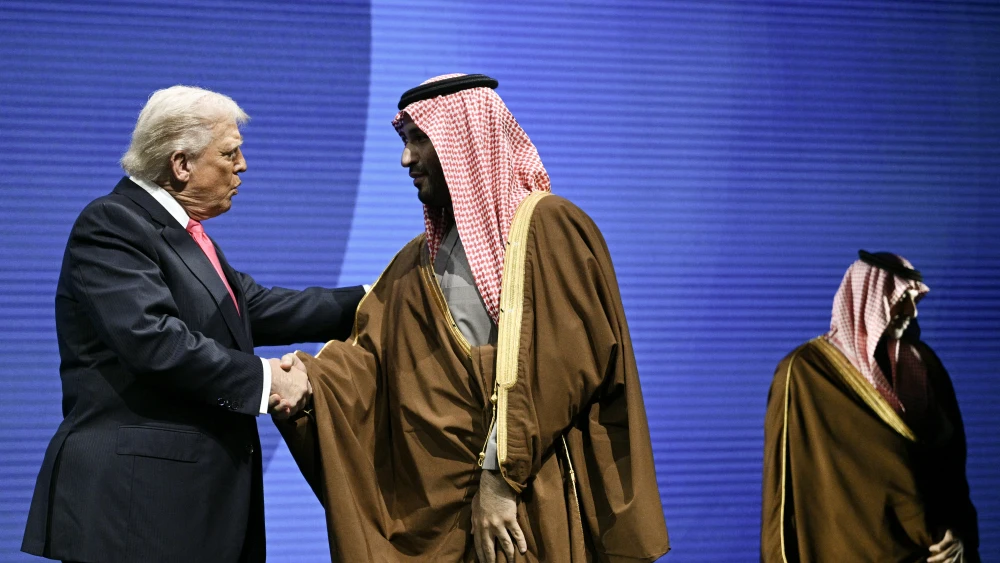
He added that the terms of the presidential approval process were unclear and consisted of consultation between U.S. President Donald Trump and Saudi Crown Prince Mohammed bin Salman.
The crown prince, widely known by the moniker MBS, is the de facto ruler of the country on behalf of his 90-year-old father. In a 2018 interview with CBS, the crown prince said that “without a doubt if Iran developed a nuclear bomb, we will follow suit as soon as possible.”
Other Saudi officials have made similar statements, including Saudi Foreign Minister Adel al-Jubeir, who said in a 2018 interview with CNN that the kingdom would seek to match Iran’s nuclear program.
“If Iran acquires a nuclear capability, we will do everything we can to do the same,” al-Jubeir said.
Sherman told JNS that a Saudi nuclear weapons program should be as concerning as the Iranian one.
“Just because they’re not Shiite does not mean that they are Zionists,” he said. “Even if you like MBS, is he going to be running Riyadh in 10 years from now?”
The United States has 26 nuclear 123 agreements, named for section 123 of the Atomic Energy Act of 1954, that govern civilian nuclear cooperation between the United States and 50 countries, the IAEA and Taiwan.
The classified portion of the U.S.-Saudi 123 agreement includes an otherwise-blank page labeled “to be filled in later,” Sherman said.
The California Democrat laughed when JNS asked if he had ever seen that before in an international agreement submitted to Congress.
“Oh, you see that all the time in draft documents,” he said. “You don’t see that, however, in documents that are supposed to be the final agreement.”
Sherman suspected that the page reflected some portion of the deal on which the United States and Saudi Arabia have yet to agree.
JNS sought comment from the White House about the meaning of the page label, including whether the submission complied with the congressional review statutes of the Atomic Energy Act.
‘Not a hint in this deal’
Saudi Arabia has long pursued a civilian nuclear energy agreement with the United States, but those talks advanced further during the Biden administration, when nuclear cooperation was reportedly raised as one element of a larger deal in which the kingdom would normalize relations with Israel.
After the Oct. 7 attacks, the Saudis publicly reaffirmed their position that they would not recognize the Jewish state without Israel agreeing to the creation of a Palestinian state.
Normalization with Israel did not appear to be a condition of the Trump administration’s talks with Saudi Arabia on a nuclear agreement until Trump wrote in July, one day after the two countries signed the agreement, that it remained contingent on Saudi recognition of Israel.
The deal “is totally subject to Saudi Arabia joining the very respected and successful Abraham Accords,” Trump said.
According to Sherman, there’s “not a hint in this deal” that it would lead to any sort of normalization between Saudis and Israelis.
“This deal was pretty much put together many, many months ago, and then after it was put together, Trump threw out this idea, ‘Oh, and you’ve got to sign the Abraham Accords too,’” Sherman told JNS. “The Saudis were not about to do that at this time, and then we saw TACO—Trump always chickens out.”
In addition to Sherman in the House, a handful of senators have spoken out against the U.S.-Saudi nuclear deal, including Sen. John Kennedy (R-La.), who was asked if he was comfortable with the deal in an interview with CBS in July.
“No,” Kennedy said, citing concerns about global stability.
“The world’s on a hair trigger,” he said. “If you’re running Japan, or South Korea, or Australia, or Brazil, or some countries in Europe, you’re at least thinking about the need to acquire a nuclear weapon, and then you see this deal with Saudi Arabia, and it’s just not good timing.”
Sherman told JNS that he has similar concerns, including about the stability of Saudi Arabia.
“There was once the most powerful monarch in the Middle East who was a good friend of the United States, and every weapon system the Shah got from the United States in 1978 was in the hands of the Mullahs in 1979,” he said.
“If the Saudis develop a nuclear weapon, it blows a giant hole in the whole architecture of the Non-Proliferation Treaty,” Sherman said, referring to the 1968 Treaty on the Non-Proliferation of Nuclear Weapons that aimed to curb the spread of nuclear weapons.
“I think if the Saudis get a nuclear weapon, Egypt and Turkey will not be far behind,” he told JNS. “If the norms established in the 1940s are frayed, you could see nuclear weapons in Japan, South Korea and Brazil.”
Under the relevant congressional review statutes, the U.S.-Saudi nuclear agreement will enter into force at the end of the 90-day review period unless Congress passes a joint resolution of disapproval. Trump could veto the latter.
Given Republican control of the House and Senate, it is unlikely that opponents of the deal could muster a veto-proof bipartisan majority heading into the midterm elections. But Sherman expects that House Democrats will introduce a resolution of disapproval anyway.
A more likely path to stopping the deal might be appealing to the “court of public opinion” and members of the Trump administration who “realize just how bad a deal this is,” he said.
“We’ve got to convince the interested public on this issue,” Sherman told JNS.