


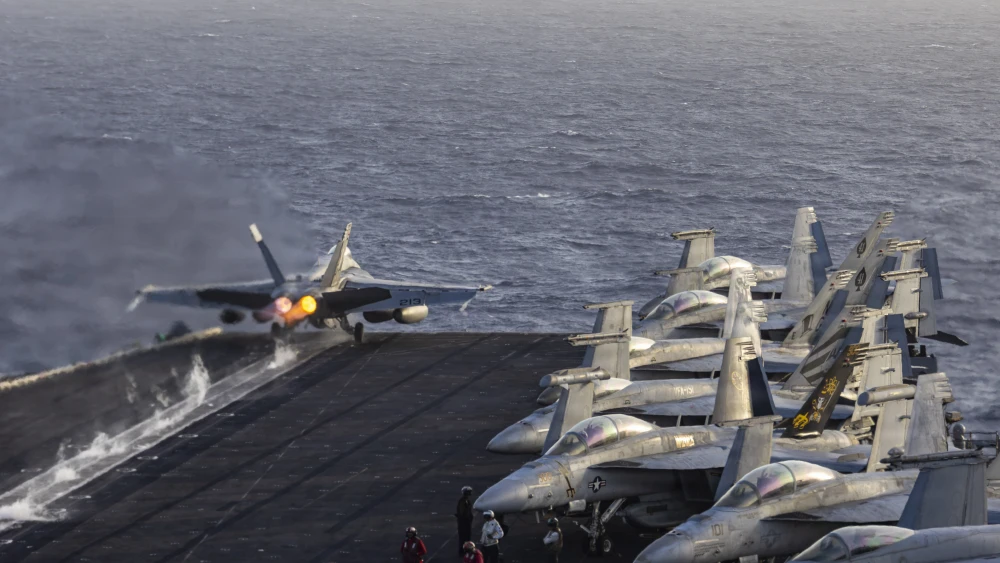
U.S. forces struck 10 Iranian military targets in and near the Strait of Hormuz overnight, U.S. Central Command said on Sunday, in response to a drone attack on a commercial tanker.
In an apparent reference to the same attack, the U.K. Maritime Trade Operations Centre, a Royal Navy arm with a regional office in Dubai, said on Saturday that it had received a report of a tanker in the Strait of Hormuz being hit by an “unidentified projectile.” The crew was unharmed and no environmental damage was reported, although the vessel sustained damage to its bridge, UKTMO said.
CENTCOM said that U.S. Navy and Air Force aircraft targeted surveillance infrastructure, communications systems, air defenses, drone storage sites and minelayer capabilities after Iran launched a one-way drone that hit the Panama-flagged M/T Kiku around 4:30 a.m. ET. The vessel was carrying more than two million barrels of crude.
U.S. Navy and Air Force fighter jets conducted strikes tonight on 10 Iranian military targets at multiple locations in and near the Strait of Hormuz for Iran's drone attack on M/T Kiku. pic.twitter.com/Z0TLZRqmF6
— U.S. Central Command (@CENTCOM) June 28, 2026
In a post on his Truth Social platform on Sunday, U.S. President Donald Trump warned of further military action if Iran continues attacks.
“United States aircraft just struck Iranian missile and drone storage locations, and coastal radar sites, for violating the Cease Fire Agreement, AGAIN! It is very possible that they will never learn!” Trump wrote. “There may come a point when we are no longer able to be reasonable, and will be forced to militarily complete the job that we very successfully started. If that happens, the Islamic Republic of Iran will no longer exist!”
Tehran had been given an opportunity to honor the ceasefire but “elected not to,” CENTCOM said on Sunday, adding that commercial traffic through the waterway continues and warning that U.S. forces “remain vigilant, lethal, and ready.”
The United States and Israel launched a major joint operation against Iran on Feb. 28, targeting the regime’s leadership, nuclear facilities and other strategic military infrastructure. By late June, Washington and Tehran had signed a memorandum of understanding establishing a ceasefire framework and 60‑day negotiations on a comprehensive peace agreement.
Iranian Foreign Minister Abbas Araghchi, speaking at a news conference in Baghdad on Sunday, warned that any move to challenge Tehran’s handling of navigation in the Strait of Hormuz would “increase the tensions” and “delay” its reopening, despite the ongoing talks to end the war, France 24 reported.
He urged all sides to stick to the memorandum of understanding governing the waterway and “not to allow this MoU to deviate from its course” and called for a new regional security framework with Gulf countries “without the presence or interference” of outside powers.
Iraq’s Foreign Minister Fuad Hussein, meeting Araghchi in the capital, said it was important to reopen the strait and lift the U.S. naval blockade on Iran, stressing that Baghdad does not support expanding the war to Gulf states and does not back attacks on Iran.
Saturday’s American military strikes followed Friday’s U.S. action tied to a separate Iranian attack on the M/V Ever Lovely a day earlier.
“U.S. aircraft struck Iranian missile and drone storage locations and coastal radar sites after Iran hit M/V Ever Lovely on June 25 with a one-way attack drone,” CENTCOM stated at the time. “The Singapore-flagged cargo ship was exiting the Strait of Hormuz along the Omani coast at the time of Iran’s attack.”
Iran said on Saturday it attacked U.S.-affiliated military targets in the Middle East in response to renewed American strikes against it the previous day, while Bahrain confirmed it had been attacked by Iranian drones in the early morning hours.



