


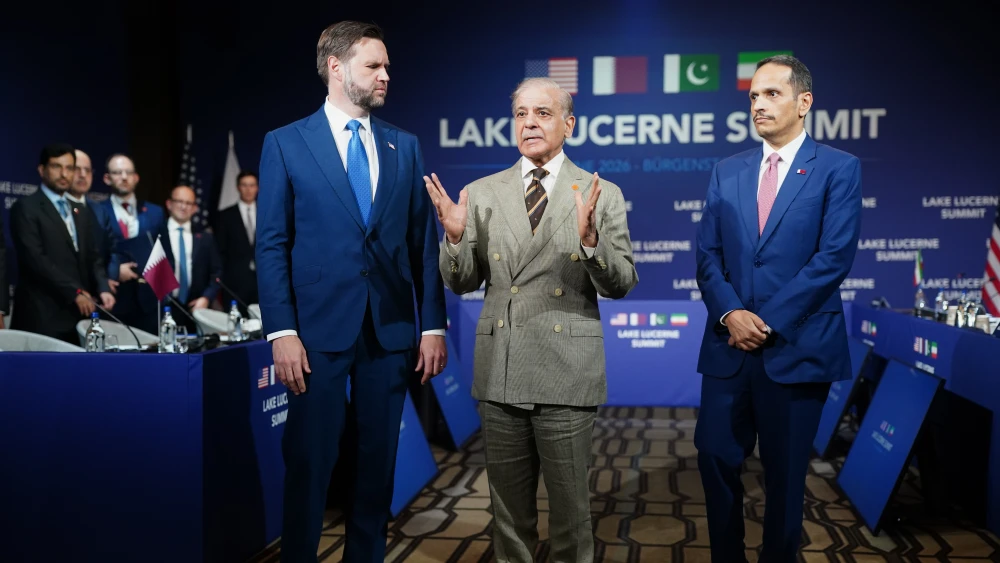
A first round of talks between the United States and Iran concluded in the central Swiss city of Lucerne on Sunday, a source close to one of the negotiating teams told Reuters.
According to Tehran’s IRNA state broadcaster, the quadrilateral meeting among Iran, the U.S., Qatar and Pakistan was suspended after some 80 minutes “to allow for internal deliberations.”
The reports came some four hours after the Qatari Foreign Ministry announced the start of the talks at Lucerne’s Bürgenstock resort.
“The State of Qatar announces, in its capacity as a mediator, the launch of the Lake Lucerne Summit and the first meeting of a high-level committee bringing together representatives of the United States of America, the Islamic Republic of Iran, and the two mediating states, the State of Qatar and the Islamic Republic of Pakistan,” the ministry announced.
Doha added that “specialized technical and expert working groups had been established to negotiate the provisions of a final agreement covering all aspects of the Memorandum of Understanding.”
U.S. Vice President JD Vance, who is representing Washington in the talks, told reporters ahead of the meetings in Lucerne that “we’ve seen great progress over the last just couple of days in ensuring that the ceasefire holds in Lebanon.
“These things are always a little bit messy,” he said. “If you go back to how much was happening three months ago and compare it to three weeks ago, great progress has been made. We’re all working toward regional peace,” the vice president continued, praising cooperation with Qatar, Pakistan and “our friends in Israel.
“There, of course, are going to be sometimes disagreements about precisely how to get there, but I actually feel great about where we are in Lebanon,” he said. “There’s still some additional wood to chop, but we’re going to keep on working at it.”
Vance landed in Switzerland on Sunday morning, joining Steve Witkoff, special envoy to the Middle East, and White House senior adviser Jared Kushner, who arrived on Saturday.
The Swiss Foreign Ministry confirmed on Saturday that the Iranian delegation—which reportedly is led by Iranian Parliament Speaker Mohammad Bagher Ghalibaf and Iranian Foreign Minister Abbas Araghchi, and includes central bank and oil officials—was on its way to the Bürgenstock resort ahead of the talks there.
“I can only be there for a day or two,” Vance told reporters before departing on Saturday.
“I think we’re going to hopefully make progress on the nuclear issue, make progress on the Lebanon ceasefire issue. Those are the two big things that I think we’re going to be focused on. I’m sure the Iranians are going to have issues they’d like to discuss as well,” he added.
Negotiations between Washington and Tehran were initially scheduled to take place in Switzerland on Friday to discuss a final agreement that would end the Iran conflict and define restrictions on Tehran’s nuclear project.
However, Vance delayed his trip to the Alpine country in the wake of hostilities between Israel and Iranian-backed Hezbollah terrorists in Southern Lebanon, NBC News reported.
The United States and Iran signed a Memorandum of Understanding on June 17 that called for the “immediate and permanent termination of military operations on all fronts, including in Lebanon.”
Four Israel Defense Forces soldiers were killed in Southern Lebanon overnight Thursday when a Hezbollah drone struck their tank. Israeli forces struck more than 80 terrorist targets and killed dozens of Hezbollah operatives following the attack.
Jerusalem and Beirut renewed the fragile ceasefire later on Friday following U.S. mediation efforts.
The top command center of the Iran Armed Forces announced on Saturday it was again shutting maritime transit in the Strait of Hormuz in the wake of Israel’s actions in Lebanon.
“It is hereby announced that the Strait of Hormuz will be closed to vessel traffic; It is noted that this first step is a response to the enemy’s breach of promise, and if the aggression continues, further steps will be planned and taken to force the enemy to comply with its obligations,” the Khatam al-Anbiya Central Headquarters said in a recorded message, according to AFP.
Vance spoke with Fox News overnight Friday, saying that the vital shipping lane has been opened, facilitating the transportation of 16 million barrels of oil per day.
Asked if Iranian forces are redirecting vessels from the Strait of Hormuz, Vance said he was “skeptical” of such reports. The vice president noted that mines are still present in the 20-mile stretch of the choke point, and therefore it could be that Iran’s navy had warned ships against crossing in these areas.
He continued that de-mining the strait could take up to 30 days, as stressed in the MoU.
“But no, we’re not seeing any evidence of the Iranians still closing the Strait of Hormuz. It is going to take some time to clear those mines though,” he said.



