


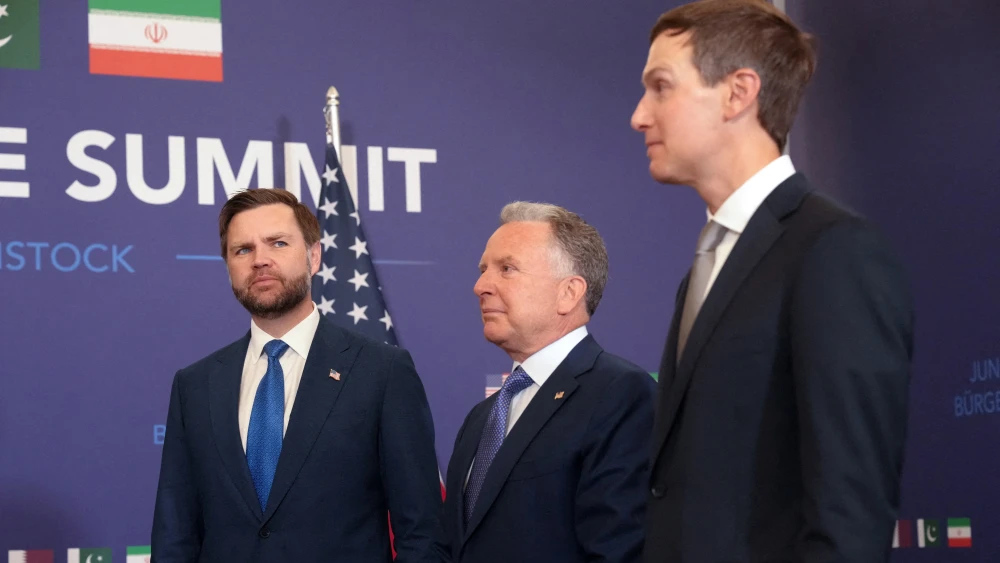
The first round of talks in Switzerland between Washington and Tehran concluded early on Monday morning, with mediators Qatar and Pakistan saying that “encouraging progress has been made.”
In a joint statement, the mediating parties said that it was agreed to establish a High Level Committee to lead focused discussions on nuclear, sanctions and a monitoring and dispute resolution group to ensure the execution of the Memorandum of Understanding signed last week.
“The High Level Committee has agreed upon a road map toward reaching a final deal within 60 days, laying the foundation for the immediate commencement of further technical talks,” said Qatar and Pakistan.
In addition, negotiations yielded the creation of a “de-confliction cell,” which will include delegations from the United States, Iran and the Lebanese government, but not Israel, aimed at ending the conflict in Lebanon, the statement continued.
Technical talks are scheduled to continue throughout the week at the Bürgenstock Resort near Lucerne in Switzerland.
Esmaeil Baghaei, a spokesman for Iran’s Foreign Ministry, announced on Monday that Tehran’s delegation was “en route to the homeland” following “intensive discussions on the implementation of the provisions of the Memorandum of Understanding to end the war.”
The talks “began on the morning of Sunday ... in Switzerland (Lake Lucerne), and continued until the early hours of Monday morning,” Baghaei wrote on X.
He stressed that Tehran’s implementation of the MoU was contingent on Israel ending military operations against Hezbollah terrorists in Lebanon and Washington lifting sanctions, including on oil exports.
“The guiding principle is ‘commitment for commitment.’ The Islamic Republic of Iran, while closely monitoring the fulfillment of the other side’s’ obligations, will employ all available means at its disposal to ensure that those obligations are fulfilled,” he said.
Negotiations on Sunday got off to a rough start in the wake of U.S. President Donald Trump’s fresh threat against Iran. “Iran must immediately stop their highly paid PROXIES in Lebanon from causing trouble. If they don’t, we’ll hit Iran very hard again, just like we did last week, only harder!!!” Trump wrote on Truth Social.
— Rapid Response 47 (@RapidResponse47) June 21, 2026
The Iranian delegation reportedly refused a photo op with the American delegation and left the negotiating venue in protest.
New footage captures the moment the Iranian delegation supposedly left the negotiation venue in Switzerland in "protest" over President Trump's threats
— The Kobeissi Letter (@KobeissiLetter) June 21, 2026
VP JD Vance proceeds to speak with Pakistani PM Shehbaz Sharif following the Iranians' exit. https://t.co/uGBtsyEnMp pic.twitter.com/l3nad3FSxz
Speaker of the Iranian parliament and Iran’s chief negotiator Mohammad Bagher Ghalibaf took to X, saying: “Don’t they realize that if their threats worked, they wouldn’t be this desperate now? We don’t count on US threats. They’d better watch their words—our armed forces are ready to respond differently. Whatever they say, we’re the ones who act.”
During talks in Switzerland, U.S. Vice President JD Vance and special envoys Steve Witkoff and Jared Kushner held an 80-minute meeting with Ghalibaf and Iran’s Foreign Minister Abbas Araghchi, the Associated Press reported.
A senior U.S. diplomat who spoke on condition of anonymity said that the American party demanded clarifications about statements made by Iran’s military regarding the closure of the Strait of Hormuz, according to AP.
Negotiators established an open line of communication to ensure commercial vessels can transit safely through the waterway.
Speaking to the press, Vance said that thanks to Trump, the objectives of opening the strait and the ending of the Iranian nuclear program had already been accomplished.
“The question before us now is how much more can we accomplish together? Can we turn over a new leaf? Can we change relations in the Middle East permanently? Or, do we go back doing things the old way—which is not our preference but is certainly very much something that can happen,” he went on to say.
.@VP delivers remarks in Switzerland: "What's brought us to this moment is @POTUS' leadership, and @POTUS' willingness to see a Middle East that is much different 10 years from now than it was 10 years ago." pic.twitter.com/CVwzTssXF2
— Rapid Response 47 (@RapidResponse47) June 21, 2026
According to Axios, Iranian officials protested in private the threats made by Trump, saying that they violated the first clause in the memorandum, which stipulates a cessation of threats of force.
Talks also focused on “all elements of the nuclear deal,” the report cited a U.S. diplomat as saying.
Araghchi wrote on X that “Tireless Pakistani and Qatari mediation has delivered major progress to end Lebanon War.”
He claimed that Iran had received upfront the waiving of sanctions on oil and petrochemical exports, the lifting of the U.S. blockade, the release of some Iranian frozen assets and the launching of a major reconstruction and development plan for Iran.
Iran’s top diplomat moreover framed the de-confliction cell as the “first real test” of the negotiations.
Tireless Pakistani and Qatari mediation has delivered major progress to end Lebanon War. Oil and petrochem exports are waived, blockade lifted, some frozen assets released, and major reconstruction & development plan launched for Iran.
— Seyed Abbas Araghchi (@araghchi) June 22, 2026
1st real test: Lebanon deconfliction cell https://t.co/q0okD2qwSO


