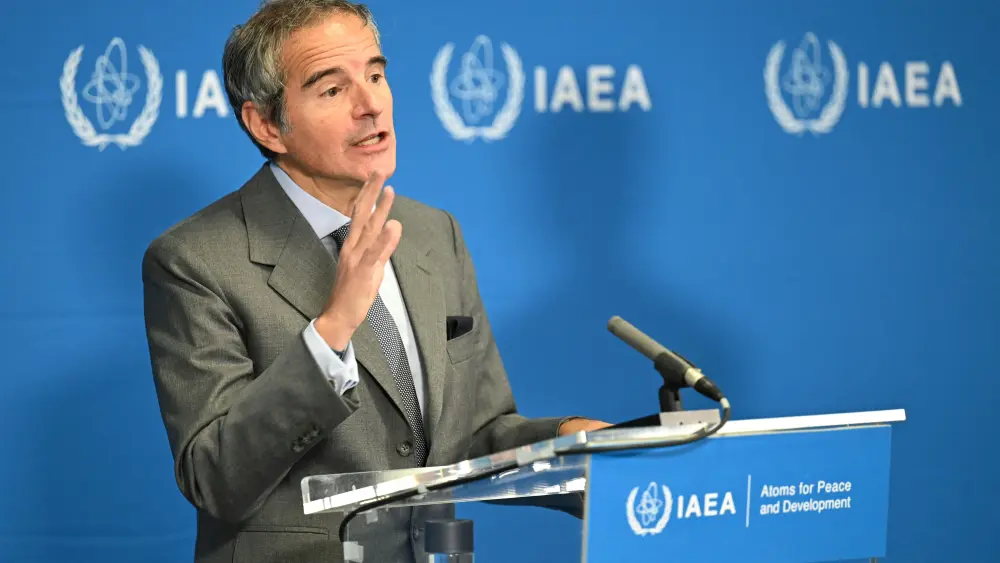
Sending U.S. special forces to secure Iran’s enriched uranium would be “very challenging,” the director of the International Atomic Energy Agency said on Sunday.
“We’re talking about cylinders containing gas of highly contaminated uranium hexafluoride at 60%, so it’s very difficult to handle,” IAEA Director General Rafael Grossi said on CBS News show “Face the Nation” with Margaret Brennan.
When asked about U.S. special forces entering Iran to secure its enriched uranium, IAEA head Rafael Grossi said the operation would be “very challenging.”
— Face The Nation (@FaceTheNation) March 22, 2026
“I guess there will be a number of decoys, a number of distracting cylinders, materials over there, which would make it very… pic.twitter.com/BNxE0XSIT3
“Then of course I guess there will be a number of decoys, a number of distracting cylinders, materials over there, which would make it very difficult,” Grossi said, adding that “I’m not saying it’s impossible. I know that there are incredible military capacities to do that, but it would be a very challenging operation for sure.”
The United States is reportedly weighing a potential operation to seize or secure Iran’s stockpile of highly enriched uranium. The Trump administration has reportedly asked the Pentagon to develop options involving the Joint Special Operations Command, though no decision has been made and the timing remains uncertain.
The IAEA estimates that Iran had 440.9 kilograms of uranium enriched to as much as 60% before last year’s Israeli-U.S. attacks. Enough, if further enriched, to produce material for 10 nuclear weapons, Reuters reported on Feb. 27.
The United States and Israel launched coordinated strikes on Iran’s nuclear and military infrastructure on Feb. 28.
Iran’s main nuclear facility at Natanz, southeast of Qom, was attacked on Saturday, according to the IAEA. “No increase in off-site radiation levels [was] reported,” the nuclear watchdog tweeted. It added that an investigation into the matter will ensue.
No damage was caused to Israel’s Shimon Peres Negev Nuclear Research Center when an Iranian ballistic missile hit the nearby city of Dimona on Saturday night, the IAEA said. “Information from regional states indicates that no abnormal radiation levels have been detected,” the nuclear watchdog tweeted.