Newsletter
Newsletter Support JNS

OECD chief expresses confidence in Israeli economy

“The extent of the war’s impact on the main growth engines of the Israeli economy, especially technology and innovation, is relatively low,” said Israeli Foreign Minister Eli Cohen.

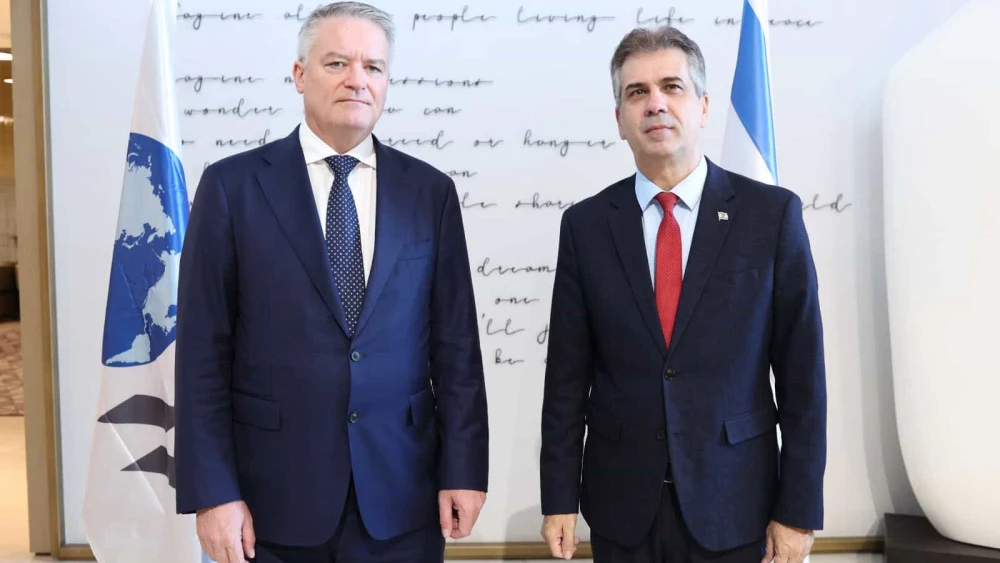
Foreign Minister Eli Cohen (r) with OECD chief Mathias Cormann in Jerusalem, Dec. 4, 2023. Photo by Mishel Amzaleg/FMO.

During a meeting with Israeli Foreign Minister Eli Cohen on Monday, Mathias Cormann, Secretary General for the Organisation for Economic Co-operation and Development (OECD), said he expects Israel’s economy to grow by 4.5% in 2025.

Cormann’s statement demonstrated the OECD’s faith in Israel’s economy in the longer term, even after the organization lowered Israel’s growth forecast from 2.9% to 2.3% in 2023 and predicted a still sharper reduction of 1.5% for 2024 (compared to 3.3%) due to the Oct. 7 attack.

Cohen detailed the moves Israel’s government and Foreign Ministry were taking to keep the economy’s wheels turning during the war.

Israel is a world leader in the fields of food security, water, climate and agriculture, and will continue to be so after the fall of Hamas and the return of the hostages, he said.

Cormann proposed the OECD’s aid tools for dealing with the challenges posed by the war in Gaza.

The two also discussed promoting regional projects with an emphasis on cooperation with the countries of the Abraham Accords.

Foreign Minister Eli Cohen meets with OECD chief Mathias Cormann in Jerusalem, Dec. 4, 2023. Photo by Mishel Amzaleg/FMO.

“The State of Israel entered the war in Gaza in a solid economic situation and with the ability to provide the best response to the needs of the Israeli economy,” said Cohen.

“The extent of the war’s impact on the main growth engines of the Israeli economy, especially technology and innovation, is relatively low,” he added.

“Past experience proves that after the end of security crises and wars, there is accelerated growth, and the expected increase in immigration to Israel from around the world will also contribute to the strengthening of the Israeli economy,” he said.

The former IDF chief and defense minister told JNS that the Jewish state must remain strong against Iran and its proxies while building domestic consensus and new regional alliances.
“I didn’t serve this country to watch it get sold out by a career politician, who would rather protect his party than his constituents,” Cait Conley stated.
“I have to get even more involved because, apparently, the progressive movement is taking such a deep root in New York City, we have no choice,” Sid Winston, of Brooklyn, told JNS.
Darializa Avila Chevalier’s victory over incumbent Rep. Adriano Espaillat caps off a trio of wins for candidates who made opposition to Israel a focus of their campaigns for New York congressional seats.
AIPAC spokeswoman Deryn Sousa told JNS that Adrian Boafo “has made clear his vision to carry forward the strong pro-Israel legacy of Congressman Steny Hoyer, one of Congress’s most steadfast champions of the U.S.-Israel relationship.”
The Associated Press called the race early for the Jewish Democrat, whom the mayor has backed.
Benny Gantz, JNS editor-in-chief Jonathan S. Tobin, Gilad Erdan, Mosab Hassan Yousef, Nissim Black and leading voices in security, diplomacy, media, law and Jewish communal affairs headline the summit’s third day in Jerusalem.

