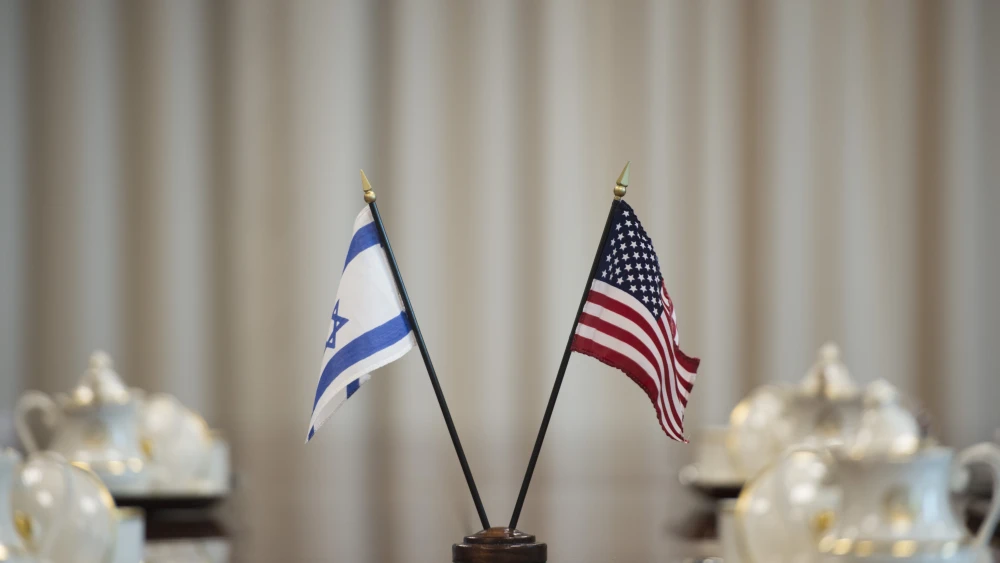
The American Israel Public Affairs Committee’s political action committee spending has become a major issue in several congressional primaries, but that hasn’t dissuaded the pro-Israel lobby from opening its checkbook as never before.
The group’s PAC and its affiliated super PAC, United Democracy Project, reported spending $71.9 million from Jan. 1, 2025, through June 30, 2026, Federal Election Commission filings show.
That’s up more than 50% compared to the same 18-month period during the 2022 midterm elections, even without the $15 million the United Democracy Project has spent in support of Rep. Haley Stevens (D-Mich.) in the Michigan Senate Democratic primary this month.
“There’s has been a surge in engagement from the pro-Israel community and increased contributions and spending reflects that enthusiasm,” United Democracy Project spokesman Patrick Dorton told JNS.
“We are also committed to impacting elections beyond the House, and Senate races are expensive,” he said. “We are looking for races where we have a reasonable chance to win. We want to spend the resources necessary to make races competitive and maximize the election of a pro-Israel candidate or prevent a detractor of the U.S.-Israel relationship from being elected.”
It’s not just AIPAC. The Republican Jewish Coalition’s PAC and super PAC spent 12 times more during the last 18 months than they did during the same period in the last midterm election—$6.6 million versus $519,722.
More than half of that spending so far, $3.8 million, went to defeat anti-Israel Rep. Thomas Massie (R-Ky.) in this year’s Republican primary.
The Republican Jewish Coalition “is laser-focused on defending Republican-led majorities in Congress and that includes holding our own side accountable,” Sam Markstein, the coalition’s political director, told JNS.
“There’s no place in the Republican Party for those who turn their backs on the MAGA agenda and do not turn their backs on the Jewish community,” he said, of the president’s “Make America Great Again” movement.
The United Democracy Project spent $4.2 million to defeat Massie, a longtime critic of Israel who responded to his primary loss by saying that he “would have come out sooner, but I had to call my opponent and concede, and it took a while to find Ed Gallrein in Tel Aviv.”
AIPAC has been front and center in several primary elections this year, including in Michigan, where former public health official Abdul El-Sayed has sought to make the group’s support of Stevens a top issue.
Two leading opponents of Israel, Sen. Bernie Sanders (I-Vt.) and Rep. Alexandra Ocasio-Cortez (D-N.Y.) have attacked AIPAC in their ads backing El-Sayed. The Progressive Change Campaign Committee accused Stevens of being “bought and paid for by AIPAC and the corporate special interests dumping historic amounts of money into her election.”
AIPAC spent $4 million to help former Rep. Melissa Bean (D-Ill.) win the Democratic primary for the seat she once held, and at least $1.2 million in support of Maryland state representative Adrian Boafo in the primary he won to succeed his former boss, outgoing Rep. Steny Hoyer (D-Md.), a long-time backer of the Jewish state.
AIPAC has notched some losses, most notably in New Jersey when it spent $2.3 million in a Democratic congressional primary against former congressman Tom Malinowski, who had previously run with AIPAC’s endorsement.
The spending weakened Malinowski’s candidacy to the point where community organizer Analilia Mejia, who has accused Israel of “genocide,” squeaked by and won the primary and then the special election.
“The terrain has changed for Jewish involvement in American politics,” Ben Dworkin, founding director of Rowan University’s Institute for Public Policy and Citizenship in New Jersey, told JNS.
“The issues about American congressional support for the state of Israel are different than they were four years ago, and I think some Jews would say that it’s much more challenging,” he said.
J Street and its super PAC also recorded large increases in spending, from $3.7 million through June 30, 2022, to $8.1 million during the same period this year.
NORPAC almost doubled its spending, from $1.2 million to almost $2.4 million, and the Joint Action Committee spent $183,300, up from $119,000.