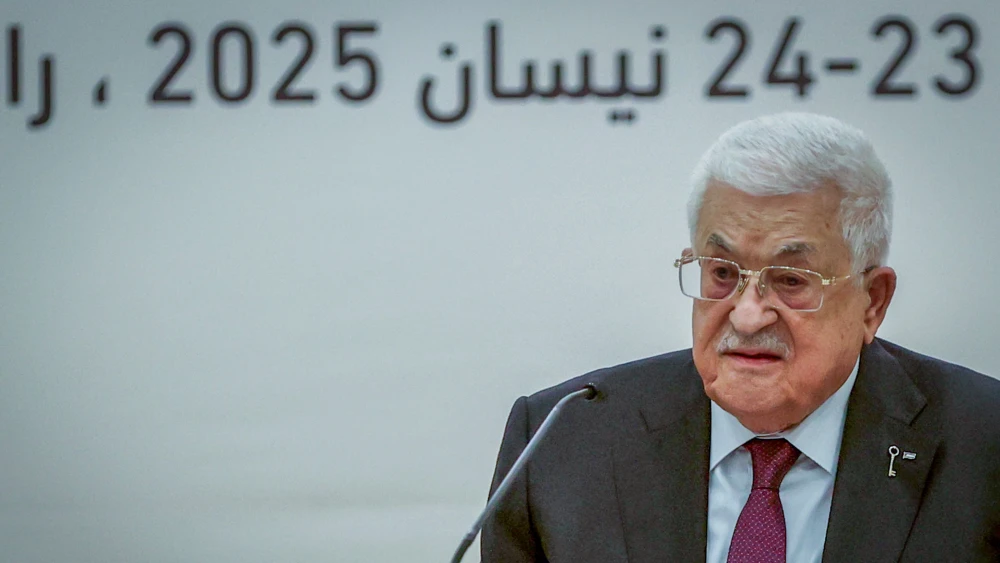

The governments of Ireland, Spain and Norway have formally recognized a nonexistent Palestinian state, just as other predominantly Muslim states have done since the United Nations elevated the status of the Palestinians to that of a quasi-state in 1988. This does not make the territory they are referring to an actual state.
Point three of the Montevideo Convention—one of the key sets of criteria under international law for statehood—highlights: “The political existence of the state is independent of recognition by other states.”
In other respects, too, the Palestinians do not fulfill the criteria for statehood.
The population of the “Palestinian territories” is composed of highly diverse Arab tribes, clans and immigrant groups—often at odds with one another—that emerged from the ruins of the Ottoman Empire. Some were long-established residents, while others arrived later for pragmatic reasons. For decades, efforts have been made to declare this heterogeneous population a kind of nation, with a common culture, history and goals, united by the narrative of the nakba (“disaster” of the creation of the Jewish state), their alleged expulsion and persecution by Israel.
The decisive factor, however, is that the majority of these people do not want a Palestinian state. If they really wanted one, they could have founded it long ago, given worldwide support and Israel’s willingness to compromise. At the very least, they could have laid the foundations for such a state: an economy, structures and institutions, and norms of coexistence on which statehood is based. None of this has happened.
The Israeli occupation of the territories and Jewish settlers are to blame, claim the worldwide supporters of this fantasy state. But in Gaza, Palestinians lived from 2005 to 2023, a full 18 years, without any Israeli troops or settlers among them. Yet they made no effort to establish a state or to prepare for one.
The reasons the Palestinians do not want their own state are as heterogeneous as the Palestinians themselves. The supposed state was conceived along the lines of U.N. Resolution 181 (II) of 1947. It was to exist alongside a Jewish state “in peace and security” and, in another, mostly forgotten paragraph, allow a Jewish minority to live “in security” on its territory—a precaution taken by the United Nations to protect Palestinian Jews.
Thus, the Jews’ presence in the “territories” of the envisaged Arab state is by no means “contrary to international law,” as claimed by the European media and European politicians, especially of the left. On the contrary, the presence of Jews is required by international law, as “close Jewish settlement” in the entire British Mandate territory of Palestine was the actual purpose of the Mandate, which was granted in 1922 by the League of Nations and confirmed in 1947 by the U.N. Founding Assembly as applicable international law.
The coexistence with a Jewish state demanded by the United Nations is one of the reasons many Palestinians do not want their own state according to the U.N. model: They would have to make do with only part of the territory that, in their view, belongs to them “from the river to the sea.”
There is a reason they cannot accept this. According to Islamic law, conquered Muslim land, including the entire territory of the Ottoman Empire, is forever Muslim. Thus, the State of Israel (or any other non-Muslim state in the Middle East) is “illegal” in their eyes.
According to Islamic law, conquered Muslim land, including the entire territory of the Ottoman Empire, is forever Muslim.
Many Palestinians reject a Palestinian state for another reason: It would be corrupt and inefficient. There are no guarantees of interior or personal security under the corrupt crony networks of Palestinian Authority leader Mahmoud Abbas or a similar figure.
The Palestinian Authority led by Abbas, which was intended to create the necessary conditions for statehood according to the Western model, by no means fulfills the conditions of a state authority or state power: clear “state territory,” a clearly defined “state people” and a “state authority” in possession of a monopoly on the use of force. In fact, the Palestinian Authority would certainly collapse if Israeli troops were to withdraw from Judea and Samaria. It would suffer the same fate as it did in Gaza and be overthrown and eliminated by a fundamentalist movement like Hamas.
In 2006, in the last parliamentary elections in the “Palestinian territories” to date, Hamas won the most votes. It then took over Gaza in a brief but bloody civil war and brutally executed every Palestinian Authority and Fatah official it could get its hands on. In Judea and Samaria, only the presence of Israeli troops has secured the power of the Palestinian Authority, which is hated by the population it rules and, according to estimates by its Palestinian opponents, wastes and embezzles 70% to 80% of Western aid funds.
Under such circumstances, a Palestinian state is difficult to imagine unless the West would like to see another Hamas state (and the wars emanating from it), or Israeli troops and settlers remaining to protect the alleged “state authority.”
The other criteria of statehood according to Western ideas are also not fulfilled by the Palestinians: There is neither agreement on the borders of the state territory nor the minimum of internal solidarity of a loudly declared but not consistent “people of the state.”
The only cohesion between Palestinian Arab groups and clans is their shared hatred of the West, and the common intention to extract as many billions in aid money from the despised and frightened Western states as possible. Arab religious fighters and terrorists of all stripes immigrating to these states provide the bloody actions to create the necessary level of fear to persuade governments and the electorate to continue financing Palestinian corruption.
On all issues beyond this, the positions of Palestinian Arab groups diverge to the point of incompatibility.
A state under the presence of Israeli troops or other foreign forces of order would not be tolerated by radical Palestinians. Nor would they demilitarize and disarm their militias, as we can see in the case of Hamas, which refuses to disarm even though the organization has lost any real power. Such groups would do everything imaginable (smuggling, secret weapons production, etc.) to achieve the actual purpose of a state as they see it, which is religious war or jihad.
Moreover, Palestinian “independence” would remain constrained by dependence on massive foreign aid. If a Palestinian state were established, many Palestinians would lose the refugee status that underpins billions in current assistance, primarily from the corrupt U.N. organization UNRWA and the European Union. Aid would likely come from other sources, such as Iran, which receives billions from China for crude oil. Other powers might also seek influence over the strategically important territory of “Palestine.” Moreover, the state would remain “fragile” or “failing,” marked by violent internal conflict; attacks on neighboring states; and lawless areas where criminal gangs and terrorist networks operate.
The question is why European governments insist on creating a state of this kind. It would most likely be a terrorist state similar to the Hamas regime in Gaza that not only keeps its own population in poverty and ignorance and invests international aid money in rocket building and global terrorist activities, but will also likely trigger another regional war. Does the world really need such a state?