


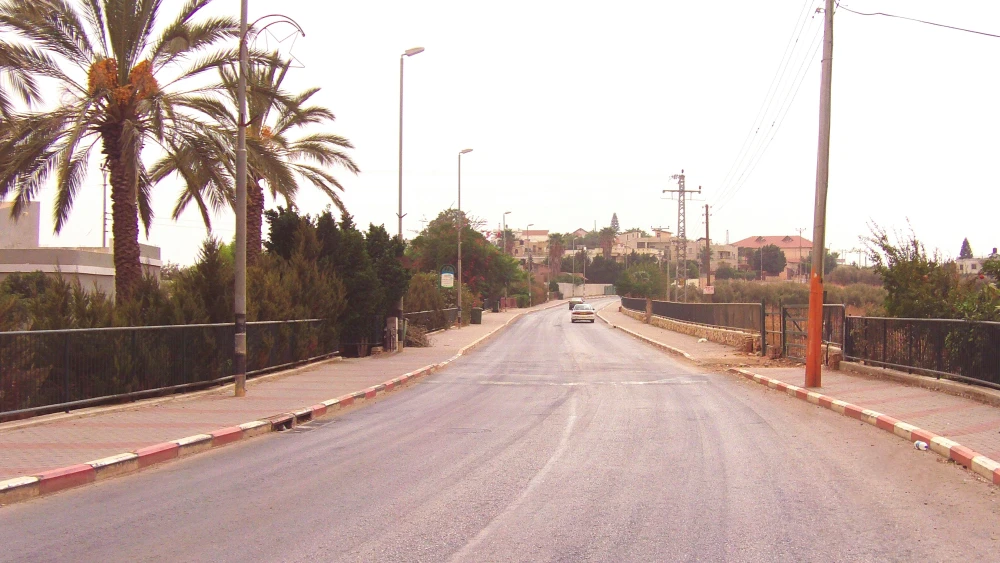

The new spokesperson for the Israeli army in Arabic is Lt. Col. Ella Waweya, a Muslim Arab from the city of Qalansawe in central Israel, not far from the coastal town of Caesarea on the Mediterranean Sea, where Israeli Prime Minister Benjamin Netanyahu’s villa is also located. Qalansawe was built after the Mamluk victory in 1265 on the ruins of a destroyed Crusader fortress, remnants of which still protrude here and there from the desert sand. The current population, almost entirely Arab, is considered devout Muslim.
Ella is 36 years old, wears her black hair loose and shoulder-length, paints her fingernails, and is presumably dressed in the latest Western fashions during the few hours she spends outside her Israeli officer’s uniform. Her desire to become a journalist, she explained in an interview with JNS, stemmed from outrage at the anti-Israel reporting of the Qatar-based broadcaster Al-Jazeera during the intifada around 2001, when she was 12 years old and began to identify with Israel, the country where she was born and raised.
After school, she studied communications at an Israeli college and, in a public debate, criticized the evasion of military service by ultra-Orthodox Jews—as an Arab, she explained, she was ready to defend her country. A few days later, she was invited to an interview at the press office of the Israeli army, and shortly thereafter, she joined the army and fought as a soldier in the 2014 Gaza war.
Within the borders of “proper Israel,” around 2 million Arabs live alongside approximately 8 million Jews, thus representing about 20% of the total population. The Arab minority includes Muslims, Christians and Druze, urban Arabs and Bedouins living in the desert—people with very different socializations and backgrounds, often in strained relationships with one another.
For a long time, the Israeli state allowed them as much autonomy as possible, such as their own Sharia jurisdiction in civil matters like inheritance, family and marriage law. But in doing so, it also left them to their own problems and anachronistic structures. The state intervened in internal Arab affairs only in cases relevant to criminal law, such as drug offenses, robbery or violence like “honor killings.”
Meanwhile, the rigid, patriarchal order of the tribes and clans is clashing with the intentions of many young Arabs to orient themselves toward the realities of the fluid Israeli majority society. This is giving rise to new conflicts.
During the last decades, the Israeli state had successfully begun settling the larger Bedouin tribes in permanent locations, resulting in thriving Bedouin towns and settlements such as Hura, Rahat, Lakyia or Arara, which boast secondary schools, shopping centers, sports facilities and polyclinics. Through compulsory education, vocational training, and college and university degrees, hundreds of thousands of young Arabs were integrated into Israeli society.
Many of them, including women, now work as doctors, lawyers, teachers, engineers, high-tech specialists or in Israel’s booming construction industry. Special colleges were established for girls to provide them with a degree free from male interference. The number of young Arabs volunteering for military service in the Israeli army is also on the rise, or, if such extensive commitment to the state meets with resistance from their families, for alternative service in hospitals, social institutions, etc.
Nevertheless, a portion of this difficult-to-monitor population group remains true to old habits, which for centuries have included all kinds of smuggling, human trafficking and organized robbery. These crimes have increased so dramatically in recent years that a revision of current policies has become necessary. In many Arab communities, the traditional feuds between clans are reaching alarming proportions. Added to this are bloody conflicts within families, especially acts of violence against women. The number of deaths due to intra-Arab violence rose again in 2025 when 252 Arab citizens lost their lives in shootings and crimes within their own communities.
Preoccupied with external enemies, Israeli governments have long neglected the violence within the Arab sector, especially since criminal activity often takes place in Arab cities and settlements that outwardly appear to be loyal to the state. These areas seemed to pose no threat; they proved impervious to Islamist influences and offered no support for Palestinian terrorism. On the contrary, local Hamas groups or terrorists on the run who sought refuge there were handed over to the Israeli police by local authorities and sheikhs. They don’t risk the advantages granted to those who cooperate with the state-run Jewish authorities: road construction and modern infrastructure, new schools, loans for public buildings, and access to Israel’s generous healthcare and social-welfare systems.
The statistics on causes of death demonstrate how negligent it was to ignore the internal Arab violence: Of the 252 registered fatalities, 80% died from gunshot wounds. The gangs’ weapons come primarily from break-ins at the numerous army bases scattered throughout Israel. It is an open secret that young Bedouins repeatedly find ways to break into military installations and steal machine guns and ammunition.
The Israeli army changed its “rules of conduct” in 2021: From now on, soldiers are allowed to shoot thieves and smugglers with live ammunition, no longer only, as before, in cases of self-defense or defense of human life. Stricter measures are also now being taken against arms-smuggling across the Jordanian border.
Because Arab clans are now well-armed, the violence easily spills over into other areas of society. Innocent civilians are increasingly at risk; for example, a 9-year-old girl was recently killed in Arara, a Bedouin town in northern Israel. The death of 35-year-old Israeli Jew, Lia Malka, in early June highlighted the problem: She was killed by a car bomb—a method commonly used in intra-Arab clan feuds—on the Ayalon Highway, one of Israel’s busiest roads. Her ex-husband is a suspect.
Israeli media reminded their readers of the renewed surge in violence within the Arab community, where 122 people have already been killed this year. The figure is higher than at the same point last year, which until now was considered the deadliest on record. Tolerance toward a criminal milieu means accepting that its negative influence will spread to other areas of society.
The case of the Arab Bedouin town of Tuba-Zangariyya illustrates just how closely loyalty to the state can be linked to gang crime. The town has long been known for the patriotic sentiments of its residents, reflected in a high rate of enlistment in the Israeli army, but it has since become a hub of Arab crime as well: drug trafficking, protection rackets and arms-smuggling.
Israel’s Minister of Internal Security, Itamar Ben-Gvir, has announced sweeping measures, and to demonstrate them, recently accompanied a police unit on a nighttime raid in Tuba-Zangariyya. A political hardliner in his youth, even a supporter of the banned Kach Party, Ben-Gvir was barred from military service.
“Which unit did you serve in?” and “You’re a coward!” the residents of Tuba, who are proud of their many soldiers, shouted mockingly at him. It’s difficult to describe the current situation of the Israeli Arabs: It could hardly be more contradictory.
The pressing problems facing the Arab minority in Israel must be addressed immediately to prevent the bloodshed from escalating and spreading to other parts of Israeli society. Further neglect would be irresponsible. Alternatives to the traditional system of tribes and clans must be developed, and safe spaces must be created for those, especially women, who wish to escape intra-Arab violence and crime. Only this will increase the number of Israeli Arabs who live according to the norms of Israeli society and contribute to its further prosperity and progress.


