


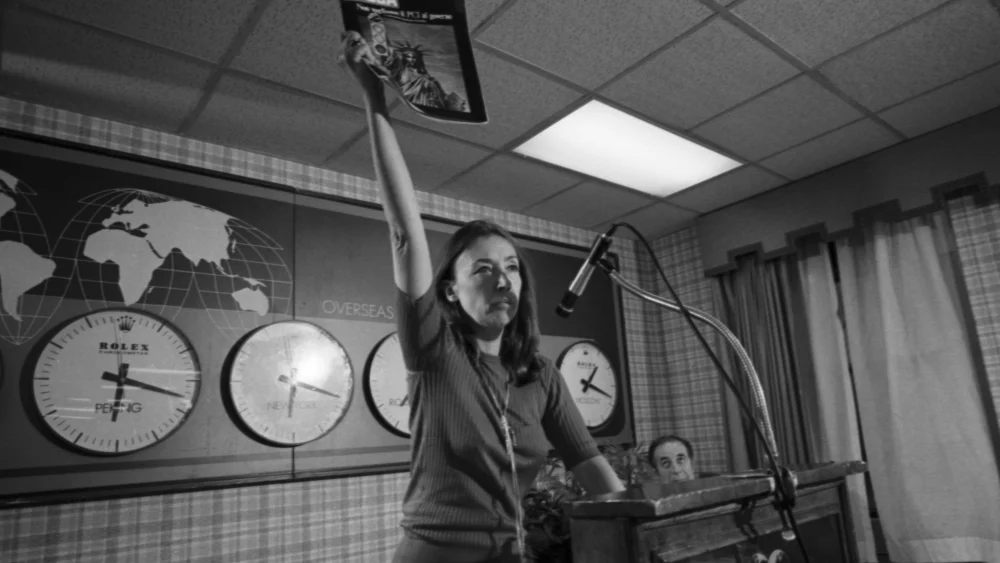

The 20th anniversary of the great Italian journalist Oriana Fallaci’s death in her native Florence on Sept. 15, 2006, passed with surprisingly little notice in the Jewish world—perhaps, in part, because it coincided with the High Holidays. I admit, with some embarrassment, that I too had forgotten it.
There is little purpose in retracing Fallaci’s extraordinary career in detail. Anyone familiar with her work already understands her place in the history of Western journalism, and there is no shortage of material available for those who wish to learn more.
It may be enough to recall that, during the Italian Civil War, she served as a teenage courier for the Resistance in a Florence ravaged by Nazi-Fascist occupation and repeated Allied bombing. Then there is her extraordinary work as a war correspondent, a role in which she became the first Italian woman to distinguish herself on such a scale. There were her reports on the condition of women, her fearless interviews with the powerful, and, of course, the famous moment when, sitting in a 1979 interview before Ayatollah Ruhollah Khomeini in Qom, Iran, she tore off the veil she had been required to wear and denounced it as a “medieval rag.”
There was also her love affair with the Greek democracy activist Alekos Panagoulis, which lasted until he died in Athens on May 1, 1976, in a car crash that Fallaci always regarded as an assassination. Finally, after the Sept. 11, 2001 attacks, came her radical and deeply controversial campaign against Islamist extremism.
Today, it is perhaps this last chapter of Fallaci’s life that is best remembered, certainly in the Jewish world. It is unquestionably the one that has provoked the most controversy over the years. On one side of the argument stood an ignorant and moralizing left; on the other, a right populated by mediocre and unimaginative sycophants who, to extract a couple of usable ideas from any major figure, must first drag that figure down to their level.
Why does Fallaci’s politically incorrect voice—as only someone who speaks honestly about her own convictions can be politically incorrect—continue to reappear in essays and commentary, at least in Italy, and more recently, in debates about immigration after the Oct. 7, 2023, Hamas attack?
Fallaci remains our contemporary because she recognized in the present something that others preferred to ignore.
As a historian, I have often felt uneasy—not so much morally as methodologically—with the essentialism with which Fallaci treated centuries of Islamic history. But a journalist is not a historian. Or perhaps a journalist is a historian of a particular kind. As Fallaci told the American news anchor Mike Wallace, a journalist “is a historian who writes history in the moment that history happens”—a Thucydides or a Polybius, in other words.
Perhaps it is precisely this quality, which necessarily comes with a certain absence of detachment, that makes a journalist’s criticism of the present so clear and powerful. Curiously, we now seem to demand too much objectivity from journalism and too little from historiography; perhaps because genuine objectivity toward the past can disturb the conscience, while the false appearance of objectivity in the present can soothe it.
This is why Fallaci is still relevant today. She possessed a quality that has become exceedingly rare: the ability to look at a phenomenon without first asking what the morally approved position toward it was supposed to be. She saw something, described it and drew a conclusion from it. The conclusion could be brutal, incomplete or historically imprecise. But it was reached without the preliminary sterilization of reality that now seems to have become one of the principal functions of parts of Western journalism and intellectual life.
This is especially true when the subject is Israel, the Arab and Muslim worlds and, after Oct. 7, the peculiar inability of part of the West to look upon a massacre without immediately beginning to search for the victim’s guilt.
The point is not to determine whether Fallaci was right on everything. That would be as foolish as it would be pointless. The more important question is why, 20 years later, some of the things she said continue to echo with such irritating regularity.
They echo when religious fanaticism is renamed “resistance”; antisemitism is linguistically sanitized until it becomes political activism; the murder of civilians suddenly becomes understandable so long as those civilians are Jews; and when a certain faction of the left, no longer capable of distinguishing between the oppressed and the executioner, retreats into formulas, slogans and rituals.
Fallaci remains our contemporary. Not because she predicted the future, but because she recognized in the present something that many others preferred to ignore.
This is what most unsettles someone like me, who comes from the left but has never been able to tolerate its hypocrisies or its grand, self-referential ideologies.
It also frightens a certain part of the contemporary left, which is a world of bourgeois liberals imprisoned in increasingly dusty ideological fixations and students with a great deal of time on their hands. What frightens them is first the prospect of seeing things as they are, and then the far more uncomfortable possibility that Oriana Fallaci may have been right.
Because if she was right—or even might have been right—about some things, then a left entrenched in its own orthodoxy, halfway between a church and a barracks, would see its peculiar kind of faith begin to collapse: the faith of the most obscurantist priest and the most obedient soldier.


