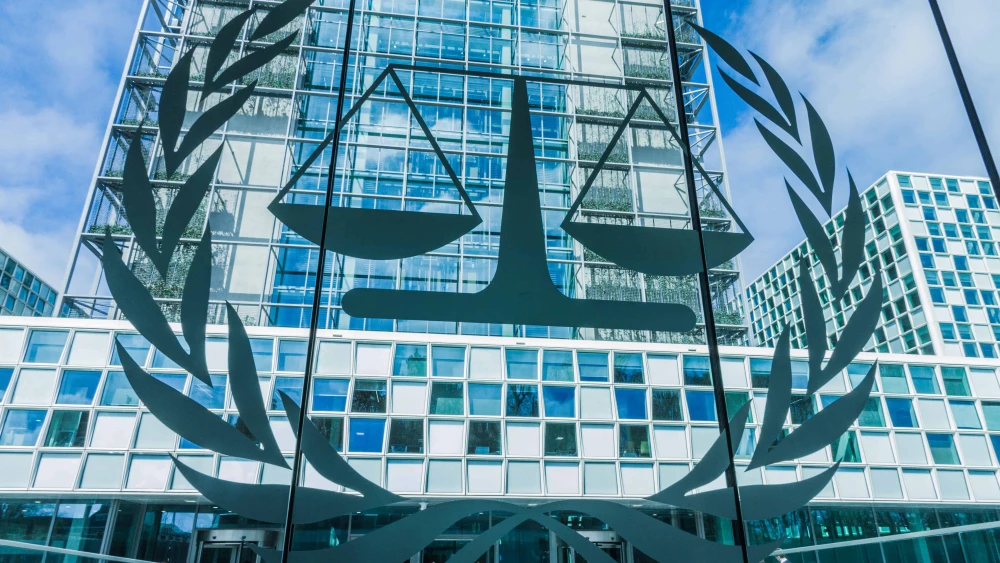

U.S. President Donald Trump made quite an impact at the U.N. General Assembly last month, not least with regard to the International Criminal Court. Standing before world leaders, he used part of his address to underline that the United States is “opposed to the out-of-control institution known as the ICC.” Trump called upon “all nations that are members of the ICC to officially resign from this rogue institution, immediately.” In so doing, he launched his administration’s latest salvo in its escalating campaign against the court.
Unsurprisingly, given that the ICC is very much a bought-and-paid-for European subsidiary, leaders within the European Union went out of their way to speak up for their $3 billion investment, urging member states to rally behind the ICC.
All the E.U.’s vassal states toed the Brussels line, as exemplified by Dutch Prime Minister Rob Jetten, who asked how anyone could “possibly be opposed to prosecuting the very worst crimes?” before declaring, “I believe there can be only one response. To say: ‘hands off’ the ICC, and all those other institutions that protect the international legal order.”
There have been similar rallying calls in defense of the ICC from the human-rights industry. Kenneth Roth, former executive director of Human Rights Watch, stated that “Trump’s attacks on the International Criminal Court reflect an effort to make the world safe for war criminals.”
An outsider would surmise from the responses of European leaders and NGOs that the ICC was an unassailable, shining legal Camelot, opposition to which somehow equates to support for war criminals and an attack on the international legal order. Such a view simply does not stand up. The reality is that the ICC has single-handedly undermined the rule of law and the international legal order. The international community must do better than continue to eulogize a court that, in effect, was stillborn.
Created in 1998 by way of the U.N. Diplomatic Conference of Plenipotentiaries on the Establishment of an International Criminal Court in Rome, the ICC was doomed from the start, beginning with the ICC’s constitutive document, the Rome Statute. Professor Carsten Stahn, the author of The Law and Practice of the International Criminal Court, noted in 2015 with regard to the Rome Statute that “the statute is full of ambiguities and dilemmas that cannot be solved in the abstract.”
He added, “Even before its existence, the court has been criticized for its selectivity, statutory limitations and potential overreach.”
Another ICC-sympathetic academic, professor William Schabas, who was present at the Rome Conference and is the author of the definitive 1,600-page The International Criminal Court: A Commentary on the Rome Statute, also candidly stated that “the final version of the Rome Statute is not without serious flaws.”
The French civil servant Marc Perrin de Brichambaut, instrumental in drafting the statute, said in 2017 that it “is not a perfect legal object … you have in a text like the Rome Statute, many elements which are at a very unequal degree of elaboration.” He also acknowledged that outsiders should “see [the ICC] as a major experimental organization, do not see it as a final construction. It will take many, many, many years to stabilize the institution and to create all the good practices which are inherent to … an international tribunal.” Professor Gerard Strijards, part of the Dutch delegation that drafted the Rome Statute, admitted: “I won’t say we gave birth to a monster, but the baby has some defects.”
Reuters has somewhat euphemistically noted that “the court has not lived up to the highest expectations.” Almost every apologist for the court has to admit that the ICC is “imperfect” or “flawed.” The pro-ICC Economist has described ICC courtroom proceedings as “bumbling,” “chaotic” and “near-farcical.” The New York Times reported that many legal experts agree that key ICC legal cases have “degenerated into something more resembling a circus, if not an outright farce.” Sympathetic legal bloggers have described its proceedings as “slapstick comedy.” Schabas even placed on record that the ICC has convicted people of crimes they never committed.
What has been presented as ICC jurisprudence has been dismissed by leading international law scholars, including Britain’s International Court of Justice candidate professor Dapo Akande, as “extremely controversial,” “inconsistent,” “stunning,” “deeply misguided,” “very dangerous and unwise,” and “very poorly reasoned.”
In April 2019, four previous presidents of the ICC’s governing body, the Assembly of States Parties, acknowledged that the court “needs fixing,” noting, inter alia, that they were “disappointed by the quality of some judicial proceedings … and exasperated by the management deficiencies.”
The Independent Expert Review, an evaluation conducted by a neutral third party that followed, reported back on Sept. 30, 2020, with 384 recommendations to address failings at the court, of which 76 were highlighted as needing to be urgently “prioritized.” Very few have been addressed, let alone prioritized.
The irony is that these European leaders and their predecessors in office are the very people who have destroyed the ICC.
They have turned a blind eye to its manifest failings as a court; allowed it to be weaponized as an instrument of European, and especially French, foreign policy in Africa; ignored the resultant racist docket; dismissed the manipulation and violation of the Rome Statute they invoke so often; and permitted the destruction of any legal standards at the court by allowing NGO-vetted ICC judges and prosecutors to be selected through corrupt vote-trading.
The result is a rotten facade kept in place only by billions of dollars in E.U. state funding and by the E.U.’s economic and political blackmail of Global South States Parties that wish to withdraw from the court.