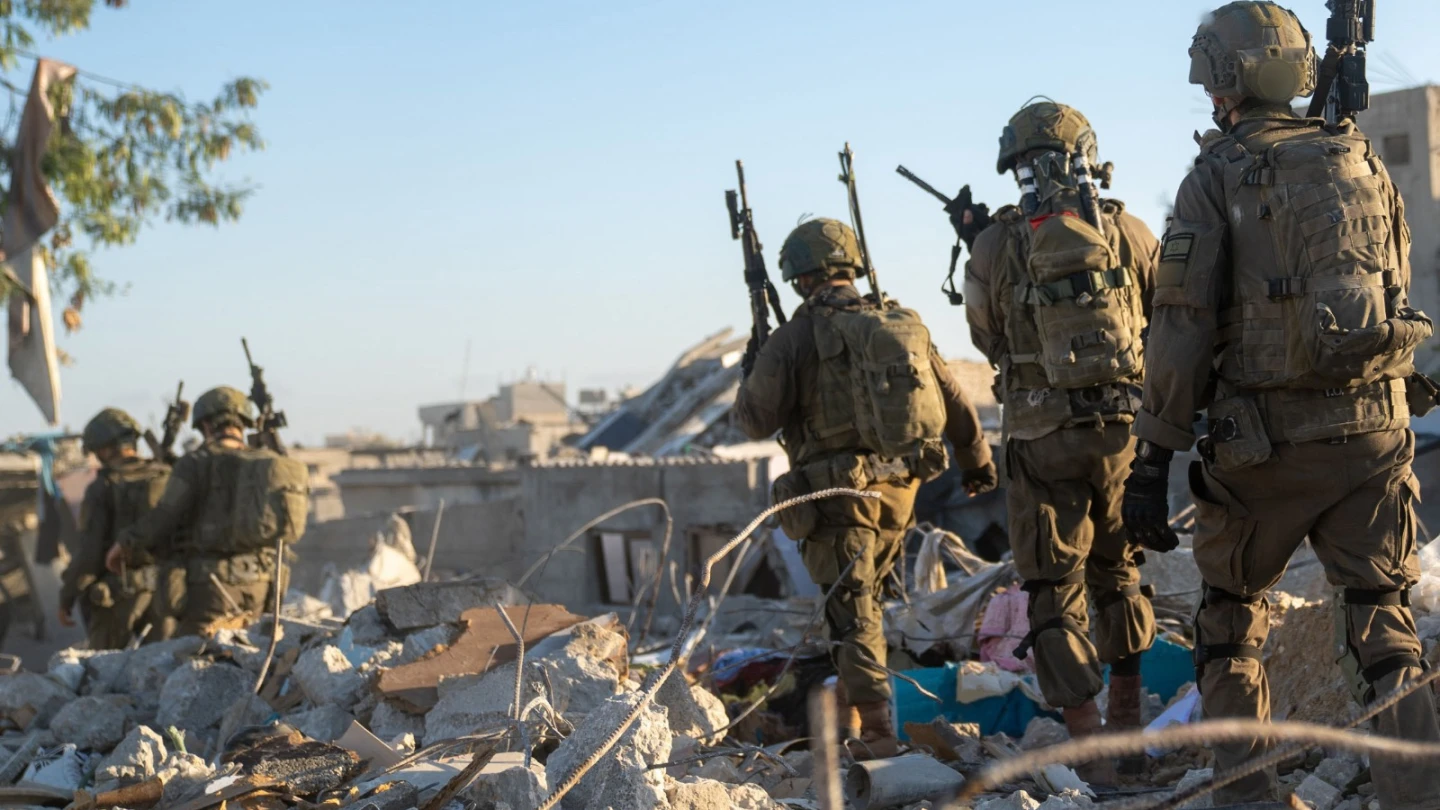
The seaside Zikim base in southern Israel borders one of the kibbutzim destroyed by Hamas during the Oct. 7 massacre. Tanks, armored vehicles and excavation equipment that unearths terror tunnels roar past, heading for the Gaza Strip. Intense looking boys in uniform go to and fro in apparent chaos. But it is not chaos, it is Israel’s ongoing series of military operations against Hamas.
The paratroopers we meet are finally having a drink. Yesterday, they managed to eat and take a shower after nine days in the Strip, during which they managed to sleep only a few hours on the ground and eat peanuts. What they found in Gaza is now making headlines around the world: Tunnels full of weapons, kindergartens full of missiles, the conquest of the Hamas “parliament,” endless battles with terrorists embedded deep in the civilian population.
Israel is on the march, advancing slowly but steadily into the heart of Hamastan. Now, it is closing in on Hamas’s main headquarters, including beneath hospitals and other civilian sites. Israel tries to protect civilians, but it is clear that the IDF will not allow Hamas’s hideous tactics to work this time. This is war to the finish, and Israel intends to finish it.
The IDF has captured Hamas’s most important bases in northern Gaza following intense battles. It has opened humanitarian corridors to the south for civilians seeking to escape the war zone. It had to do so after Hamas terrorists began killing civilians trying to flee, hoping to use them as human shields instead. Over 45 Israeli soldiers have been killed so far, in addition to the 1,400 murdered and some 240 kidnapped on Oct. 7.
Shon, a 24-year-old soldier, says, “I didn’t have time to call my family. I know I should. We are reserves, but perfectly trained.” When war broke out “I was in Tel Aviv, working in start-ups. But I rushed away as soon as our commander called. We immediately started fighting in the invaded kibbutzim. It’s unspeakable what [Hamas] did to children and families.”
“How do I feel?” he asks. “That we will never let it happen again.”
Irwin, who just returned from India, says: “In Gaza, I hope there are normal people. We are here to free them too. We know that we can die, but the purpose is bigger than us. There is no choice. We will not suffer another attack like the one on Oct. 7.”
These soldiers fight out of love for their homeland—moledet in Hebrew—for their homes and families; values that are difficult even to pronounce in Europe.
The soldiers’ main target is the crown jewel of Hamas’s terror infrastructure—the tunnels. They have found them littered with the detritus of terror, as well as possessions likely belonging to the hostages, such as baby bottles and diapers, as well as lists of Hamas “guards.”
Now Hamas’s “parliament,” government buildings, police headquarters, and more are in the hands of the IDF.
Daniel, 21, was wounded in the fighting. At Ichilov Hospital in Tel Aviv, this pianist, marksman and nurse recounts, “I found myself naked after the blow that took me in the back and head. Next to me, my best friend was bleeding. Stunned, I heard shouting: ‘Nurse! Nurse!’ But I was the nurse. He was bleeding, we saved him and now he is next to me here in the hospital.”
“I have damage to my ear, my head, I’m burned on my arm and body,” he says, “but I’m dying to get back to my unit. I know I’m needed. We are a single body. We share sleeping bags and the last sandwich.”
Back at Zikim, Shahar, a 30-year-old paratrooper, recounts: “On the seventh, they sent us directly to the kibbutzim. As soon as we arrived in Be’eri, in Alumim, we were hit in the face by the blood, the dead on the ground, the horrors and a huge number of terrorists. I lost a very dear friend of mine there, whose body was found only after a week.”
“Entering Gaza to fight is the most natural thing,” he says. “I was injured in the back and head, but I asked to return as soon as possible. My grandparents were Holocaust survivors, my father fought in the [1973] Yom Kippur War. Never again is now—and now, it’s my turn.”
“If we show weakness, Hamas will try to tear us to pieces again,” he asserts. “It makes me angry that the world doesn’t care about us. We do everything to save the civilian population. Hamas uses it as a human shield. My mother takes people from Gaza to hospitals in Israel. We offer incubators to hospitals that hide terrorist leaders. What else do you expect from us?”