


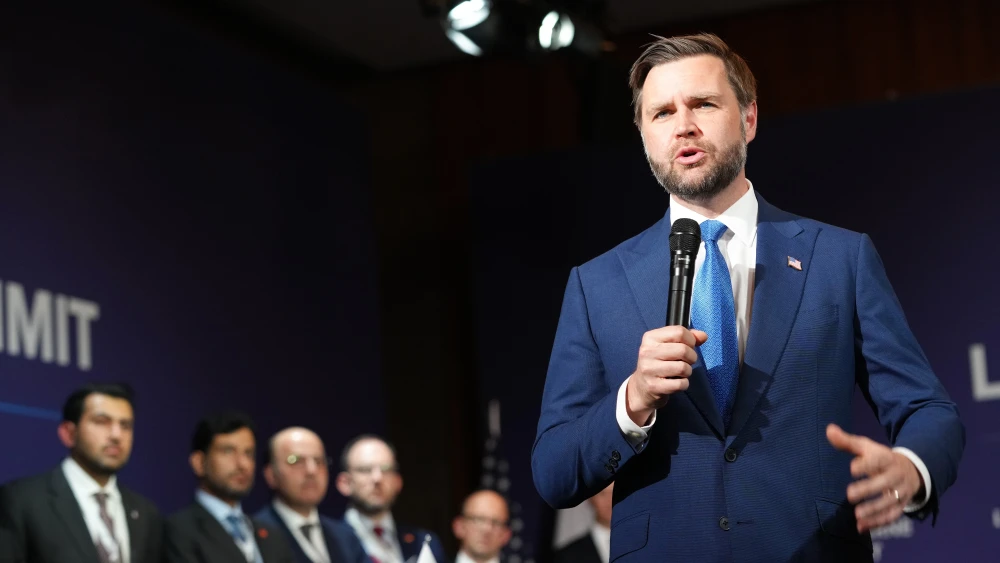

After months of cooling his heels as U.S. Secretary of State Marco Rubio took the lead on a number of foreign-policy initiatives, including the war on Iran, U.S. Vice President JD Vance has now emerged from the shadows. Having opposed the war from the start, Vance’s stock rose within Trumpworld as the president grew frustrated with Iran’s refusal to surrender.
As a Memorandum of Understanding was agreed to between the United States and Iran, with Israel cut out of the process, it was Vance taking questions about the issue on the White House podium. He was then dispatched to Switzerland to negotiate a conclusion to the war that would presumably ensure freedom of navigation in the Strait of Hormuz, lower gas prices and somehow also accomplish the key initial goal of the war: ending the threat of an Iranian nuclear program.
Persuading Trump to sideline the highly competent Rubio—and being allowed to both shelve and insult America’s Israeli allies—was no small triumph for the vice president. Putting Vance at the helm of American foreign policy represented a victory for the neo-isolationist and anti-Israel wing of the administration and the Republican Party. It also further solidified, at least for the moment, the vice president’s status as the frontrunner to succeed Trump in 2028.
Be careful what you wish for …
Nevertheless, the veep should have been more careful about what he had wished for.
It was one thing to argue that the war on Iran wasn’t worth the price the president was paying for it in terms of public disapproval of the conflict and higher gas prices, both of which seemed sure to hurt the GOP in the fall midterm elections. It’s quite another to be tasked with coming up with an agreement to conclude a war without being saddled with responsibility for a pact with Iran that is almost certain to be construed by America’s enemies and allies, not to mention the electorate, as a humiliating defeat.
Trump may have been joking when he said, “If it works out, I’m going to take the credit. If it doesn’t work out, I’m blaming JD.” But having been put behind the wheel for a test ride to see if his approach to world affairs is better than Rubio’s, the vice president is going to be hard-pressed to avoid driving the country and the administration into a ditch from which it will not easily be extricated.
Vance put himself in the situation because Trump was frustrated with the war. The joint U.S.-Israeli military strikes had succeeded in inflicting enormous damage on Iran’s military as well as its nuclear and missile programs, and eliminated most of its senior leaders. But whether or not, as critics of Israel have asserted, Israeli Prime Minister Benjamin Netanyahu oversold the president with claims that the Islamist terror regime would soon collapse in the face of these devastating blows, Tehran wasn’t surrendering.
It countered these attacks by menacing shipping in the Strait of Hormuz, thus raising fuel prices worldwide and putting economic pressure on Trump to stop the war. In return, the United States placed a blockade on Iranian ports that threatened Tehran with economic collapse. But the impulsive Trump lacked the patience to wait out the Islamists and agreed to first a ceasefire in April and then the MoU that, at least temporarily, ended the war.
Iran appeasement 2.0
As it stands now, that document sets up Iran to have won the conflict. Washington is already unfreezing assets that will result in the regime getting billions in funds that it can use to solidify its tyrannical hold on power, as well as reinforce its beleaguered Hamas and Hezbollah terror auxiliaries. Even worse, Trump appears to be willing to allow Iran to keep its missiles and to include the current conflict in Lebanon in the deal, thus enabling the Hezbollah terrorists to survive and to continue threatening northern Israel with continued attacks.
In exchange for this, the Islamists look to being let off the hook with recycled promises about not building nuclear weapons that—short of restarting a war that he is apparently tired of—Trump lacks the leverage to enforce.
If he doesn’t reverse course, then there will be no avoiding comparisons of this attempt at appeasement to former President Barack Obama’s 2015 Iran nuclear deal that Trump had rightly criticized as disastrously weak.
And the man he has sent to Lake Lucerne to wrap up a deal along these lines and to somehow do it in a way that won’t look like an abject defeat is Vance.
It’s true that, at least until he was sent to Switzerland to accomplish this impossible feat, Vance at least got the opportunity to do something he and his fellow neo-isolationists had been itching to do for many months: to insult and treat Israel like a vassal state.
At a White House presser on June 18, Vance had mischaracterized the MoU with Iran to make it not sound as if it were an American defeat. Contrary to his assertions, the economic benefits to Tehran for simply agreeing not to threaten traffic in the Strait of Hormuz will not await proof of its good behavior. In addition to lifting the blockade on Iranian ports, allowing them to resume the sale of oil, the release of billions in frozen funds immediately gives the Islamist regime a lifeline that will enable it both to survive and continue funding its terrorist proxies.
It’s also clear now that the United States has no intention of forcing the Islamic regime to give up the ballistic missiles it has built to threaten Israel and its Arab neighbors.
Among other things, Vance also told an obvious lie when he claimed that the release of funds to Iran was somehow not as bad as Obama’s similar gesture. Contrary to his assertion, Obama did not send U.S. taxpayer dollars to Iran but, like Trump, also unfroze Iranian assets.
Insulting Israel
But savoring his moment at the same podium from which Rubio had informed the press about America’s efforts to decisively defeat Iran, Vance turned his ire on the Jewish state. He scolded Israelis, including members of the government, for having the temerity to criticize the United States for abandoning the war, strengthening an enemy nation and betraying the persecuted people of Iran by ensuring that their tyrants will stay in power.
He warned them that they had no recourse but to accept whatever Trump did because “Donald J. Trump is the only head of state in the entire world who is sympathetic to the nation of Israel at this moment in time, and he happens to be the head of state of the world’s superpower.”
What’s more, he added, “If I was in the cabinet of the Israeli government, I might not be attacking the only powerful ally that I have anywhere left in the entire world.”
The not-so-subtle message to Jerusalem was that it was a vassal state that had better shut up about being betrayed in this manner. And while Democrats who appeased Tehran knew that they had to put up with being criticized for their feckless behavior, Trump and Vance made it clear that they won’t tolerate Israelis doing the same to them.
That was a pointed reference to Israeli Finance Minister Bezalel Smotrich and National Security Minister Itamar Ben-Gvir, who, unlike Netanyahu, didn’t hold back when it came to expressing their feelings about what the Americans did. And while the two often say and do outrageous things that do not aid Jerusalem’s cause, Ben-Gvir wasn’t wrong when he said the United States ought to have dealt with “the Nazis of the 21st century”—Iran—“just as the United States dealt with the Nazis of the 20th century.”
Israel is no vassal state. The United States gets enormous benefits from its alliance with this democratic Middle East partner in terms of weapon development and intelligence. As Vance himself stated in 2024, it’s the ideal MAGA ally since, unlike Europe, Israel fights alongside America.
Still, Vance’s willingness to characterize Iran’s possession of weapons to threaten other nations as morally equivalent to Israel’s military was troubling. “You can’t tell a country, whether Israel or Iran, they’re not allowed to have any self-defense,” he said.
And yet, Vance revealed his own bias against Israel when, perhaps channeling the blood libels spread by leftist antisemites like his podcaster friend Tucker Carlson, he warned the Israelis that those who decried an American decision to surrender were simply being bloodthirsty.
“I guess my response to them would be: What is your exact proposal? You’re a country of 9 million people. You can’t just kill your way out of solving every single national security problem that you have,” said Vance.
That accusation was as reckless as it was unfair. Israel isn’t trying to kill its way out of anything. It was viciously attacked on Oct. 7, 2023, by Iranian minions who carried out the worst mass slaughter of Jews since the Holocaust. It was the target of direct missile barrages launched on April 14 and Oct. 1, 2024. And it was attacked by missiles, rockets and drones throughout the war that started on Feb. 28, leading to casualties, damage and sending much of the country into bomb shelters day after day.
Had America been similarly attacked, we know very well that Trump and Vance would have exacted a far greater revenge on the assailants than the targeted strikes that Israel executed on Iranian targets.
Being able to vent his contempt and lack of sympathy for an ally that fought side by side with American forces and who were essential to the success America achieved may have given Vance some satisfaction. But it won’t get him out of the fix in which he now finds himself.
A weak negotiator
Simply put, the Iranians know that Vance’s position in the talks is weak. That’s why they are treating him with the same contempt that they once treated Obama’s envoys, as they continually take back any concessions he says he’s wrung out of them, making it clear that if he wants an agreement, then it will have to be on their terms.
We don’t know yet how the negotiations will end. Perhaps Trump’s natural aversion to bad deals and his unwillingness to be a party to a pact that will rightly be characterized as an abject surrender that will not achieve any of America’s war goals will cause him to recall Vance and return to war. He ought to know that as unpopular as the war may be, ending it in defeat will be even more unpopular. Having invested so much political capital in the conflict already, he won’t win it back by mimicking Obama’s appeasement.
Or perhaps he is so sick of the conflict and too panicked by gas prices, plummeting polls and the prospect of a Democratic sweep of the midterms to reverse course again.
Either way, he has set up Vance to fail. Trash-talking Israel may earn him cheers from the antisemitic groyper wing of the GOP, but neither they nor his fellow Israel-bashers at mainstream media outlets like The New York Times will win him the 2028 GOP presidential nomination. And if the vice president is the architect of an end to the war that will be the moral equivalent of President Joe Biden’s retreat from Afghanistan, then it may earn him a place in history, but not one that will be a stepping stone to the Oval Office.
Jonathan S. Tobin is editor-in-chief of JNS. Follow him: @jonathans_tobin.


