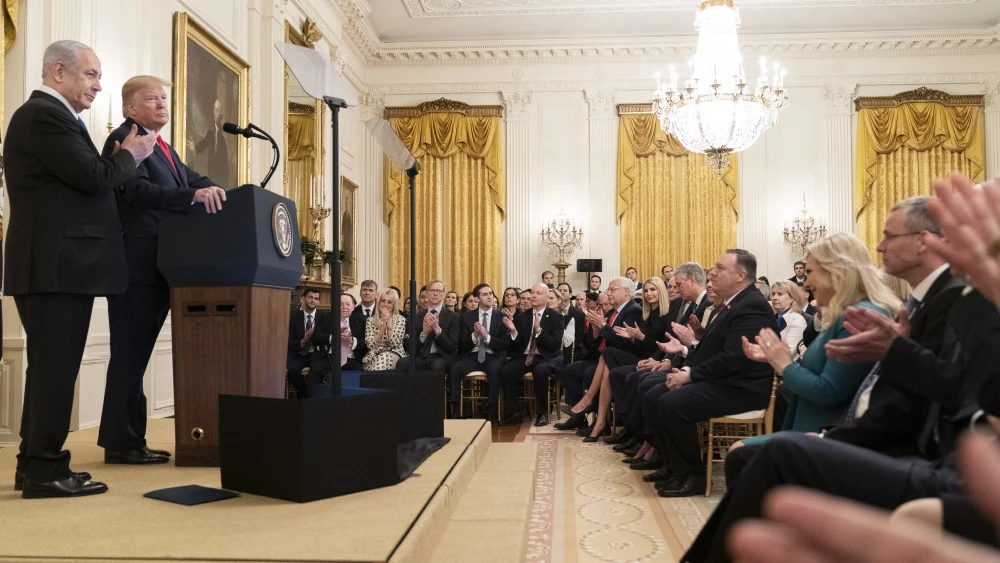

Commentators and Middle East experts have now had a few weeks to scrutinize the Trump peace plan, whether to praise or bury it. Many have dwelt on what the plan offers Palestinians in terms of land, but it seems almost to have gone unnoticed that the plan puts paid to the primordial issue driving the conflict: the Palestinian “right of return.”
The Arab-Israeli conflict created both a Palestinian and Jewish refugee problem. Palestinian refugees, who have suffered over the past 70 years, have been treated as pawns on the broader Middle East chessboard, and empty promises have been made to them and to their host countries. A similar number of Jewish refugees were expelled from Arab lands shortly after the creation of the State of Israel, and have also suffered.
The Trump plan states, clearly and unequivocally, that there shall be no “right of return” to Israel for Palestinian refugees—code for overwhelming the state of Israel with millions of “refugees” and their descendants. Instead, under the plan the “refugees” will be absorbed in their host countries or in a state of Palestine in the West Bank and Gaza.
As long as there is no humanitarian solution for the Palestinian refugee problem, Israel-Palestinian conflict will never end. The Trump plan understands this, and for the first time tries to come up with a “just, fair and realistic” solution that does not involve even a token return of “refugees” to Israel.
Moreover, for the first time in a peace document, the Trump plan explicitly mentions the Jewish refugees from Arab countries, in the same sentence with Palestinian refugees.
The document states: “A similar number of Jewish refugees were expelled from Arab lands shortly after the creation of the State of Israel, and have also suffered. ... Most settled in the State of Israel and some settled elsewhere.” (In fact, more Jewish refugees [850,000] fled Arab countries than Palestinians fled Israel [711,00]. Some 200,000 settled outside Israel.)
An innovation is that the plan suggests that Israel ought to be compensated for absorbing Jewish refugees.
Some resent the comparison—Palestinian refugees are the byproduct of a war their side started and lost. The Jewish refugees were innocent non-combatants far from the theater of war, deliberately scapegoated by Arab regimes because they happened to have the same religion and ethnicity as Israelis.
Others have criticized the plan for affirming that “a just, fair and realistic solution for the issue relating to Jewish refugees must be implemented through an appropriate international mechanism separate from an Israel/Palestine Peace Agreement.” Quite what this international mechanism might be is not specified. Observers fear that any agreement between Israel and the Palestinians that detaches justice for Jewish refugees from the main peace agenda will end up kicking the Jewish refugee issue into the long grass.
The underlying premise behind the “separate international mechanism” approach is likely to be that the Palestinians are not responsible for the Jewish refugees. The Jewish refugees ought to be compensated by the Arab regimes which dispossessed them and expelled them. But seven Arab League states went to war with Israel—a regional war that created both sets of refugees. The logical conclusion is that a regional agreement ought to be signed that deals with both issues simultaneously.
Another disappointment is that nowhere does the Trump plan mention the International Fund proposed by President Bill Clinton at Camp David in 2000. This was intended to compensate individual refugees, both Palestinian and Israeli, for their lost assets. The fund would have also had the virtue of compensating Jewish refugees who settled outside Israel.
But whatever its shortcomings, the Trump plan is not intended to do more than sketch out the broad outlines of a deal. It has tried to grapple with the refugee elephant in the room, and for this alone deserves praise.
Lyn Julius is the author of “Uprooted: How 3,000 years of Jewish Civilization in the Arab World Vanished Overnight” (Vallentine Mitchell, 2018).