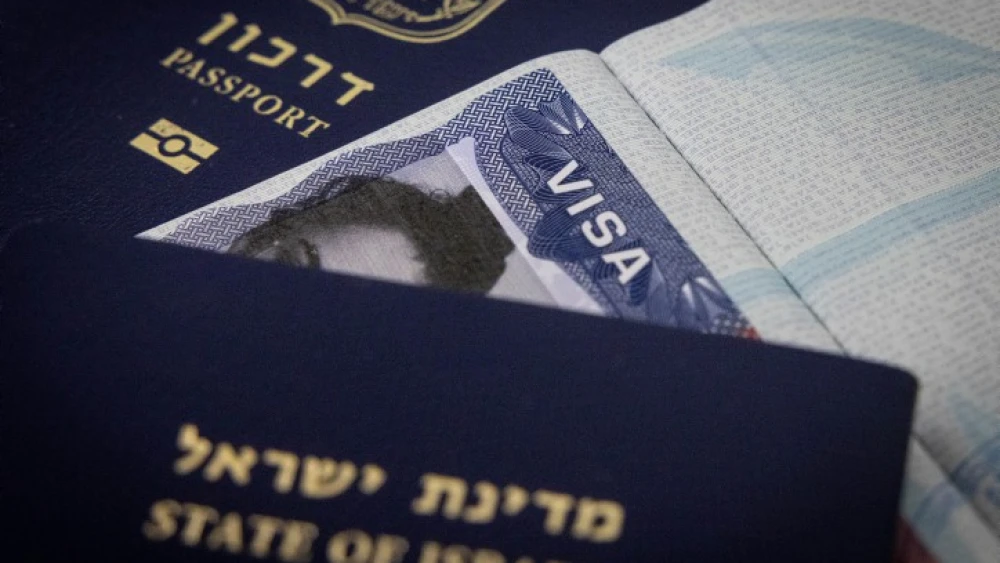

There is a moment every Israeli traveler knows. You are standing in a European airport—at the check-in counter, passport control or in the security line—and you reach into your bag. The small navy-blue booklet comes out, its cover bearing a menorah flanked by two olive branches, with the words “State of Israel” printed in English and Hebrew, and something in the air changes.
A glance. A pause that lasts half a second too long. An expression that requires no translation. You have not said a word. You have done nothing except exist with the wrong document in your hand.
Since Oct. 7, 2023, and through the cascade of war that followed, traveling through Europe with an Israeli passport has become an exercise in performed invisibility. You tuck the document face down. You slide it under your palm on the counter. You are now an expert at the swift, low transfer from pocket to official hand and back, minimizing the risk that anyone nearby might read the words on its cover.
Dimitry Kochenov, the “Passport Professor,” whose 2019 MIT Press book Citizenship dissects the global passport hierarchy with surgical precision, writes that a passport “carries borders in one’s pocket,” and is not a neutral identity document but a condensed statement of one’s place in the global hierarchy. He is right. What he could not have fully anticipated is that for the Israeli traveler in today’s Europe, the passport carries something more visceral than hierarchy. It has become a target.
Kochenov argues that passports judge people “by the color of their passport and nothing else,” making the document a practical measure of worth. The Israeli experience in European airports is that framework made flesh, a moment of eye contact, an awkward silence.
The check-in agent takes slightly longer than necessary, expressionless in a way that nonetheless conveys something dark. The security officer’s questions drift from the procedural into something more editorial. The fellow passenger in the boarding line registers the navy booklet in your hand and shifts their weight, almost imperceptibly, away. The duty-free cashier whose warmth, freely extended to the travelers before and after you, runs briefly cold. No accusation is made. None is needed. The passport has already spoken.
It is the setting that makes all this so suffocating. Europe is not incidental here. This is the continent that spent centuries constructing the legal, theological and eventually biological architecture of Jewish exclusion. This is the continent whose 20th century produced the definitive proof of where that logic leads. And this is the continent that built its postwar identity around the vow of “never again.”
The airports of Berlin and Amsterdam, Paris and Brussels are not neutral transit zones. They are built on specific ground, and Israelis moving through them carry that history in their bodies, not just their passports. When a fellow passenger gives you that look across the departure lounge, you are not simply a citizen of an unpopular state. You are a Jew in Europe being scrutinized. The layers do not separate cleanly.
In Citizenship, Kochenov argues that for most of the world, citizenship is primarily a liability rather than an asset, a blood-based allocation of burdens and privileges that reproduces global inequality at every border crossing. The Israeli passport was never a mobility superpower, long excluded from Arab states and fraught with complications across parts of Asia. But within the Western world, particularly Europe, it has carried full visa-free access, indistinguishable in practical terms from any other Western passport. A gateway, not a gate. This is eroding.
The formal visa arrangements remain unchanged, but the human texture of crossing has shifted in ways no bilateral agreement captures. Hostility leaves no paper trail. A look costs nothing and proves nothing. And yet it accumulates, checkpoint by checkpoint, until a flight becomes something to get through rather than enjoy.
There is a word that goes missing in the respectable discourse about Israeli policy and its contested morality. That word is antisemitism.
Not a criticism of a government. Not anger at a military operation. Not the entirely legitimate range of political positions one might hold about Gaza or the strikes on Iran. Antisemitism: the ancient, persistent, shape-shifting conviction that Jewish presence is itself the problem, that Jewish people carry their guilt collectively and wear it on their passports.
What is happening to Israeli travelers in European airports is not a political protest. Political protest is a banner unfurled outside an embassy. What is happening at the check-in counter is something older and more reflexive, updated for the current news cycle but drawing from the same well.
Kochenov wrote about the global architecture of citizenship, not about Jews in Europe. Yet his words—citizenship systems as instruments of “complacency, hypocrisy and domination”—land with uncomfortable precision on this continent and in this moment.
Europe mourns its historical antisemitism in museums and memorial days, in plaques and pedagogy, in solemn ceremonies at the sites of its greatest crimes. It is considerably slower to recognize the live version standing in its passport control lines, clutching a navy-blue booklet embossed with a menorah, waiting to be waved through or held up, welcomed or made to feel like a problem that needs processing.
The Israeli traveler learns to expect it. Learns to minimize the exposure of that booklet, to read the room before reaching into your bag—to brace for the weight of judgment that arrives before a single word is exchanged. That is what it means to carry your place in the world in your pocket and know that in Europe, in 2026, that place is unwelcome.
The booklet has not changed. Europe has simply stopped pretending.