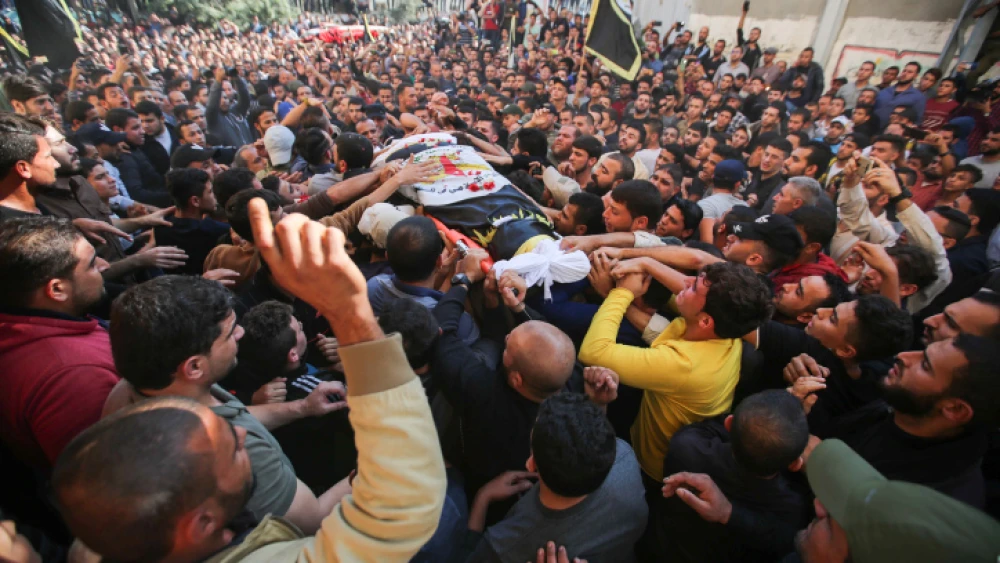

Israel landed a double blow on Tuesday against the Palestinian Islamic Jihad, Iran’s proxy in the Gaza Strip, through simultaneous air operations on two fronts.
The Israel Air Force targeted senior PIJ commander Baha Abu al-Ata in Gaza City, and at the same time attacked the Damascus home of Akram al-Ajouri, who headed the PIJ Military Council and served as right-hand man to PIJ Secretary-General Ziad Nakhla, who hides out in Hizbullah’s Dahiya neighborhood in Beirut, Lebanon.
Al-Ajouri was reportedly injured in the attack in Damascus, and his son killed.
Hamas condemned the killing of al-Ata, and according to reports from Gaza PIJ and Hamas leaders are in hiding.
Various Palestinian factions throughout the Gaza Strip are leveling threats that “the enemy will pay a heavy price.”
In response to the Israeli strikes, PIJ launched over 200 rockets at Israel in under 24 hours. “We are going to war,” said PIJ leader Nakhala, "[Israeli Prime Minister Benjamin] Netanyahu has crossed all the red lines in killing Al-Quds Brigades Commander Baha Abu al-Ata.”
In an attempt to calm the security situation, an Israel Defense Forces spokesman announced that Israel has not renewed its policy of targeted killing.
Egyptian intelligence has reportedly initiated talks with Israel, Hamas and PIJ in an attempt to stop the escalation.
Who was Abu al-Ata?
The targeting of Abu al-Ata, who was responsible for the northern sector of the Islamic Jihad’s military wing, is an important step toward restraining the PIJ’s opposition to the Israeli-Hamas ceasefire reached in May with the help of Egypt.
Abu al-Ata challenged the Hamas leadership in the Gaza Strip, who had been afraid to confront him, and often had disagreements with PIJ leader Nakhala.
Nakhala maintains a direct relationship with Gen. Qassem Soleimani, commander of the Iranian Islamic Revolutionary Guards’ Quds Force.
Israel considered Abu al-Ata to be a “ticking time bomb,” and attempted to target him during “Operation Pillar of Defense” in 2012; his house was destroyed during “Operation Protective Edge” in 2014.
In recent days, Abu al-Ata promoted further attacks against Israel, deploying squads for infiltration, sniper and drone attacks, and to prepare to launch rockets of various ranges.
Abu al-Ata is believed to have been responsible for most of the rocket attacks from the Gaza Strip in the past year.
A few weeks ago, Abu al-Ata visited Egypt together with Nakhala for talks with Egyptian intelligence chiefs about maintaining the relative calm with Israel. The Egyptians reportedly paid tribute to PIJ and released dozens of detainees from Egyptian prison in the hopes that this would encourage the organization’s leaders to maintain the calm.

PIJ’s Iranian master
However, Islamic Jihad obeys only Iranian instructions, and earlier in November launched a barrage of rockets at Ashdod and other cities near Gaza.
Following Israeli reports naming Abu al-Ata as being responsible for the rocket attacks, he went underground. When he came out of hiding, he surrounded himself with women and children to serve as human shields. Israel waited for an opportune moment, striking his home in the Shejaiya neighborhood of Gaza on Tuesday.
It is still unclear whether the events of Nov. 12 will lead to a few days of fighting or to a wider Israeli military operation. Israel is responding cautiously to the rocket fire in an attempt to keep Hamas, the strongest organization in Gaza, out of the conflict.
But while Israel is attempting to limit the military confrontation to the PIJ front only, it’s not the only one making the decisions. Hamas, too, receives instructions from Iran, and also follows the mood on the Gaza street. As a co-member with PIJ of the “Joint Gaza Military Front,” Hamas may also join in the hostilities.
Indeed, Israel estimates that Hamas will be forced to do so, even though it does not want a widespread military confrontation with Israel. With intense pressure coming from the Gazan street, Hamas may attempt a measured response. The question of whether this will become an extensive military confrontation will also depend on Israel’s response to the rocket fire.
This article was first published by the Jerusalem Center for Public Affairs.