


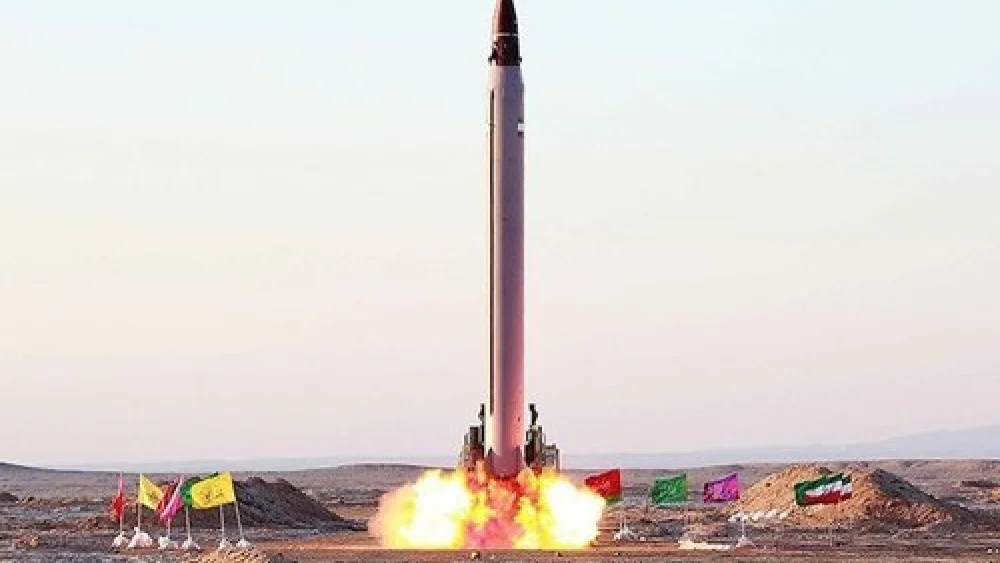
The Trump White House has accelerated a secret program to sabotage Iran’s ballistic missile and rocket projects, The New York Times reported on Wednesday, quoting current and former administration officials.
The officials said the operation was part of an expanding campaign by the United States to weaken the Iranian military and isolate its economy.
Officials told the Times that it was impossible to precisely quantify the success of the classified program, but that in the past month alone, two Iranian attempts to launch satellites failed within minutes.
Those two rocket-launch failures—one on Jan. 15 and another unacknowledged attempt on Feb. 5—were part of a pattern over the past 11 years. In that time, 67 percent of Iranian orbital launches have failed, an exceedingly high number compared to the 5 percent failure rate worldwide for similar space launches.
Hours after the Jan. 15 attempt, U.S. Secretary of State Mike Pompeo said Iran’s satellite launchers had technologies “virtually identical and interchangeable with those used in ballistic missiles.”
The setbacks have not deterred the ayatollah regime, however, and earlier this week Iranian President Hassan Rouhani vowed to “continue our path and our military power.”
The Trump administration, similar to Israel, maintains that Iran’s space program is a cover for its efforts to develop intercontinental ballistic missiles capable of carrying nuclear warheads.
The American officials who spoke to The New York Times described a far-reaching effort, created under former President George W. Bush, to slip faulty parts and materials into Iran’s aerospace supply chains. The program was active early in the Obama administration but was reinvigorated in 2017, when Pompeo took over as the director of the CIA and provided it with new resources.
Tehran had grown suspicious even before U.S. President Donald Trump withdrew last May from the 2015 nuclear accord. Brig. Gen. Amir Ali Hajizadeh, the head of Iran’s missile program, accused American and allied intelligence agencies of turning their campaigns of “infiltration and sabotage” to Iran’s missile complex from its atomic infrastructure.
“They want to repeat their nuclear sabotage in the missile area,” he told Iranian state television in 2016, vowing the program will never stop “under any circumstance.”
The CIA declined to comment on the report, while administration officials asked The New York Times to withhold some details of its reporting, mostly involving the identities of specific suppliers to the Iranian program, because the effort is ongoing.



