Traffic remained unimpeded throughout the country on Tuesday morning, “contrary to erroneous reports” that protesters had blocked major roads, according to the Israel Police.
“At this time, all roads across the country are open to traffic,” Israel police posted to its X account shortly after 9:00 a.m. on Tuesday. While protesters had blocked traffic in several locations, the roadblocks were cleared “within a short time,” the statement continued.
The “day of rage” was organized by the Hostages and Missing Families Forum, which has been highly critical of the government’s handling of the hostage crisis.
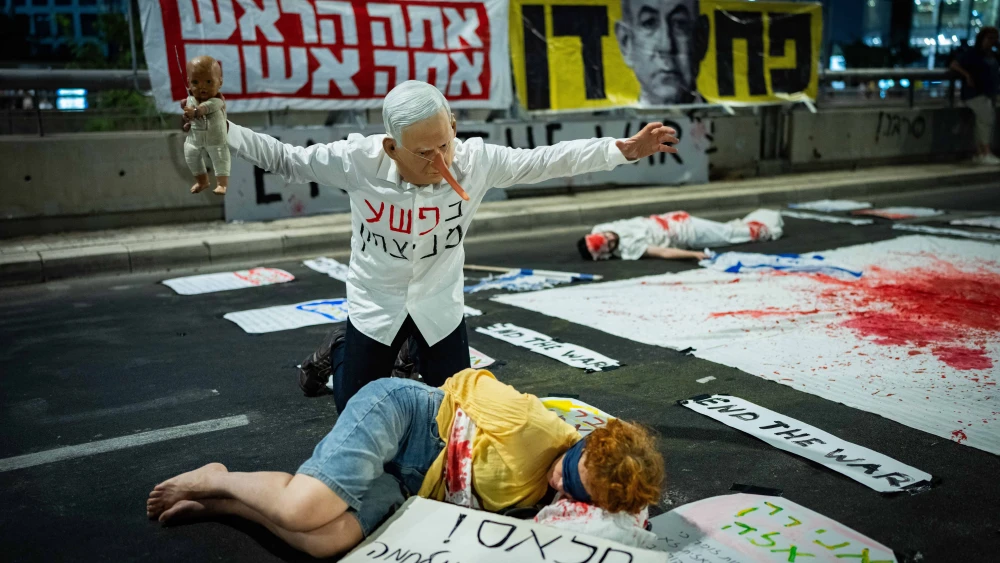
Protests began at around 6:30 a.m., under the slogan, “Israel is standing.” Demonstrators stood at intersections throughout the country, shouted the names of the hostages, waved flags and carried signs.
Police said the Ayalon Highway, an inter-city thoroughfare which runs along the eastern border of Tel Aviv, was blocked at various points “by rioters who did not obey the police’s instructions, while endangering road users.”
One protester was arrested in the Tel Aviv district, after being found in possession of a smoke grenade. Several traffic tickets were given out.
“The freedom of protest and expression is not the freedom to infringe on the freedom of movement of many,” the police noted. “Blocking traffic routes without authorization and in a manner that may endanger road users or impair the freedom of movement of many citizens will not be permitted.”
In addition to blocking traffic, demonstrators posted a flag with pictures of the hostages in front of the U.S. Embassy in Tel Aviv, according to Israel’s Channel 12 News.
Accompanying the image was the text: “50 hostages can’t wait, let them go.” Hamas is still holding 50 hostages in Gaza, 20 of whom are believed to be alive, according to Israel’s hostages coordinator, Israel Defense Forces Brig.-Gen. (res.) Gal Hirsch. Hamas holds the bodies of the remaining 30.
Protesters also demonstrated in front of the homes of government ministers, including Yariv Levin, Yoav Kish, Ron Dermer, Nir Barkat and Gila Gamliel, as well as that of deputy minister Sharren Haskel.
High-tech companies and venture capital funds also joined the protest, among them Meta, Wix, Monday, Fiverr, Playtika and Papaya Global, Channel 12 reported.
Families connected to the Hostages and Missing Families Forum universally blamed Israeli Prime Minister Benjamin Netanyahu for the failure to bring their loved ones home. They argue against the Israel Defense Forces’ plan to attack Gaza City, the terror group’s last stronghold, calling instead for the government to reach a deal with Hamas for the release of hostages.
Einav Zangauker, whose son Matan remains a hostage in Gaza, said on Tuesday, “We could have ended the war a year ago and brought all the hostages and soldiers home. We could have saved the abductees and soldiers, but the prime minister has repeatedly chosen to sacrifice civilians for the sake of his rule.”
Hagit Chen, the mother of Itay, an IDF soldier who was killed on Oct. 7, 2023 and whose body is still held by Hamas, said: “There is a real possibility of an agreement that can bring back our 50 loved ones. In the face of this possibility, the prime minister chooses to lead military maneuvers and prioritizes defeating Hamas.”
Itzik Horn, the father of Iair (who was released in February) and Eitan (who remains in captivity), said: “The progress of the plan to occupy Gaza, while there is an agreement [to free the hostages] on the table for the prime minister’s signature, is a stab in the heart of the families and the entire nation.”
Israeli Prime Minister Benjamin Netanyahu has so far resisted pressure for a partial deal, saying he would only agree to a comprehensive agreement that brings all the remaining hostages home at once. On Aug. 21, he ordered “immediate negotiations” for the release of all the hostages “on terms acceptable to Israel.”
“We are at the decisive stage,” he said. “Defeating Hamas and securing the release of all hostages go hand in hand.”
On Aug. 25, while meeting Sen. Joni Ernst (R-Iowa), Netanyahu said the government’s decision to advance the war into Gaza city is “unequivocal.”
The Tikvah Forum, another group representing hostages’ families, supports the prime minister’s approach.
“How does blocking roads promote the return of kidnapped people?” it wrote in a Tuesday Facebook post. “A vast majority of the people already understand: stopping the war for a partial deal that will leave half of the abducted behind is simply not an option,” it said in another post.
“Only a military defeat of the enemy, until he begs to return all the hostages, will guarantee security for the country of Israel and the return of everyone together,” the post continued.
The Hostages and Missing Families Forum plans another protest at Hostages Square in Tel Aviv on Tuesday evening.