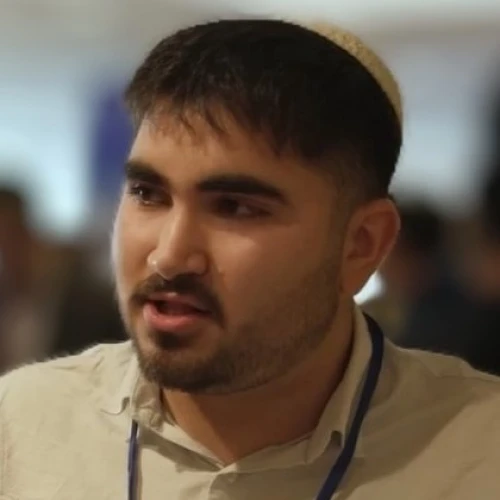
“It’s important that people don’t lose motivation and that they trust the Israel Defense Forces, as we work to create a better future—not just for us, but for generations to come. We cannot lose motivation, whether it relates to antisemitism worldwide or the situation in Israel,” 21-year-old Sgt. I, a combat medic in the IDF’s 769th Brigade, told JNS on Sunday.
Sgt. I, originally from Jerusalem, has been serving in northern Israel for the past two years and described the situation there as highly complex.
“My role as an active combat medic involves both military personnel and civilians in the Upper Galilee region. When someone is wounded, we are called out,” he said. “There have been many rocket attacks on civilian populations, and civilians have been injured. Ordinary people have found themselves in a situation where a foreign terrorist organization is bombing them, and they are living under constant threat,” he added.
As part of a medical evacuation team, Sgt. I provides initial treatment to the wounded, including administering tourniquets. Equipped with advanced life-support systems, he stabilizes patients for transport to hospital or evacuation by helicopter.
Hezbollah began firing rockets and suicide drones at Israel on March 2, in retaliation for the Jewish state’s targeted killing of Iranian Supreme Leader Ali Khamenei in the opening strikes of “Operation Roaring Lion/Epic Fury” on Feb. 28.
In response to the terrorist organization’s violation of the U.S.-brokered Nov. 27, 2024, truce agreement with Lebanon, Jerusalem launched an aerial campaign against Hezbollah and ordered IDF troops to advance and take control of additional areas in Southern Lebanon to halt cross-border attacks.
The IDF on Monday said it had begun “striking Hezbollah terrorist infrastructures in Beirut,” after saying on Sunday that it had eliminated dozens of terrorists and destroyed more than 200 Hezbollah targets as part of efforts to expand the security zone in Southern Lebanon.
One of the primary challenges, Sgt. I said, is treating patients under fire, including rocket attacks and UAVs.

“We put ourselves in danger to ensure people receive the best medical care possible. It is a very complex situation that can change at any moment. People often don’t have enough time to reach a bomb shelter—sometimes they hear the explosion before the siren,” he said.
Despite the challenges, Sgt. I noted that forces in the region—both reservists and conscripts—are working around the clock to restore a sense of security and encourage residents to return, particularly those evacuated following the Oct. 7, 2023, Hamas attack.
“We understand the magnitude of this moment and the responsibility we carry. As a medical team, we are constantly training and preparing for any possible scenario,” he said.
In his role as a medical event coordinator, Sgt. I oversees the operational management of missions. He leads a team of two medics and one paramedic, ensuring their deployment and gathering critical information while coordinating with helicopters and regional medical units.
“My job is to communicate. We train extensively for mass-casualty events so I know who is in front of me, who to coordinate with when the helicopter arrives, and what type of aircraft is coming,” he said.
“We train medics and paramedics intensively so they know protocols by heart. We prepare for everything—from rocket attacks and ground infiltrations to medical emergencies like heart conditions and strokes. We must be ready for all scenarios,” he added.
Sgt. I initially sought to serve in a combat role, but did not meet the requirements. Wanting to serve as close to the front lines as possible, he chose to become a combat medic.
“When I arrived, I immediately understood the responsibility of caring for others, and that is why I am still here today. I was later offered a role as a foot soldier in a battalion and could have transferred, but I developed a deep connection to this region and its people. That is what made me stay,” he said.
“I understand the responsibility I carry. Seeing people from around the world trust us to protect them gives us the motivation to sleep at 6 a.m., wake up at 8 a.m. on two hours of rest, and work as hard as we can so others can sleep more safely the next day,” he added.