Dimona, Israel—Amid the soot-covered ruins of a home in southern Israel demolished by an Iranian ballistic missile, the wedding ring was found.
It was just a day earlier when Dorit Azran and her 29-year-old son, Dor, along with their two dogs—all sheltering in their safe room at the time of the missile impact—escaped unscathed from the home.
“It was a visible miracle,” Dor recounts of the harrowing ordeal when the missile, packed with half a ton of explosives, slammed into the yard just outside of their house.
His father, David Azran, was out that Saturday night, March 21, when the city of Dimona (population of more than 40,000) was hit, and he rushed home to his family.
When day broke, standing barefoot amid the rubble of his demolished home, an assault rifle slung over his shoulder, he found what he was looking for: the wedding ring that his wife of three decades had left as she ran for safety.
“There is nothing to worry about,” the 54-year-old stated plainly to JNS on Sunday as he walked through his gutted home, seemingly unconcerned with both the destruction strewn all around as well as the renewed air-raid sirens warning of incoming missile attacks. “We have Divine protection.”

‘I’m a man of faith’
It was, in fact, anything but a normal Saturday night.
On that fateful weekend, his wife and son were huddled in the safe room with their two Australian Shepherds when the missile slammed on the ground outside and burst on impact, injuring scores of people and creating widespread destruction in the city in the Negev Desert, as did another missile fired that same evening at the nearby city of Arad (population about 30,000).
Dor told his nervous mother, who was on the phone with his aunt, to send her the picture of a leading Moroccan Sephardic rabbi, known as the Baba Sali, which they had in the room. He tried to assure her that everything would be OK since the Sabbath had just ended.
Then two loud explosions rocked the home. Peeking through the window of the sealed room that had opened, he saw flames of black smoke and fire shooting up in the night air outside, he recounted.
“Ruchkie,” his mother said, on the phone, using an antiquated nickname for her sister Rachel, “tell David and tell him to come.”
Racing out of the sealed room, the debris and ash all around them, the mother and son took cover in a nearby shelter as sirens of another missile attack rang out. Rescue workers got the dogs out of the house, which had been declared a no-entry zone shortly thereafter. (A third dog that remained upstairs at the time of the attack was injured by shrapnel but is recovering.)
Having rushed back, David slept the night in his car outside his home.
At daylight, his traumatized wife called to tell him about the missing wedding ring. Looking amid the rubble near the fireplace, he uncovered it, along with several photos from their wedding album.
“I’m a man of faith,” he said, noting that he had donated a kidney a decade ago.
He said he believed that what goes around comes around: “There is a circle of energy.”

‘Israel is a country of volunteers’
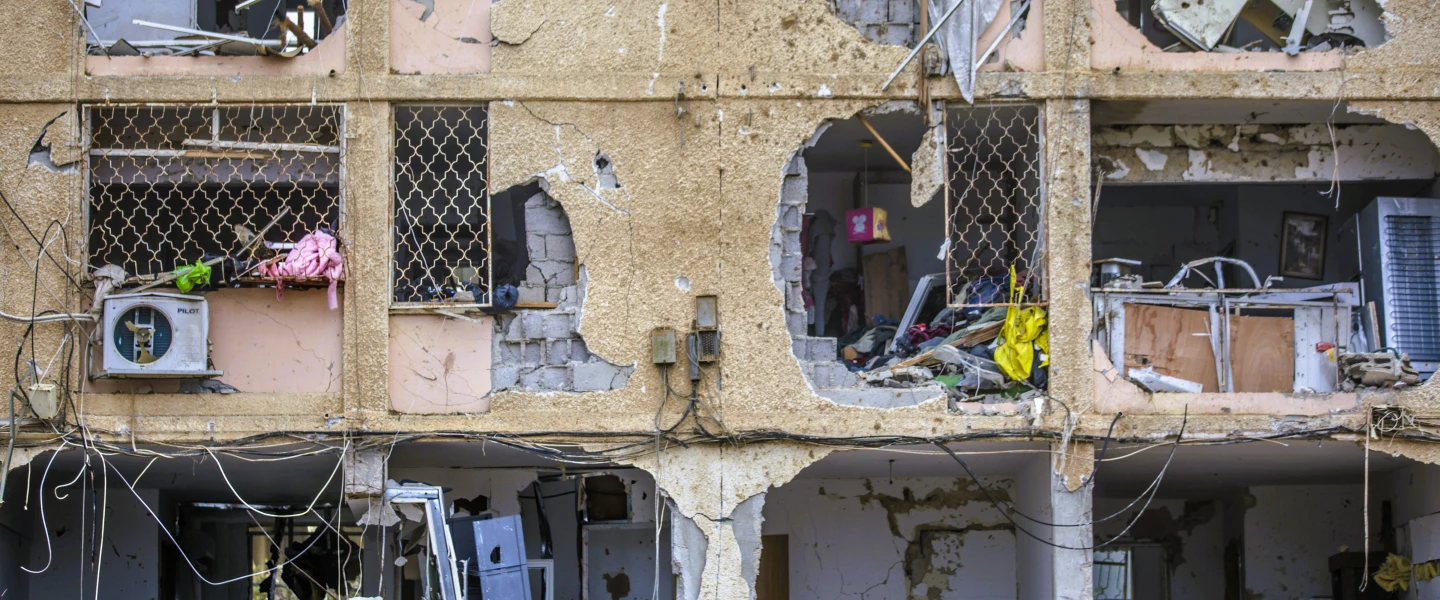
A week after the attack, the home—on a city side street muddied by debris, construction crews and the spring rains—still looks like a scene out of a war zone. A desk chair and two living-room chairs are the only remaining furnishings in the skeletal remains of the house, through which a stray cat was meandering on the day the Azrans talked about their experience.
The site of an adjacent kindergarten that once stood outside has been completely gutted, leaving a gaping hole next door.
Still, teenage volunteers sweep the streets and some of the less damaged homes in a seemingly impossible task.
“I feel it is very important to do this, knowing you are helping people who need it,” said Nitsan Gamla, 18, of the Golan Heights, who was volunteering with the One Heart organization.
“Israel is all about volunteering. Israel is a country of volunteers,” offered Keshet Nachman, 19, from Jerusalem. “If my home were blown up, I know that a hundred 18-year-olds would be there to clean it up, so it’s important to repay the favor,” she said.
Mohamed Abu Ajaj, 20, from the Bedouin community of Kseifa, was among the security personnel stationed to safeguard the homes.
“It was all such a mess when I first got here,” he recounted, noting that residents had to be bused out since the parking lot was filled with destroyed vehicles.
An adjacent supermarket on the main thoroughfare was still shuttered. About a mile away, a Middle Eastern restaurant was busy serving lunch on Sunday amid intermittent sirens, warning of further incoming Iranian missiles. It served as both sustenance and shelter to visitors.
As for David, he remains resolute. “They cannot beat us,” he told JNS from his demolished home. “God is with us.”