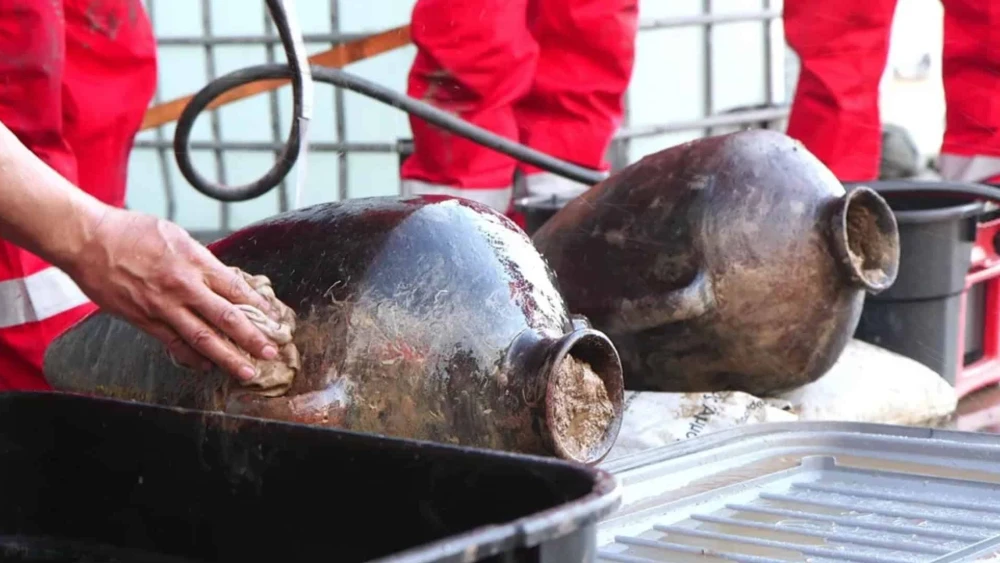
The most ancient ship ever found in the deep sea has been discovered off Israel’s northern coast, shedding light on trade more than three millennia ago and revealing the existence of advanced navigation skills in that era, the Israel Antiquities Authority announced on Thursday.
The 3,300-year-old ship’s cargo, including hundreds of intact amphorae, was located 55 miles from shore at a depth of just over 1 mile, the state-run archaeological body said.
The dramatic find was uncovered during a standard seafloor survey last year by a leading natural gas company.
Sample vessels from the cargo were positively identified as coming from the Late Bronze Age Canaanite period, according to the IAA.
“The ship seems to have sunk in crisis, either due to a storm or to an attempted piracy attack—a well-known occurrence in the Late Bronze Age,” said Jacob Sharvit, head of the IAA Marine Unit.
He called the find “a world-class, history-changing discovery.”
“This find reveals to us, as never before, the ancient mariners’ navigational skills—capable of traversing the Mediterranean Sea without a line of sight to any coast,” he said. “To navigate they probably used the celestial bodies, by taking sightings and angles of the sun and star positions.”
Only two other shipwrecks with cargo are known from the Late Bronze Age in the Mediterranean Sea, and both were found relatively near the shore, according to the IAA.
Based on the earlier finds, the academic assumption until now was that trade at that period was executed by safely moving from port to port, keeping the coastline within view.
“As part of our ongoing activity to discover and extract natural gas from the deep sea, we conduct surveys that check different parameters, using an advanced submersible robot to scour the seafloor,” said Karnit Bahartan of the Energean hydrocarbon exploration company, which chanced on the site.
“About a year ago, during a survey, we saw the unusual sight...what seemed to be a large pile of jugs heaped on the seafloor...and when we sent [the IAA] the images it turned out to be a sensational discovery, far beyond what we could have imagined,” she said.
The jugs were the most efficient means of transporting relatively cheap and mass-produced products such as oil, wine and other agricultural products such as fruit, said Sharvit.
The finds from the ancient ship will be displayed to the public in Jerusalem.