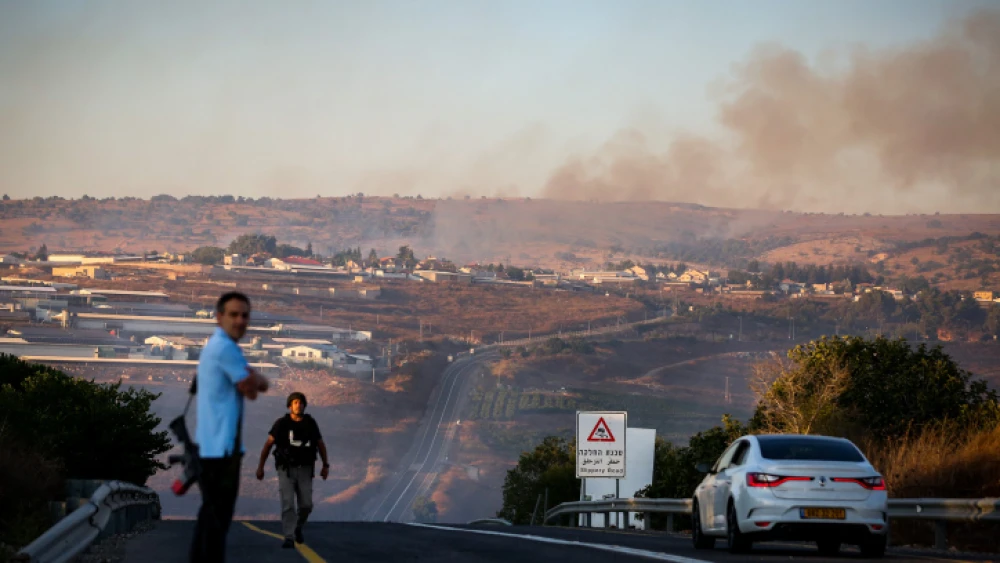
It’s hard to shake off the lingering feeling of discomfort that followed IDF Chief of Staff Lt. Gen. Aviv Kochavi’s publication on Thursday of the results of a probe into Hezbollah’s firing of an anti-tank missile at an IDF vehicle near Avivim on the northern border last month.
The incident was defined as “serious” by none other than the chief of staff himself. It entailed a military ambulance entering an off-limits area, exposing itself to Hezbollah missile fire. An anti-tank missile was fired at the ambulance but missed it by a few yards, allowing the five personnel in it to escape without a scratch. Only by luck did the IDF avoid five funerals and a major escalation that could have led to real fears of an all-out war, which it did not want.
Therefore, it’s unclear why the IDF opted initially to focus on the positive outcome of the incident. The outcome is deceptive—this was a serious error, a failure, and an example of failure to follow orders put in place after similar situations ended in bloodshed.
What was the deputy battalion commander, who approved the vehicle’s route in violation of an explicit order, thinking? And what was the entire chain of command above him thinking in not taking pains to ensure its orders were being carried out in the field?
It’s also not clear why the chief of staff chose to draw a distinction between this incident and routine activity and operations, as well as combat operations.
Obviously, it is more dangerous to operate in combat conditions, where more mistakes are made. If this were an IDF ambush gone wrong, for example, it would be reasonable to back the commanders. Errors like the one that occurred near Avivim, however, are entirely manufactured.
Kochavi, however, adopted in full the conclusions of GOC Northern Command Maj. Gen. Amir Baram, including his decision to limit the reprimands to the battalion level—and the battalion commander was reprimanded for another incident entirely: the faulty evacuation of the Avivim base. However, the chief of staff was aware of the criticism about a lack of sufficient oversight at the division level, and summoned the division commander for a discussion to “clarify” the incident.
This is not a step included in the IDF’s disciplinary protocol, and is designed mainly to create the illusion of severity. On Sunday, someone in the General Staff remarked sarcastically that “it’s lucky they didn’t call in the division commander’s parents, to make it clear how unacceptable his behavior was.”
A spot-on cliché says it’s better to have commanders who have already made mistakes, because they know the price of their errors and will take extra care to make sure they don’t repeat them. This is also probably the reason why Kochavi chose not to put the heads of the commanders who messed up at Avivim on the chopping block; he wanted to give them a chance to learn, to draw their own conclusions and improve.
The question is whether the IDF, as an organization, will do the same.
Only last week, Kochavi drew a grim picture of the current security situation, in which the chance of a war is rising. The northern border is more volatile than ever, which means that operational discipline must be enforced, both as a matter of routine and in emergencies. “He who spares the rod spoils the child,” the Bible says—we need to hope that the chief of staff’s soft response to the incident at Avivim won’t come back to haunt him (and all of us) in the next needless operational foul-up.
Yoav Limor is a veteran Israeli journalist and columnist for Israel Hayom.
This article first appeared in Israel Hayom.