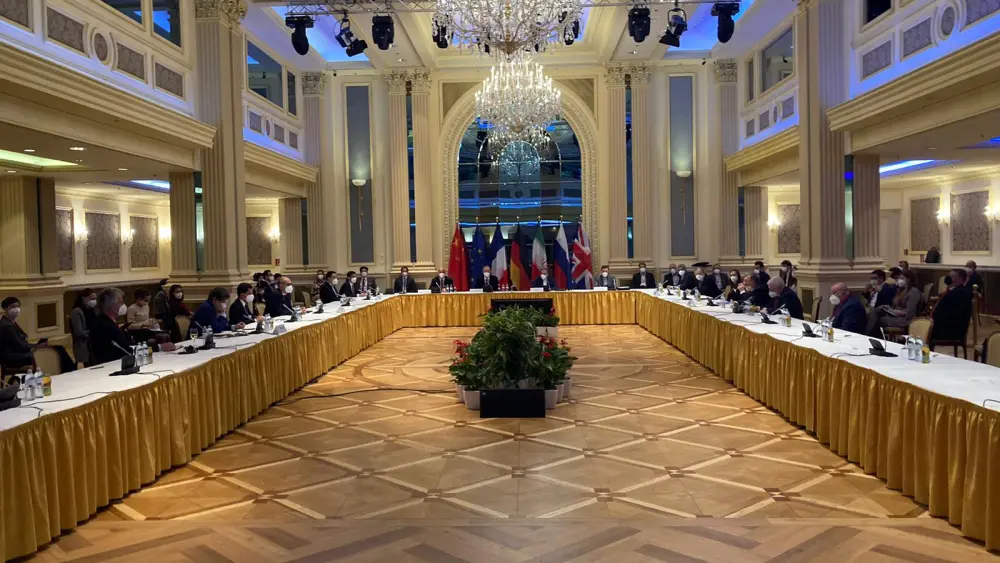
The French Foreign Ministry warned on Monday that Iran is endangering the possibility of a return to the 2015 Joint Comprehensive Plan of Action nuclear agreement.
“Iran continues to exacerbate the nuclear situation. If it continues down this path, not only will it delay the moment when an agreement might be reached providing for the lifting of sanctions, but it could compromise the very possibility of concluding the Vienna talks and restoring the JCPOA, " said French Foreign Ministry spokeswoman Agnès Von Der Mühll during a daily press briefing.
While “progress has been made” during the six negotiating sessions held so far in the Austrian capital, it is “urgent” that Tehran return to the negotiating table, she added.
“We are consulting closely on this situation with our E3 partners and other participants in the JCPOA, including the United States, with the shared goal of resuming negotiations as quickly as possible and reaching an agreement,” said Von Der Mühll.
Earlier this month, Reuters reported that Iran would not return to the Vienna talks until the government of newly elected Iranian President Ebrahim Raisi has had time to settle in, which would likely mean sometime in mid-August. The U.S. State Department confirmed the report, saying that the Iranians had “requested more time to deal with their presidential transition.”
The United States unilaterally pulled out of the JCPOA in May 2018 and re-imposed sanctions lifted by the accord, citing as its reason the agreement’s failure to adequately prevent future Iranian efforts to obtain nuclear weapons, address Iran’s ballistic-missile program or its destabilizing actions in the Middle East. Iran has since taken a series of steps away from its commitments under the deal.
Shortly after the conclusion on June 21 of the sixth round of negotiations in Vienna, Iranian Ambassador to the U.N. Majid Takht Ravanchi said that Iran’s return to the deal would be conditional on the lifting of all sanctions and on the United States committing not to withdraw from it again.
On July 6, the French, British and German foreign ministries issued a joint statement expressing “grave concern” over an International Atomic Energy Agency report confirming that Iran had begun enriching uranium metal.
“Iran has no credible civilian need for uranium metal R&D and production, which are a key step in the development of a nuclear weapon,” the statement said.
This latest in a long series of JCPOA violations was “all the more concerning” in light of the fact that no date had been set for the next round of the nuclear talks in Vienna, the statement continued.
The three countries also expressed concern at the degree to which Tehran has limited IAEA access to its nuclear sites.
“We strongly urge Iran to halt all activities in violation of the JCPOA without delay and to return to the negotiations in Vienna with a view to bringing them to a swift conclusion,” the ministers said.