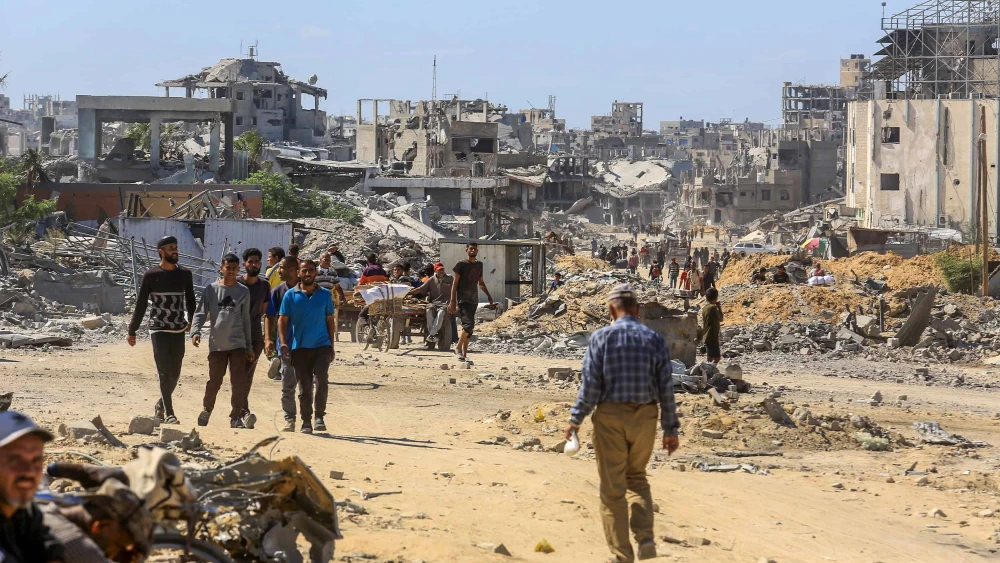
Ali Shaath, who has been tasked to head the Gaza administration reconstruction of the Strip, was praised by the White House last month as “a widely respected technocratic leader.” But an Israeli watchdog group said Shaath shares the radical anti-Israel ideology one would expect from a former Palestinian Authority functionary.
“[H]is ideology is taken directly from the Palestinian Authority’s playbook of hate and terror promotion,” said Palestinian Media Watch in a statement on Sunday.
Before U.S. President Donald Trump tapped Shaath to lead the National Committee for the Administration of Gaza (NCAG), Shaath shared his views about Israel and terrorism in an April 2025 podcast, as revealed by PMW.
In the YouTube interview, Shaath declared Israel a Western colonial project. “This colonialist [Israel], who was planted by America and Western Europe … , they planted it [Israel] in Palestine since the Balfour Promise [i.e., Declaration].”
During the interview, he wouldn’t refer to Israel by its name, calling it “the occupation,” effectively denying its right to exist. In the P.A. lexicon, PMW pointed out, all of Israel is an “occupation,” and all Israeli cities are “settlements.”
Itamar Marcus, founder and director of Palestinian Media Watch, told JNS that “the American attempt to create a future for Gazans is completely dependent on the quality of the people who will rule Gaza.
“The Americans must tell the leaders that they have to have the honesty and confidence to tell Palestinians what will be for them a difficult truth: Jews are indigenous to the land with thousands of years of history, and therefore Israel has a right to exist. If the Palestinian leaders can’t even say this, there is no point in wasting time on this experiment,” he said.
“If Ali Shaath was just parroting P.A. ideology when he said these words, now is the time for him to apologize and tell Palestinians the truth. If he actually believes them, Trump must replace him before he even starts,” Marcus said.
Shaath not only espoused P.A. ideology in the interview, but he also revealed that he had engaged in its violent tactics, boasting about his role in organizing attacks on Israeli positions in Khan Yunis, the city in the Gaza Strip where he was born.
“Like every Palestinian, I did an activity with young people at school, demonstrations against the Israeli occupation, and we would stand in areas where there are checkpoints of the occupation [i.e., Israel] and their positions and throw rocks at them,” he said.
“We set this day ablaze, and I actually was the organizer of this activity for this national act in the city of Khan Yunis. I succeeded in awakening all the opinions and feelings of the people, and they set out for the occupation’s positions,” Shaath said.