


Amid increased international attention to antisemitism, researchers are asking questions beyond the headlines: How does anti-Jewish prejudice take shape? Why is it sometimes difficult to recognize? And how can institutions determine whether their efforts to address it make a measurable difference?
These questions brought scholars from North America, Europe, Israel and beyond to Brock University in St. Catharines, Ontario, for the second annual Symposium on Antisemitism on Oct. 14-15.
Co-chaired by Brock psychology doctoral researcher Perla Matusof and Jonah Butovsky, Ph.D., the gathering focused on empirical research across psychology, sociology, education and other disciplines. It built on a 2025 symposium that fostered professional relationships in a field that has received increased attention since Oct. 7, 2023.
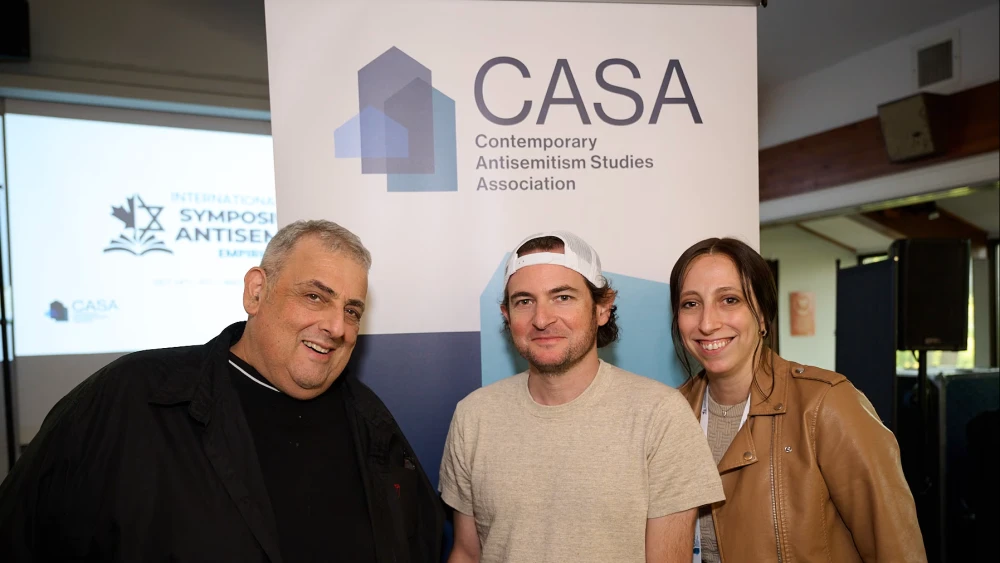
This year’s event was associated with the Contemporary Antisemitism Studies Association (CASA), founded in July by professor David Hirsh of Goldsmiths, University of London and the London Centre for the Study of Contemporary Antisemitism; Ayal Feinberg, Ph.D.of Gratz College; and David Barak-Gorodetsky, Ph.D. of the University of Haifa. CASA connects researchers across institutions and disciplines to strengthen international collaboration and scholarship.
The presentations highlighted areas in which researchers are collaborating.

Presentations explored how antisemitism is experienced, recognized and often dismissed, including research by professor Valérie Boussard of Université Paris Nanterre on young Jewish adults in France, Matusof and Kent Harber, Ph.D.of Rutgers University on the minimization of anti-Jewish discrimination and Graham Wright, Ph.D. of Brandeis University on antisemitism’s relationship to political ideology and other prejudices. Additional studies examined Jewish faculty experiences and the use of artificial intelligence to identify antisemitism in digital environments.
Beyond understanding the problem, researchers confronted another question: How do we know whether efforts to combat antisemitism actually work?
Leonard Saxe, Ph.D. of Brandeis University examined the challenge of evaluating educational programs and institutional initiatives, distinguishing their perceived value from evidence of lasting changes in knowledge, attitudes or behavior. His research reviewed hundreds of antisemitism-related commitments made by selected universities, emphasizing the need to establish what institutions actually implement and whether measurable outcomes follow. Drawing on decades of quantitative and qualitative research collected from the same international organization, Saxe illustrated how longitudinal studies and comparison groups can help assess longer-term educational outcomes.
That emphasis on rigorous evaluation was reinforced by Feinberg and Yael Silverstein of New York University, who distinguished between changing knowledge, influencing attitudes and affecting behavior.
The implications of antisemitism extend beyond campuses to Jewish organizations, Holocaust education, professional institutions and online environments. A program’s popularity or emotional impact cannot alone establish whether it achieves its objectives.
Brock University president Lesley Rigg and vice provost Rajiv Jhangiani demonstrated institutional support for such research initiatives. The event concluded with collaborative roundtables exploring research partnerships and shared methodologies.
The challenge ahead is not simply to document antisemitism more extensively, but to understand its underlying mechanisms, recognize its varied manifestations and identify which responses can produce measurable outcomes.


