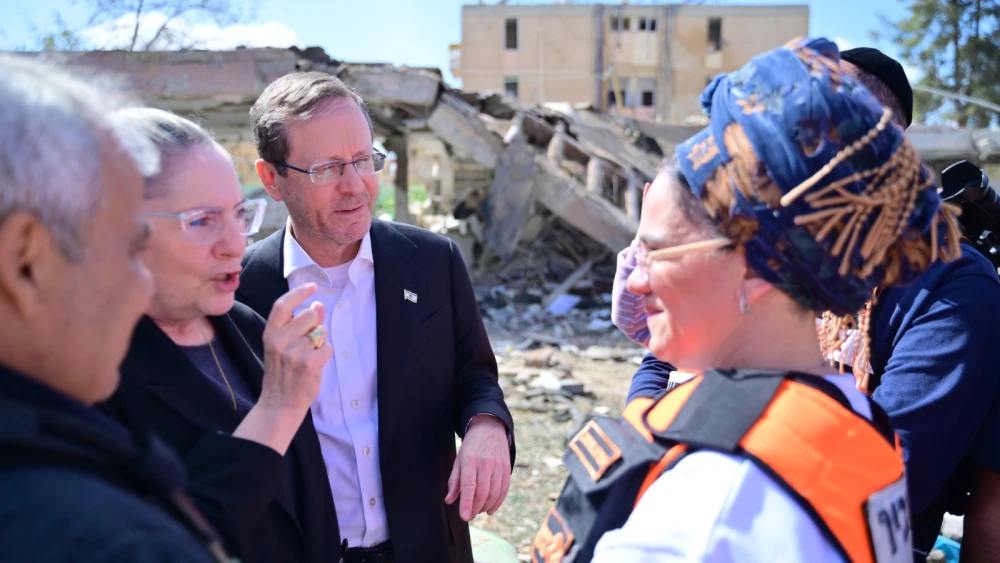
For the past three weeks, Israelis have almost become accustomed to the sights of destruction and carnage left by missile strikes. This morning, we awoke to those sights in southern Israel, in the city of Dimona, known as the home of the Negev Nuclear Research Center. Piles of rubble from damaged buildings, mixed with twisted metal and shattered glass from cars lining the dusty streets, tell the story of a night of destruction. It claimed no lives, but the damage will take the local population time to recover from.
Against the backdrop of destruction, Israeli President Isaac Herzog and first lady Michal Herzog arrived to witness firsthand the aftermath and meet those working quietly and relentlessly to help a shaken community along the road to recovery.
Among them was Efrat Suissa, the widow of Yoel Suissa, a United Hatzalah volunteer who died in a car accident. Standing near the impact site, she spoke with the president about a different kind of emergency response—one that does not treat physical wounds but those that linger beneath the surface.
Suissa has become a source of support for others in moments of acute distress. A social worker by profession, following her family’s personal tragedy, she chose to become certified by United Hatzalah as a member of the specialized Psychotrauma Unit.
Upon hearing the news of the initial impact on United Hatzalah’s dispatch system, she moved swiftly to the scene to provide psychological first aid to those caught in the chaos. “I arrived at the scene and provided initial care to an elderly woman and several children,” she said. “From there, I continued to the emergency response centers, where we carried on delivering support. Even now, we are still here, continuing to provide the necessary care.”
Her work, like that of dozens of volunteers in the unit, extends beyond the initial moments after impact. It is a sustained effort to stabilize, listen and gently guide individuals back from shock and fear.
A central part of that effort, particularly in the hours following traumatic events, is the use of therapy animals. Suissa described to the president and first lady how volunteers communicate with panic-stricken individuals through the comfort and care provided by these specially trained dogs.

“We meet people who are having difficulty speaking or processing what they’ve experienced,” she said. “For some, simply sitting with the dog, touching them, creates a sense of calm. From there, we can begin the process of emotional regulation and support.”
The interaction is subtle but powerful. In the presence of a calm, responsive animal, barriers begin to lower. Children who moments earlier were inconsolable find a point of focus. Adults who struggle to articulate their fear begin to engage. It is both literally and figuratively a bridge over troubled waters.
Herzog’s visit to Dimona was not his first encounter with this aspect of United Hatzalah’s work. Just over a week ago, he and the first lady visited the organization’s national headquarters, where they met with volunteers from the Psychotrauma Unit, including volunteer Tzofit and her service dog, Fiona. That meeting offered a glimpse into the structured, highly trained approach behind what can appear at first glance as simple acts of compassion.

There is, however, an additional layer of resonance to this encounter. In January, a few weeks after the Chanukah Massacre at Bondi Beach in Sydney, Herzog traveled to Australia to stand with a grieving community. While in Sydney, the president heard firsthand accounts of how United Hatzalah’s Psychotrauma and Crisis Response Unit dispatched a delegation of volunteers to provide emotional and psychological first aid to victims and residents in shock.
Today, once again, the president and first lady heard how this specialized unit is deployed and the impact of human connection in stabilizing victims in the critical hours after trauma.
That shared experience, across continents and crises, underscores the recognition that emergency response does not end with physical care. It extends into the psychological domain, where recovery is often more complex and enduring.
In Dimona, amid the wreckage of a single night, United Hatzalah’s mission was on display—not in dramatic gestures but in steady presence, in quiet conversations between caregiver, a dog named Fiona and those who experienced the Iranian threat firsthand.