Very few books change not only the lives of their authors, but the fate of the world. Abraham Lincoln acknowledged the enormous impact of Uncle Tom’s Cabin when, meeting diminutive Harriet Beecher Stowe, he is said to have exclaimed: “So you’re the little woman who wrote the book that made this great war!” The Communist Manifesto, Origin of Species, The Jungle, Cry, the Beloved Country, Silent Spring, and One Day in the Life of Ivan Denisovich have also exerted such wide-reaching effects that, for better or worse, their publication dates mark decisive boundaries between before and after. After their appearance, the world would never be the same.
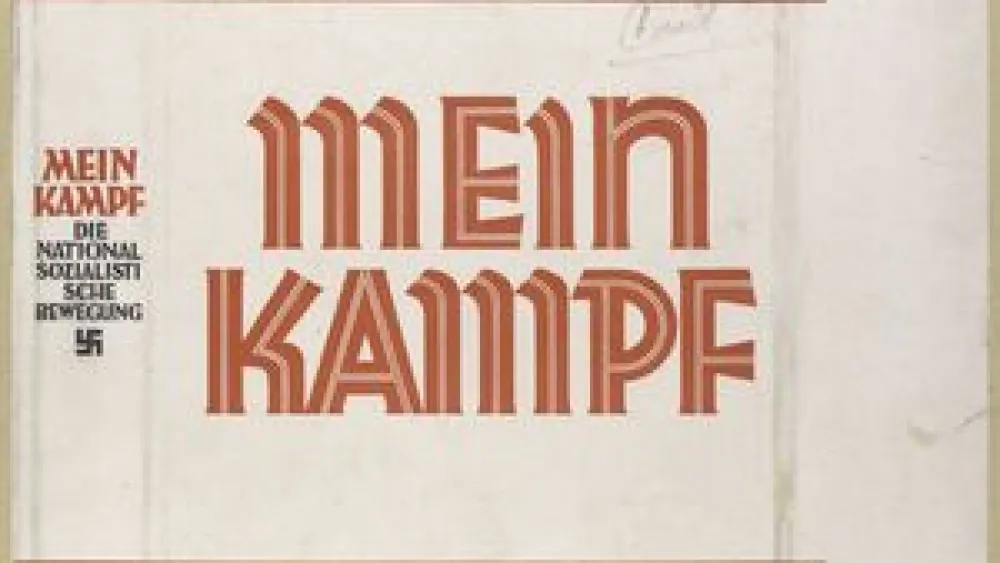
Mein Kampf, too, belongs on that list, alas. It is possible to argue that six million Jews and millions of others might not have been murdered had that rambling, wretched book never been written. Begun in 1924, while Adolf Hitler was incarcerated in Landsberg Prison for the Beer Hall Putsch, his failed attempt to overthrow the Weimar Republic, Mein Kampf (My Struggle) is a messy medley of memoir, treatise, and rant. Written with the assistance of Rudolf Hess, it consists of two volumes, published in 1925 and 1926, respectively.
Hitler surveys his life to that point, proclaims Aryan supremacy (he believed that Germans and Austrians belonged to a superior “race” he dubbed “Aryan”), and outlines a program for the purification of Europe. After the Nazis came to power in 1933, free copies of Mein Kampf were given to every newlywed couple and, later, to every soldier stationed on the front. By the time of Hitler’s death in 1945, about 10 million copies of that noxious book were in circulation.
The copyright to Mein Kampf is owned by the German state of Bavaria, the cradle of Hitler’s movement. Anxious to prevent a resurgence of Nazism, the Federal Republic of Germany prohibits swastikas, the “Heil Hitler” salute, and Holocaust denial. Although there is no official ban on possession of Mein Kampf, Bavaria has refused to authorize its republication and has pursued legal action against pirated editions. However, Bavaria has not been successful in suppressing translations of the book, and an English version is easily accessible on the Internet. Though it dismisses Egyptians as “a decadent people composed of cripples,” Mein Kampf was translate—by Nazi war criminal Luis Heiden— into Arabic in 1963. It was translated into Turkish in 2005, and the fact that that edition became a bestseller did nothing to impede deterioration in relations between Ankara and Jerusalem.
By international law, copyright on a book expires 70 years after the death of its author. That means that on January 1, 2016, Mein Kampf is scheduled to enter the public domain, available for anyone to re-publish and disseminate. However, to preempt the miscreants who are sure to exploit this opportunity to profit from the Führer’s vile ideas, Bavaria has announced that it is authorizing the Institute of Contemporary History in Munich to produce a fully annotated edition shortly before the copyright expires. The volume will include extensive commentary designed to expose the egregious factual and logical errors in Mein Kampf. “We want to make clear what nonsense is in there—with, however, catastrophic consequences,” explained Markus Soeder, the finance minister of Bavaria. Much of that dangerous nonsense is of course directed at the Jews, whom Hitler found repulsive—not only physically filthy and smelly but suffering from “moral mildew.” He contends that Jewish men lust after Aryan women, in order to contaminate the master race. Resuscitating the vicious canard that Jews carried the bubonic plague, he claims that Jews are suffering from “a moral pestilence, with which the public was being infected.”
Although Mein Kampf does not yet demand the genocidal Final Solution, it does anticipate the gas chambers of Auschwitz and Bergen-Belsen. Blaming the Jews for Germany’s devastating defeat in World War I, Hitler contends that: “If at the beginning of the war or during the war 12,000 or 15,000 of these Hebrew corruptors of the people had been held under poison gas, the sacrifice of millions at the front would not have been in vain.” Hitler was confident that if everyone read his book, what he imagined to be the Jewish conspiracy to control the world would be thwarted. “Once this book is common property of the people, the Jewish menace may be broken,” he wrote. So the Bavarian government’s decision to put Mein Kampf back into circulation might seem foolhardy, like razing houses in order to thwart arson.
Indeed, Deirdre Berger, head of the Berlin office of the American Jewish Committee, sees the plan to mass-produce Mein Kampf again as playing with fire. “I think we shouldn’t underestimate the potential danger to this day of this book,” she warned. However, Dieter Graumann, head of the Central Council of Jews in Germany, sees re-publication as the kind of controlled burn administered by rangers in order to save forests. “If it is going to be released, then I prefer seeing a competent annotated version from the Bavarian state than profit seekers trying to make money with Nazis.”
Any fair and sensible person would wish that Mein Kampf, the verbal spoor of a deranged and deadly mind, would simply disappear. However, because it will not, the next best thing is to make it easily available for widespread study and contempt.
Steven G. Kellman is a professor of comparative literature at the University of Texas at San Antonio (UTSA).