Newsletter
Newsletter Support JNS

IAEA: Iran has begun construction on underground nuclear facility

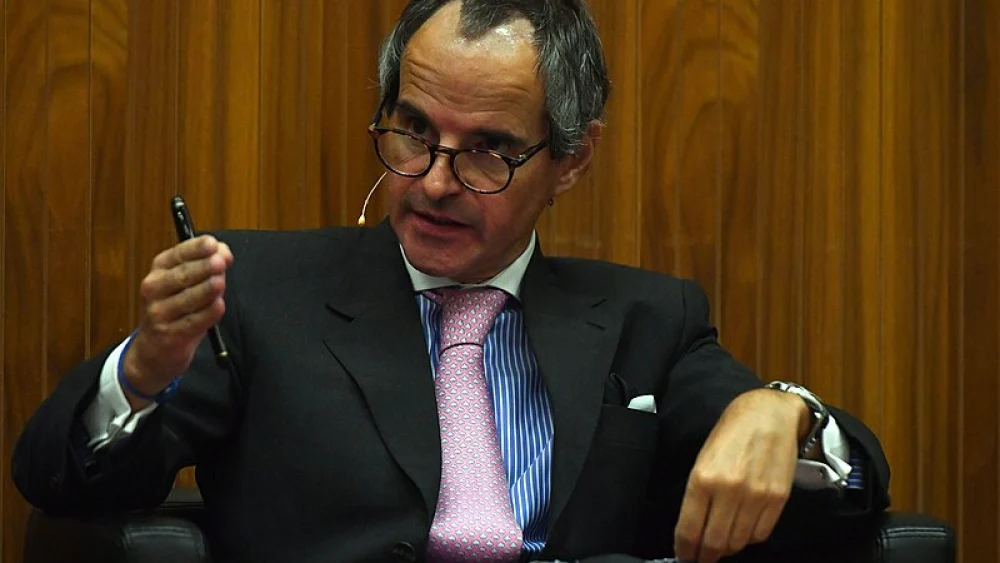
IAEA Director-General Rafael Grossi says he doesn’t think Tehran has a “significant quantity” of uranium “to indicate amounts which could be theoretically used for the development of a nuclear weapon.”

International Atomic Energy Agency Director-General Rafael Grossi in Vienna on Oct. 2, 2019. Credit: Dean Calma/IAEA via Wikimedia Commons.

International Atomic Energy Agency (IAEA) Director-General Rafael Grossi confirmed on Tuesday that Iran has begun construction on an underground centrifuge-assembly plant after a previous one exploded in what the regime claimed was an act of sabotage.

The explosion in question took place in July at the Natanz nuclear site, previously the target of the Stuxnet cyber attack, reportedly a joint U.S.-Israel maneuver.

After the explosion in the summer, Iran said it would build a new site in the mountains.

“They have started, but it’s not completed,” Grossi said in an interview with AP in Berlin. “It’s a long process.”

Grossi said the IAEA doesn’t think that Iran has a “significant quantity” of uranium “to indicate amounts which could be theoretically used for the development of a nuclear weapon.”

However, he added, “all of these are projections, and the IAEA is not into speculation. What may happen? What could happen? We are inspectors, we say the amounts that we see.”

The United States is “shutting down the financial infrastructure that allows the regime to continue its threats to U.S. national security and global shipping,” the U.S. treasury secretary said.
“The American people are crying out for an end to U.S. tax dollars subsidizing Israel’s military,” Rep. Greg Casar, chair of the Congressional Progressive Caucus, told colleagues.
A U.S. Department of Homeland Security spokesman told JNS that the administration “acted well within its statutory and constitutional authority” in Khalil’s case, “as it does with any alien who advocates for violence, glorifies and supports terrorists, harasses Jews and damages property.”
“The Strait of Hormuz is open to all ship traffic except for Iran,” the U.S. president wrote.
The amendment “would restrict our country’s ability to confront Hamas, Hezbollah and other terrorist organizations in the region who are sworn enemies of both the United States and Israel,” the House minority leader said.
“We are prepared for any scenario,” the prime minister assured.