


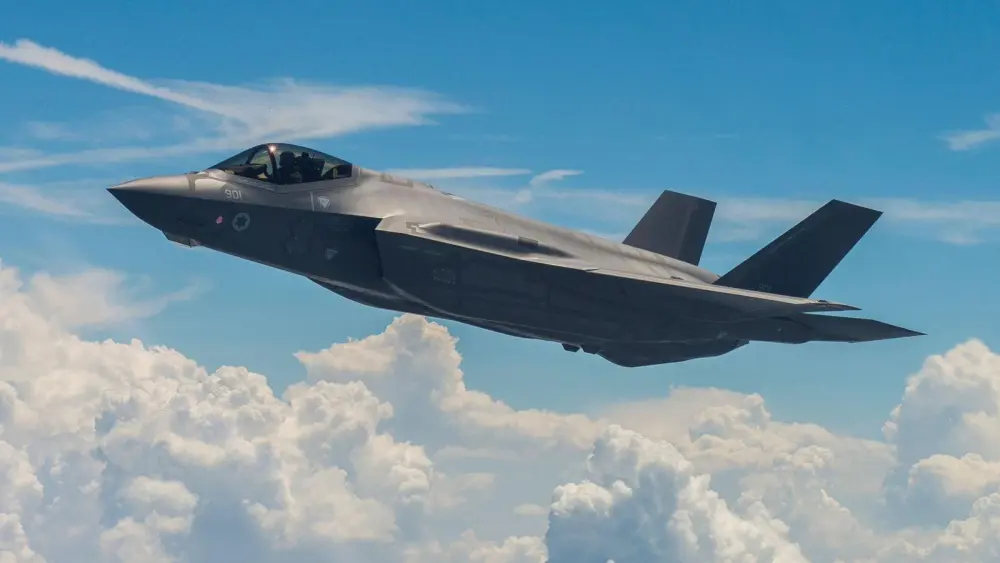

The Israel Defense Forces launched extensive retaliatory airstrikes overnight on Monday against Iranian strategic air-defense networks and missile-material production facilities, following Iranian missile attacks on Israeli cities that began on Sunday night.
“At 4:10 a.m., dozens of Israeli aircraft struck the Iranian regime’s air-defense system. And I just want to remind that we previously disabled Iranian air-defense systems, and since then they’ve been attempting to restore and rebuild their military capabilities. So last night, those systems were struck again and some of them were fully dismantled,” and Israeli military official told journalists, addressing the overnight retaliation.
According to IDF assessments, Iranian air-defense systems were recently placed in a number of different areas in Iran, as part of the regime’s efforts to rehabilitate detection and defense capabilities damaged during the IDF’s “Operation Roaring Lion,” which lasted from February 28 to April 8.
The official commented on the broader internal priorities of the regime, adding, “It’s not a secret that the economic situation in Iran is awful. And instead of investing their resources in their people, they’re investing them in spreading their terror more.”
The IDF source outlined a second wave of Israeli strikes focusing on industrial supply lines within the Islamic Republic.
“Again, later on this morning, we conducted a strike on the petrochemical complex in Mahshahr in southwest Iran. In this complex, chemical materials are produced and used for ballistic missiles that are fired toward the state of Israel. The strikes and the damage to the complex disrupt their ability to manufacture various types of weapons that they use against countries like Israel, but also against the whole Middle East,” the official said.
Transitioning to northern-border operations, the official provided new details on the major Hezbollah subterranean site announced by the military on Sunday after it was discovered at Beaufort Ridge in Southern Lebanon. The source described this as “a strategic place for Hezbollah, from which it is operating. It’s gathering intelligence and watching us from there, planning more direct attacks on Israel.”
“We will not allow Hezbollah or any terrorist organization to plan or carry out attacks on our civilians, whether from the villages or on the border or the heart of Beirut. We remain deployed on our borders, ready for both defensive and offensive operations. And we will continue to operate according to the directives of the political leadership. Over the past day, the IDF chief of staff has spoken twice to the commander of CENTCOM and they are discussing the situation,” said the official.
A senior IDF officer present at the briefing also described the active defense cooperation with Washington during the recent combat, stating that, similar to “Operation Roaring Lion,” “there are American representatives from the U.S. military sitting in the operations control center in IDF Headquarters in Tel Aviv, and Israeli representatives in the U.S. Air Force base in Florida.
The officer rejected any attempts by Tehran to restrict Israeli offensive decisions.
“We have no equations,” he said. “The Iranians are trying to limit us to equations, but we will not let them produce a new reality in the Middle East.”
The briefing concluded with an outline of the current state of aerial operational theater: “The strikes that were completed assist to deepen even further the freedom of action of the air force in the skies of Iran,” said the IDF source.
Israeli Defense Minister Israel Katz issued an official policy statement outlining Israel’s strategic parameters for both the Lebanese and Iranian fronts, stating, “The fate of the Dahiyeh [Hezbollah headquarters] in Beirut is as the fate of the communities of the north.”
He defined the military’s retaliatory framework for cross-border infrastructure, adding, “Every strike on the communities of the north will lead to a strike in the Dahiyeh.”
“The IDF will continue to act in Lebanon against the Hezbollah terror organization,” Katz affirmed, adding, “We reject outright the threats of Iran. Every Iranian attempt to make a link between Lebanon and Iran and to attack Israel will be answered with great force, as happened yesterday.”


