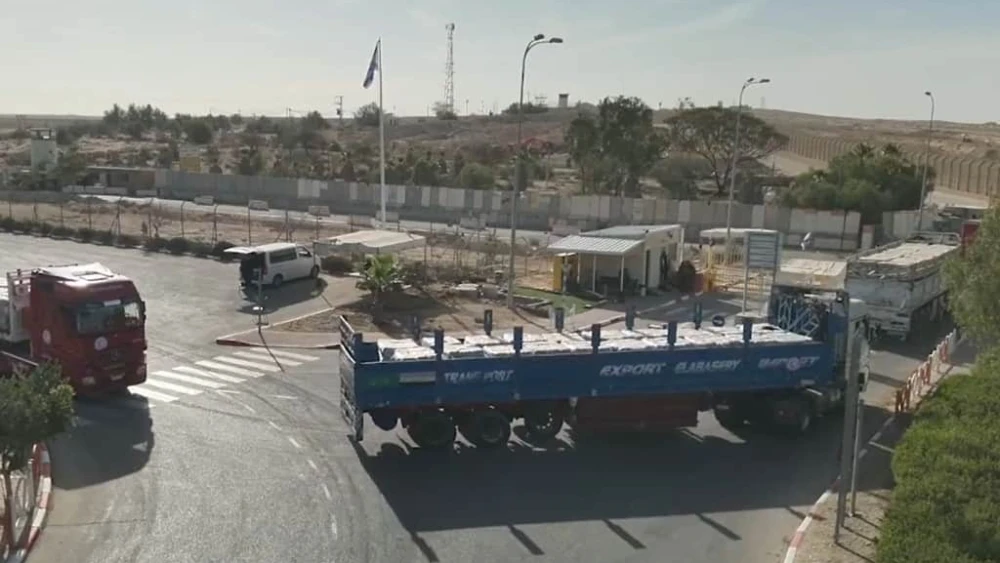

As Israel’s war with Hamas rolls on, the strategic importance of the Philadelphi Corridor, an Israeli codename for a 8.7-mile long border area between Gaza and Egypt, has come into sharp focus.
Initially established as a buffer zone controlled by Israeli forces under the 1979 peace treaty with Egypt, the area became a point of contention following Israel’s withdrawal from the Gaza Strip in 2005.
Since Hamas’s takeover of Gaza in 2007, the Philadelphi Corridor has been a critical arms smuggling route for the terror group. Israeli government representatives have repeatedly emphasized the need to secure this area to ensure the demilitarization of Gaza and prevent the inflow of weapons and other materials to Hamas. At the same time, Egypt has voiced its fierce opposition to such a move, warning of major consequences for Egyptian—Israeli relations.
Senior research scholar Ely Karmon of the International Institute for Counter-Terrorism at Reichman University in Herzliya told JNS, “There is no doubt that control of the Philadelphi Corridor is important now and especially in the future to ensure prevention of Hamas’s rearmament.”
Karmon added that the Egyptians “made an effort to close most of the tunnels” running under the corridor, and even built a canal to prevent the construction of new tunnels. This arose from Egypt’s supreme interest in preventing a link between Gaza and Islamic State in Sinai, with Hamas collaborating with the jihadists in smuggling weapons, and even providing medical treatment in Gaza for injured ISIS members.”
Egypt was also alarmed by the prospects of military aid provided by Hamas to the Muslim Brotherhood in Egypt after the downfall of the Brotherhood government led by Mohammed Morsi in 2013, said Karmon.
“This caused several crises between Egypt and Hamas. The operational question remains whether Hamas has built new tunnels under the water barrier, including through cooperation with supportive or corrupt elements in Egypt,” he said. “What we have discovered since the war regarding the tunnel project in Gaza clearly shows they have the capability. I certainly raise the scenario that the Hamas leadership along with several hostages have already been transferred there,” Karmon cautioned.
According to professor Eyal Zisser, vice rector of Tel Aviv University and chair of Contemporary History of the Middle East, “Through this route, a large part of Hamas’s advanced weaponry was smuggled from Egypt. This was during the years of anarchy in Egypt following the Arab Spring, with weapons smuggled from Iran via Sudan to Egypt and from there to Gaza. Today, the Egyptian army is effectively acting against smuggling, but to ensure that Hamas has no smuggling route, Israel needs to efficiently control the main entrance to the Strip.”
Zisser assessed that “the problem of the Egyptians is not that Israel is striking Hamas, but the Egyptian fear regarding the fleeing of Palestinians into the heart of Sinai; they want to prevent this. In Rafah today, there are masses of refugees, and the Egyptian fear is that an Israeli military operation in Rafah will drive them into Sinai,” he said.
He added that if Israel coordinates its military operation with Egypt and ensures that Gazans do not flee into Sinai, the Egyptians will likely not oppose it, being satisfied with publicly condemning Israel.
“The Egyptian statements are theatrical, for the sake of public opinion in Egypt. Egypt does not sympathize with Hamas’s plight. But for the Egyptians, the escape of refugees into the heart of Sinai is a red line because it is a danger to stability in Egypt. Therefore, on this issue, they are definitely serious. And as mentioned, a solution can be found that meets the needs of Israel and the concerns of Egypt,” Zisser argued.
Meanwhile, Israeli-Egyptian diplomatic efforts are likely quietly continuing to resolve the issue.
Israel appears determined to eventually seize control of the Philadelphi Corridor, which is pivotal to achieving its long-term goal of ensuring that Hamas does not rebuild its future genocidal terror army.