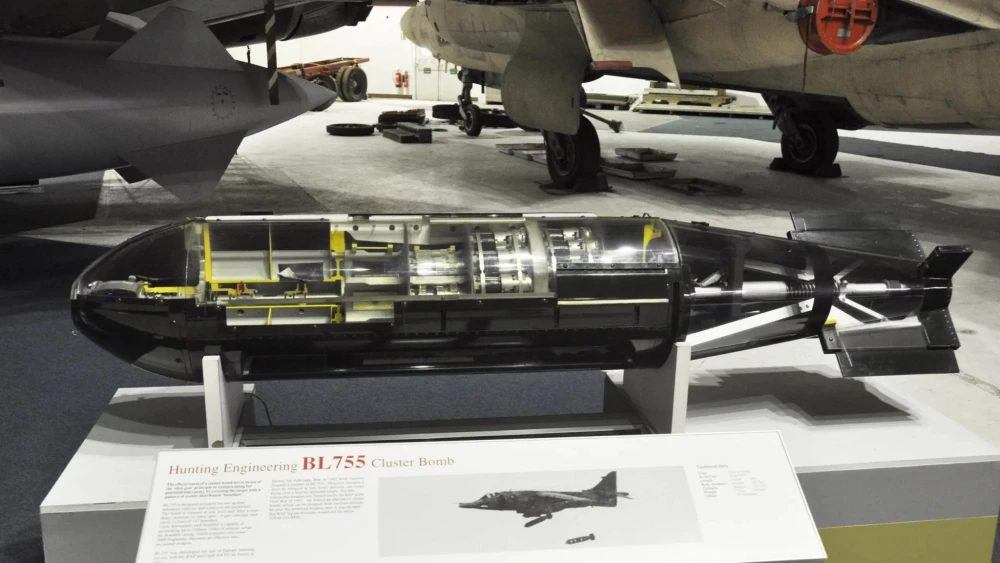
Iran’s use of cluster munitions has become a dominant feature in its conduct of warfare against Israel and many of its neighbors in the Gulf states.
International law does not prohibit the lawful use of cluster munitions—it acknowledges that such munitions may be used against purely military targets such as military air strips and strategic and tactical bases. States, including the U.S. and Israel, employ such weapons for military purposes.
However, their use in an indiscriminate manner that could endanger civilians and civilian locations is strictly forbidden and constitutes a violation of international humanitarian law.
Iran is not a party to the 2010 Dublin Convention on Cluster Munitions, in which 112 states committed never to use such weapons. But Iran’s widespread and indiscriminate use of cluster bombs constitutes a clear violation of customary international humanitarian norms.
Similarly, the employment of this munition by the Shi’ite terrorist organization Hezbollah from Lebanese territory represents a violation of Lebanon’s commitments, as a party to the convention, not to enable armed groups on its territory to use these weapons.
This, in addition to the basic violation by Lebanon of the terms of the 2024 cease-fire accord with Israel, mediated and supervised by France and the U.S., by which it committed to preventing Hezbollah and all other armed groups from operating against Israel.
The use of cluster munitions is regulated in the Convention on Cluster Munitions, adopted on May 30, 2008, in Dublin. It entered into force on Aug. 1, 2010.
The states party to the convention are committed to refrain from using, developing, producing, acquiring, stockpiling or transferring to anyone, directly or indirectly, cluster munitions.
Currently, 112 states are parties to the convention, including Japan, Australia, Iraq, Lebanon, Canada, most of the Europeans and … Palestine, which acceded on Jan. 2, 2015, declaring that it does not maintain cluster weapons and has no victims of such weapons.
Seventy-three states are not party to the convention, including the U.S., Israel, China, Russia, Saudi Arabia, Qatar, Kuwait, Syria, India, Pakistan, Turkey, Egypt, Morocco and Iran.
Legality
In its second preambular paragraph, the convention seeks to “put an end to the suffering and casualties caused by cluster munitions at the time of their use, when they fail to function as intended or when they are abandoned.”
Thus, while cluster munitions, per se, are not declared by the convention to be illegal, the states choosing to become party to the convention nevertheless commit to refraining from using them.
As such, the convention does not reflect customary international law prohibiting the use of cluster munitions, as long as they are used in accordance with the accepted norms of armed conflict and directed at legitimate military targets.
One of the principal international humanitarian law norms of armed conflict is that of distinction, requiring an attacker to distinguish between combatants and noncombatants. Cluster munitions targeting a purely military target, such as the runway of an air force base (and similar targets), are not problematic. But when fired at mixed targets where combatants and noncombatants are in close proximity, and the munitions do not distinguish, then their use violates the international law principle of distinction.
As stated in the preamble to the convention, the indiscriminate use of cluster munitions against targets that are not strictly military targets causes suffering and casualties among the civilian population, as is patently evident by the widespread Iranian use of such weapons against Israel’s civilian population centers, as well as against Iran’s neighbors among the Gulf states.
Israel
Israel chose not to become party to the convention, maintaining that the military utility of cluster munitions is necessary in Israel’s immediate strategic and tactical circumstances, and that such munitions are needed for addressing specific operational needs against area targets and mobile missile launchers and for deterring large-scale conventional attacks along its borders.
In this context, Israel has declared consistently that its use of such weapons is strictly directed toward legitimate military targets, and in no way is directed indiscriminately with the aim of harming civilians. This position was based on the proviso that use of such weapons, if directed solely at legitimate military targets and with the aim of minimizing civilian harm as required by international humanitarian law, does not violate the customary international law prohibition on the use of weapons with indiscriminate effects.
The U.N. General Assembly annually urges states to accede to the convention, the last time being in Resolution 79/58 on Dec. 2, 2024, titled “Implementation of the Convention on Cluster Munitions.” Israel usually abstains from the vote on such resolutions together with the U.S., Iran and others. Russia voted against.
According to the NGO Landmine and Cluster Munitions Monitor, which tracks adherence to and compliance with the relevant international instruments, Israel has developed, produced, exported and acquired cluster munitions, and hosts U.S. stocks. Israel has licensing agreements for production and assembly of such munitions with Germany, Switzerland, Turkey, the U.K. and the U.S.
Iran
During the ongoing as well as the previous hostilities, Iran has been indiscriminately and deliberately firing cluster munitions on a large scale against Israeli residential areas.
As reported by Amnesty International, Iranian missiles release dozens of small explosive bomblets over large areas, sometimes across several kilometers, covering several areas of civilian settlement. Those bomblets that fail to detonate continue to endanger the local population as they remain on the ground as dangerous unexploded ordnance.
Indiscriminate use of cluster munitions against civilian populations represents a prima facie grave violation of customary rules of international humanitarian law, irrespective of whether a state is, or is not, a party to the Convention on Cluster Munitions, since customary international law applies to all states and combatant elements in armed conflict.
Referring to such indiscriminate use by Iran, Amnesty International’s senior director for research, advocacy, policy and campaigns, Erika Guevara Rosas, stated in July 2025:
Cluster munitions are inherently indiscriminate weapons that must never be used. By using such weapons in or near populated residential areas, Iranian forces endangered civilian lives and demonstrated clear disregard for international humanitarian law.
Civilians, particularly children, are most at risk of injury or death from unexploded submunitions. Iranian forces’ deliberate use of such inherently indiscriminate weapons is a blatant violation of international humanitarian law.
Customary international humanitarian law prohibits the use of inherently indiscriminate weapons, and launching indiscriminate attacks that kill or injure civilians constitutes a war crime.
While, as stated above, Iran is not party to the convention, its deliberate, widespread and indiscriminate use of cluster munitions targeting Israel’s civilian locations, as well as civilian locations in other neighboring countries, represents a clear and grave violation of the norms of international humanitarian law and international practice, that obligate all states to avoid military actions of an indiscriminate nature targeting and endangering civilian concentrations.
In light of Iranian violations, there exists every legal necessity and justification to make appropriate representations to the international community, its institutions, and to the international media, and to provide evidence of such misuse by Iran.
It would certainly be appropriate for Israel to address a complaint to the U.N. Security Council and international humanitarian monitoring bodies, even if the chances of anything being done by them would be slim.
Lebanon
The use by Hezbollah of Lebanese sovereign territory to bombard Israel’s civilian areas with cluster munitions represents a clear violation of Lebanon’s sovereign obligation as a signatory party to the Convention on Cluster Munitions to prohibit the use of such munitions from its territory.
Furthermore, in ratifying the convention on Nov. 5, 2010, Lebanon knowingly accepted the call, in the 12th preambular paragraph of the convention, “that armed groups distinct from the armed forces of a State shall not, under any circumstances, be permitted to engage in any activity prohibited to a State Party to this Convention.”
In its ratification of this convention, Lebanon attached a declaration that it does not have cluster munition stockpiles, and accepted the obligation to ensure clearance of remnants in its territory by May 2026.
The NGO Human Rights Watch had earlier confirmed Hezbollah’s deployment of the Chinese-made Type-81 122 mm rocket with cluster munitions. HRW documented two Type-81 cluster strikes that took place on July 25, 2006, in the Israeli town of Maghar in the Galilee.
In an Oct. 18, 2006, news release, HRW stated:
International humanitarian law obliges warring parties to distinguish between combatants and civilians and, when attacking legitimate military targets, to ensure that the military advantage gained in the attack outweighs any possible harm caused to civilians. Hezbollah launched cluster attacks that were at best indiscriminate, i.e., they violated the principle of distinction by using unguided and highly inaccurate cluster munition models against populated areas. At worst, Hezbollah deliberately attacked civilian areas with these weapons.
In September 2024, the Cluster Munition Coalition warned against the use of cluster munitions by any actor under any circumstances as armed conflict escalated between Israel and Hezbollah forces in Lebanon. The Cluster Munition Coalition noted that a photograph purportedly taken in Southern Lebanon, which was circulated on social media, appeared to show a dual-purpose improved conventional submunition of Chinese manufacture.
Conclusion
Tragically, by its very nature, armed conflict conducted in most areas in today’s realities, together with the advanced technological attributes of the weaponry being used, endangers civilians.
International humanitarian law has traditionally attempted to reduce the extent of danger to civilians in armed conflict and especially to prohibit warring elements, whether states or terror groups, from maliciously, deliberately and indiscriminately targeting civilians and civilian population centers. This is with the aim of ensuring that any military advantage gained in an attack must limit any possible harm to civilians.
The malicious, deliberate and indiscriminate targeting by Iran and by its proxy Hezbollah of Israel’s civilian areas, as well as civilian areas in other neighboring states, intending to instill fear and terror among the civilian population and thereby gain military advantage at the expense of the civilian population, clearly violates all humanitarian norms and is absolutely prohibited.
It remains to be seen whether the international community, rather than seeking to assuage and mollify the aggressors and bury its collective heads in the sand, will display the essential political courage, genuine will and practical capability to confront such malicious violations in an assertive, productive and impartial manner.
Originally published by the Jerusalem Center for Security and Foreign Affairs.