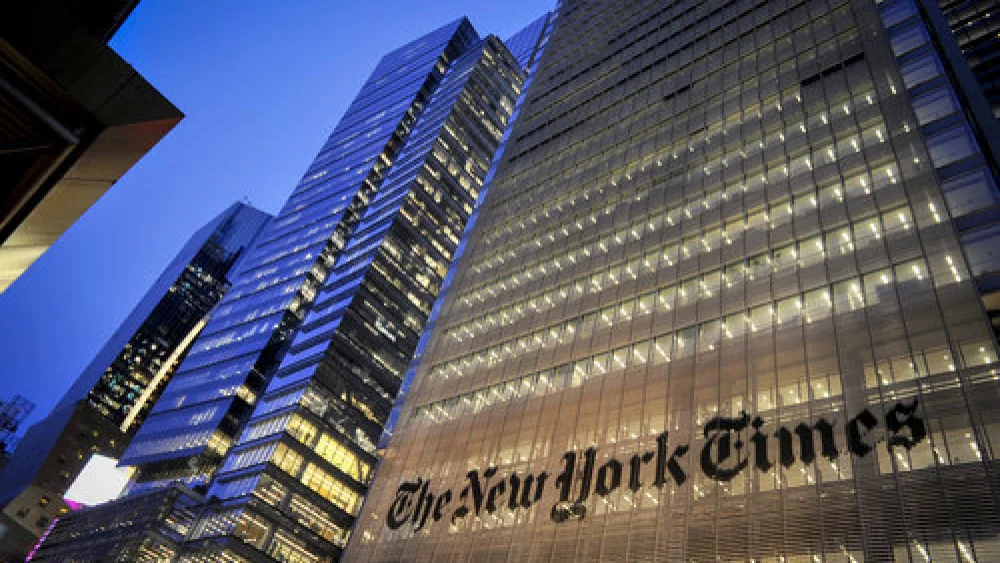
The New York Times issued an official apology on April 28 over their publishing of an anti-Semitic cartoon on April 25.
The cartoon, which appeared in the Times’ international edition above a column about immigration from Thomas L. Friedman, showed U.S. President Donald Trump wearing a kipah and sunglasses being guided by a dog with Israeli Prime Minister Benjamin Netanyahu’s head.
In a statement on Sunday, the Times said it was “deeply sorry” about the cartoon. The statement followed an earlier one on April 27 acknowledging that its publication had been “an error of judgment.”
“We have investigated how this happened,” read Sunday’s statement, “and learned that, because of a faulty process, a single editor working without adequate oversight downloaded the syndicated cartoon and made the decision to include it on the Opinion page. The matter remains under review, and we are evaluating our internal processes and training. We anticipate significant changes.”
Many were not satisfied by the paper’s response.
Anti-Defamation League director Jonathan Greenblatt said via social media that the apology was “insufficient.”
“New procedures obviously are needed but @nytimes must do more,” Greenblatt wrote on Twitter, going on to suggest that the Times start implementing “sensitivity training for their staff on #antiSemitism” and “educate readers on the persistent poison of anti-Jewish hate.”
Times columnist Bret Stephens wrote in an April 28 op-ed that the Times’ decision to publish the cartoon reflected “an astonishing act of ignorance of anti-Semitism—and that, at a publication that is otherwise hyper-alert to nearly every conceivable expression of prejudice, from mansplaining to racial microaggressions to transphobia.”
“Imagine, for instance, if the dog on a leash in the image hadn’t been the Israeli prime minister but instead a prominent woman such as Nancy Pelosi, a person of color such as John Lewis, or a Muslim such as [Minnesota Congresswoman] Ilhan Omar,” wrote Stephens. “Would that have gone unnoticed by either the wire service that provides the Times with images or the editor who, even if he were working in haste, selected it?”
Stephens added that “the mainstreaming of anti-Zionism, including by this paper” has resulted in anti-Semitism being viewed “as a form of political opinion, not ethnic prejudice.”