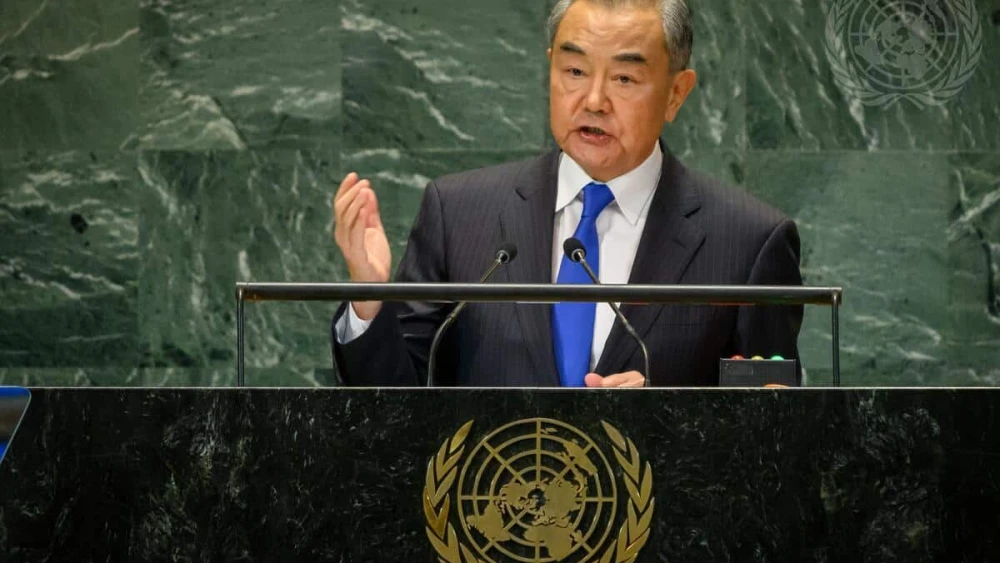
China’s Foreign Minister Wang Yi on Monday pledged his country’s support for Lebanon and objection to “indiscriminate attacks on civilians.”
During a meeting with Lebanese Foreign Minister Abdallah Bou Habib on the sidelines of the 79th U.N. General Assembly in New York, Wang said, China would continue to stand on the “side of justice and on the side of Arab brothers, including Lebanon.”
Beijing, he continued, was paying “close attention to the development of the regional situation, especially the recent explosion of communication equipment in Lebanon, and firmly [opposed] indiscriminate attacks on civilians.”
On Sept. 17, thousands of pagers used by Hezbollah terrorists simultaneously exploded, killing at least 12 and wounding more than 3,000. A day later, hand-held radios used by the terror group also detonated.
Hezbollah has blamed Israel for the targeted attack, but Jerusalem has not acknowledged responsibility.
Over the past 24 hours, Israel has carried out 1,600 targeted strikes against the Iranian terror proxy. The Israeli military has issued thousands of warnings to Lebanese civilians to flee areas known to house Hezbollah weapons caches, via telephone, the internet and radio.
The terror group stores missile stockpiles and launchers in civilian neighborhoods and buildings, endangering Lebanon’s civilian populace, according to the Israel Defense Forces.
The Israeli Prime Minister emphasized in a video statement directed to the Lebanese people on Monday that “Israel’s war is not with you, it’s with Hezbollah.”
Israel has been under continuous missile attack from Hezbollah in Lebanon since Oct. 8, 2023, one day after Hamas invaded Israel’s south, killing 1,200 Israelis.
“Fighting violence with violence will not solve problems in the Middle East, but will lead to greater humanitarian crises,” Wang said during his meeting with Habib, according to a statement from his ministry.
China’s position is for a permanent Gaza ceasefire and the withdrawal of Israeli troops to make way for a two-state solution, he added.
Earlier this week, Beijing called on its citizens to leave Israel, describing the situation along the border with Lebanon as “extremely tense, with frequent military conflicts.”
“The security situation in Israel remains severe, complex, and unpredictable,” according to a statement issued by China’s Embassy in Israel on Sunday. As such, Chinese citizens are urged to “return home or relocate to safer areas as soon as possible.”