


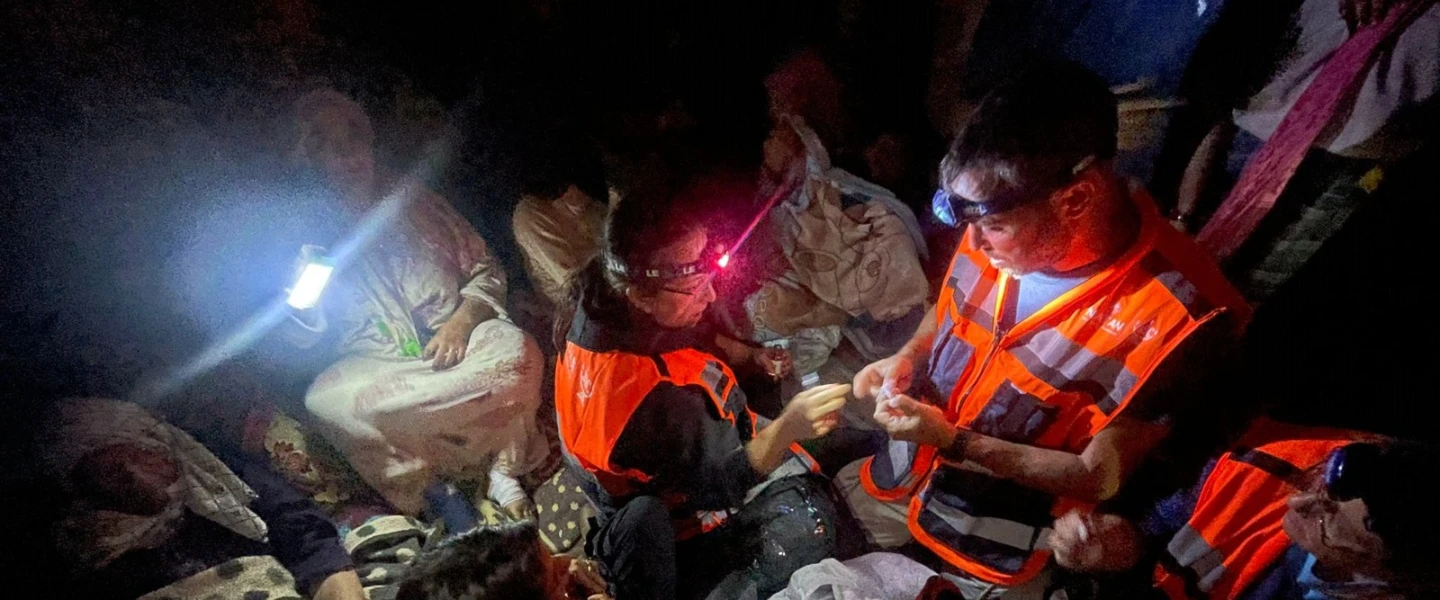
Despite the absence of formal diplomatic relations between Israel and Venezuela, Israeli humanitarian teams have once again entered a crisis zone where official channels do not exist, arriving not as diplomats, but as medical responders operating outside formal state frameworks.
Following two powerful earthquakes that struck Venezuela on June 24, killing thousands and overwhelming local emergency systems, Israeli organization NATAN Worldwide Disaster Relief—along with several other groups—dispatched an emergency medical team to the Caracas region as part of a wider Israeli humanitarian response already taking shape through non-governmental networks.
The tremors, measuring 7.2 and 7.5 on the Richter scale and striking within seconds of each other, caused widespread destruction and triggered urgent search-and-rescue operations, as hospitals across affected areas struggled to cope with mass casualties.
For Israeli responders, the deployment is shaped not only by the scale of the disaster, but by the absence of formal diplomatic ties between Jerusalem and Caracas.
“When a disaster of this magnitude strikes, there is no time to hesitate,” Alice Miller, CEO of NATAN Worldwide Disaster Relief, told JNS. “Twenty years of experience have taught us that the first hours are what matter most—medically and psychologically alike.”
Humanitarian aid in the absence of diplomacy
In countries where Israel has no formal diplomatic relations, humanitarian operations often become one of the only practical forms of contact between systems that do not formally interact.
Miller said this dynamic has become central to NATAN’s operating model.
“We do not arrive with flags first,” she said. “We arrive with medicine, listening, and respect. That is often the strongest form of diplomacy.”
She emphasized that the work is not political but acknowledged its broader effect.
“The mission is first of all medical. We go because people need care, not because we are trying to make a political statement,” she said. “But it would be dishonest to say there is no diplomatic effect.”
“In places where people have never met Israelis, or where Israel is seen only through conflict and politics, the experience of being treated by an Israeli doctor or nurse can change something very basic. It does not solve geopolitics, but it creates a human encounter that is real.”
For Miller, the idea of operating in diplomatic “blank spaces” fits a career shaped by engineering, aviation, and systems thinking.
Before leading NATAN Worldwide Disaster Relief, she worked as an Israeli Air Force (IAF) engineer and later in the space industry, fields defined by precision and operating under pressure.
She is also widely known in Israel for her successful legal challenge that opened IAF pilot training to women, a landmark Israeli civil and women’s rights Supreme Court ruling that reshaped military aviation policy. She later became a civilian pilot.
That background, she said, shapes her approach to humanitarian work.
“NATAN made sense to me because it combines operational discipline with humanitarian purpose,” she said. “It is fast, practical, and professional, and it allows Israelis to bring their skills to people in crisis.”
Symbolically, her decision to take up the role with NATAN came after the Hamas massacres of October 7, 2023.
“I did not see this as leaving Israel’s recovery,” she added. “I saw it as part of Israel’s recovery- showing that even after our own trauma, we can still respond to suffering with competence, compassion, and humanity.”
A model built for gaps in the system
NATAN Worldwide Disaster Relief operates with small, specialized teams designed for the earliest phase of disasters, when large humanitarian systems are still mobilizing or constrained by access and infrastructure.
The organization has previously worked in Ukraine, Mozambique, and near the Syrian border, and maintains ongoing activity along the Venezuelan-Colombian border, supporting migrant populations.
Miller pointed to Ukraine as a defining example.
“NATAN did not arrive as a massive system with heavy infrastructure,” she said. “It arrived with focused teams that knew exactly what they could do: provide medical care, psychosocial support, and continuity in a chaotic refugee setting.”
The same approach is guiding the Venezuela deployment: identify gaps quickly, deploy narrowly, and avoid duplicating larger institutional efforts.
First steps in Venezuela
NATAN’s initial assessment team left on Saturday night for Venezuela, with a second wave of professionals expected to follow based on findings in the field.
“The first 48 hours will be practical and focused,” Miller said. “Assess the situation, connect with local authorities and partners, understand where the gaps are, and decide where we can add the most value.”
Depending on needs on the ground, teams may establish mobile clinics, support overwhelmed hospitals, or expand outreach to underserved communities.
Despite the absence of diplomatic relations between Israel and Venezuela, multiple Israeli humanitarian organizations are already active or preparing deployment through established international partnerships and local networks.
IsraAID is sending emergency response teams from its regional base in Colombia, focusing on psychological first aid, mental health support, and water, sanitation and hygiene (WASH), alongside local partners with established relationships in Venezuela.
SmartAID is working through in-country partners to assess urgent needs and prepare delivery of emergency equipment and supplies.
The American Jewish Joint Distribution Committee, together with the Venezuelan Jewish community, is already providing immediate humanitarian support including food, water, medicine, and shelter, and is preparing to expand operations once access improves.
Lihi Levian Yaffe, director of humanitarian assistance at SID Israel, said the response reflects long-term infrastructure rather than crisis improvisation.
“Humanitarian organizations don’t build emergency response capacity when disaster strikes- they build it over many years,” she said. “Even in complex environments like Venezuela, Israeli organizations are able to rely on established partnerships and trusted networks to respond within hours.”
A recurring Israeli role in global crises
For NATAN, the Venezuela deployment reflects a broader pattern of Israeli humanitarian engagement in places where formal diplomatic frameworks do not exist, but urgent human needs do.
As Miller put it, the organization’s identity is rooted in professional capability paired with civic responsibility.
“Israel has so many strengths, and two of the most important are professionalism and volunteering,” she said. “We understand very deeply what it means to have doctors, nurses, and social workers stand by you when everything familiar breaks down.”



