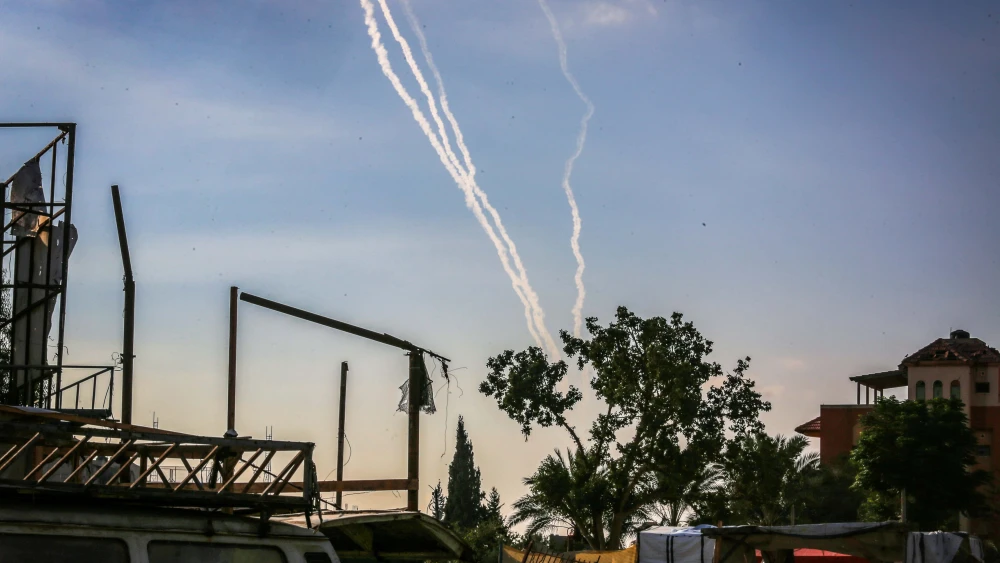

On Jan. 6, terrorists in northern Gaza fired three rockets toward Sderot, Ibim and Nir Am, one of which was intercepted by the Israeli Air Force, with the other two causing damage but no injuries. The attack came after days of sirens in southern Israel, only some of which were false alarms.
These incidents underline the vastly reduced yet persistent threat posed by Hamas and Palestinian Islamic Jihad (PIJ), whose rocket arsenals and operational capabilities have been significantly degraded since the start of the war on Oct. 7, 2023.
At the start of the war, Hamas and PIJ reportedly held 15,000 rockets and a five-brigade, division-strong invasion force capable of seizing Israeli territory and committing massacres. Today, their remnants consist of scattered guerrilla cells with small arms, rocket-propelled grenades and explosives—as well as a handful of projectiles. Israeli assessments suggest that these groups collectively have no more than dozens of rockets left, perhaps as many as 100.
However, professor Kobi Michael, a senior researcher at the Tel Aviv-based Institute for National Security Studies and the Misgav Institute for National Security and Zionist Strategy in Jerusalem, believes it may be more than a handful.
“I think it’s more than dozens. I think we’re talking about a few hundred rockets. We have to remember that Hamas prepared in advance for launching very large barrages at Israel, and hence, many rockets were prepared ahead of time,” including in underground locations and in orchards, he told JNS.
Michael described the recent launches as the Gaza terrorist groups’ final performance, arguing that in the war’s aftermath they will not regain the ability to flood Israeli skies with rockets, retaining only the ability to sporadically launch a projectile.
Currently, the vast majority of the Hamas and PIJ arsenal has been destroyed, said Michael. He noted also that some of its precious few remaining rockets are being launched as IDF forces close in on them.
While Hamas retains small arms, TNT, and, potentially, the capacity for extremely restricted rocket production, “Compared to what they had in October, and even after Oct. 7, we’re talking about completely minimal capabilities,” he said.
IDF operations in northern Gaza since the ground operation there began on Oct. 27 have focused on clearing key areas such as Beit Hanoun and Jabalia of remaining Hamas elements. On Jan. 5, Israel’s Army Radio reported that rockets fired at the Erez Crossing had originated in Beit Hanoun, where the IDF’s Nahal Brigade had been operating.
A joint statement by the IDF and Israel Security Agency (Shin Bet) on Jan. 5 detailed recent strikes on over 100 Hamas targets, resulting in the elimination of dozens of operatives and the destruction of rocket launch sites. These types of operations, combined with precision strikes and intelligence efforts, have diminished Hamas’s ability to operate freely in the northern Gaza Strip.
While the IDF has made substantial progress in northern Gaza, new challenges are emerging in Gaza City, south of that area, Michael said. “They will try to regroup and rebuild capabilities in areas where we are less present, and we must be vigilant,” he told JNS.
The IDF’s responses would include continuous intelligence monitoring and targeted operations, he added.
Despite their diminished arsenals, sporadic rocket fire continues, and remains a threat that must be taken seriously, he told JNS. “Even a single rocket that is not intercepted can cause damage and casualties, as we saw in Sderot,” he said.
“We need to be prepared for occasional rocket fire even after the war concludes,” he cautioned. He emphasized that intelligence and operational freedom would allow Israel to maintain pressure and respond swiftly to any renewed threats.
During a Jan. 2 call organized by the Washington D.C-based Jewish Institute for National Security of America (JINSA), Maj. Gen. (ret.) Amikam Norkin, former commander of the Israeli Air Force, emphasized the ongoing need for military operations in Gaza, stating, “The IDF will be launching military operations against terrorists in Gaza every few weeks.”
Maj. Gen. (ret.) Yaakov Amidror, former national security adviser to Prime Minister Benjamin Netanyahu, stated on the same call, “I think that we succeeded in neutralizing Hamas as a military terrorist organization, but still Hamas is strong inside Gaza.” Amidror suggested that neutralizing Hamas entirely would take at least a year of sustained efforts, including targeting its leadership and infrastructure.
Amidror also raised the issue of governance post-conflict, asserting, “When it will not be relevant inside Gaza, we can call a third party to come into Gaza and take control of the civilian side. Until then, no one [externally] will be ready to take responsibility.”
On Jan. 4, IDF engineering units uncovered and destroyed a Hamas tunnel in central Gaza containing manufacturing facilities for munitions and explosives. The operation underscored ongoing efforts to dismantle the group’s remaining rocket production infrastructure.