Hamas had closely followed 100,000 Israeli troops on social media and other networks for years before executing the Oct. 7, 2023, massacre, meticulously collecting information about Israel Defense Forces posts along the border, including how to operate Israeli tanks, Israel’s Army Radio correspondent Doron Kadosh reported on Sunday.
The terrorist organization established an array of some 2,500 members who took part in gathering data online, piece by piece, for five years before the attacks on the northwestern Negev, according to Kadosh.
This intelligence apparatus tracked Israeli soldiers on social media, created fake accounts—such as a WhatsApp group for recruits into an elite IDF combat unit—and gained access to soldiers and officers who shared seemingly trivial data such as random photos and videos from their bases.
“By cross-referencing photos and videos taken inside bases—from soldiers’ TikToks to images from beret ceremonies or discharge events—Hamas built precise models of IDF positions: where the rear gate was, where security cameras were placed, where the rapid response team was stationed, and where the armory was located,” tweeted Kadosh.
“Using this information,” the correspondent continued, “Hamas built maps, simulations, and even simulators. It purchased a 3D simulation software at full 1:1 scale, and constructed simulators of bases and outposts. Nukhba terrorists could put on virtual-reality headsets in Gaza and rehearse their infiltration of each outpost.”
He went on to report that the Israeli intelligence community knew about Hamas’s project, but “did not imagine” how accurate it was.
An officer in the Israeli Air Force, who saw Hamas’s preparations to raid a base he served at, told Kadosh, “Hamas knew this base better than I did.”
Hamas’s intelligence unit managed to join WhatsApp groups related to the IDF. For example, it joined a recruitment group belonging to the Egoz commando unit, the report continued.
This way, Hamas tracked individuals over the course of years, seeing them become commanders and officers, in what provided a broad picture of almost every platoon or battalion in the IDF.
Hamas “produced daily reports on routine IDF activity: where each platoon was located, where every Iron Dome battery was positioned, and whether the IDF had made changes in its force deployment or quietly moved forces from one sector to another. Cross-referencing the thousands of information items flowing in from the networks enabled them to obtain sensitive information about sensitive IDF systems and units,” according to Kadosh.
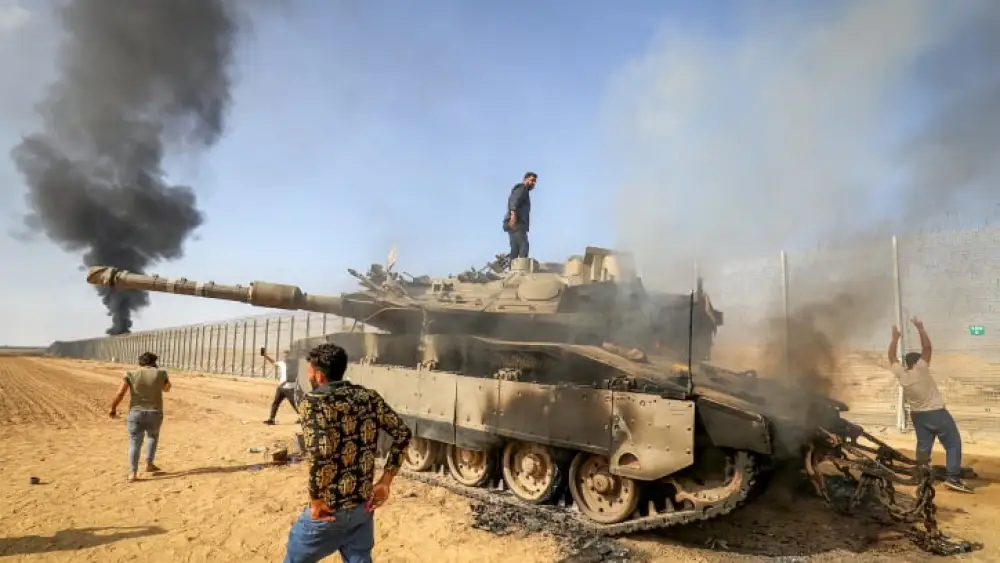
The terrorist group even put together a special force that was trained to operate the Israeli Merkava tank. Through an advanced simulator program and a long period of training, this special Nukhba force managed on Oct. 7, 2023, to disable IDF tanks in the Gaza border area and render them unusable, the report stated.
“The terrorists knew about a secret button in the tank which, when pressed, disables the tank for a certain period,” noted Kadosh.