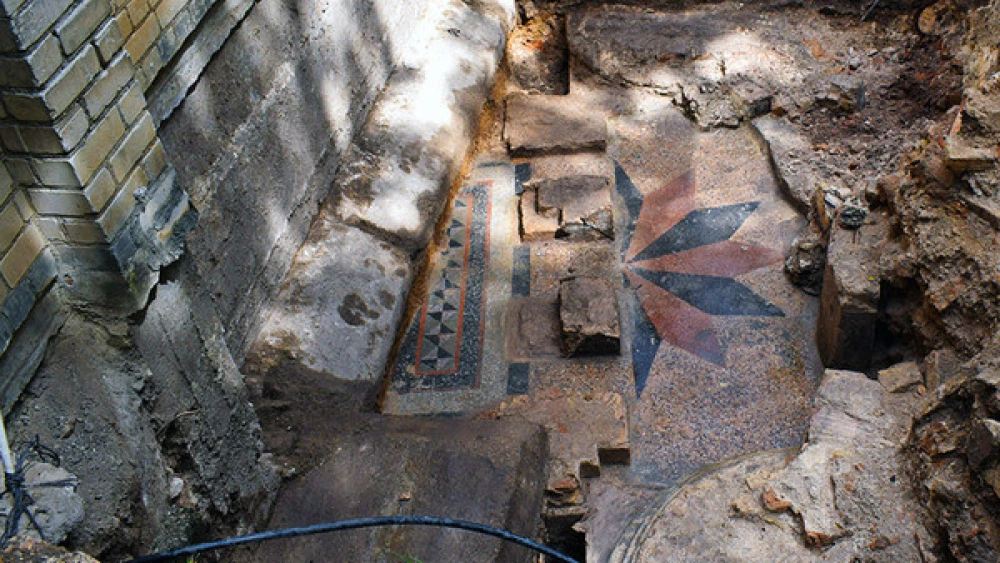
Hebrew inscriptions were discovered for the first time since the beginning of the excavation project to expose the Great Synagogue of Vilna, Lithuania, which was burned during the Holocaust and demolished by the Soviets.
According to the researchers, Jon Seligman of the Israel Antiquities Authority and Justinas Račas of the Kultūros paveldo Išsaugojimo pajėgos of Lithuania, who have conducted excavations in Lithuania every summer for the last four years, “the large and significant inscription, dated to 1796, was part of a stone Torah-reading table that stood on the magnificent bimah of the synagogue in Vilnius.”
The table was donated, according to the text, by two brothers: Rabbi Eliezer and Rabbi Shmuel. It stands in memory of their mother, Sarah, and their father, Rabbi Chaim, who, according to the inscription, had emigrated from Lithuania to Israel and settled in Tiberias.
It was from this table that the Torah was read to the congregants for about 200 years until the burning of the synagogue and its final destruction by the Soviets 70 years ago.
The inscription, which was studied together with Vladimir Levin of the Hebrew University of Jerusalem, reads: “In the year ‘Raise us with joy to our country’ [1796], [This Torah reading table] was donated by R. Eliezer and R. Shmuel, the sons of R. Chaim who lived in Tiberias, be it rebuilt and reestablished soon in our days. ‘And died Sarah’ [Gen. 23:2] our mother, the daughter of R. Shabbtai, on the 4th of Adar ‘I gave to Jerusalem a messenger of good news’ [Is. 41:27] [=1782] and our father R. Chaim son of R. Chaim died there on the 7th of Nissan ‘arise and have mercy on Zion [Ps. 102:14] [=1786].”
These brief sentences point to the deep connection between the Lithuanian (Litvak) community and Israel, which has existed since the days of the Gaon of Vilna until the present day.
According to the preliminary investigation, the donor family was one of the leading rabbinical families in Lithuania at the beginning of the 18th century.
Due to the absence of the family name in the inscription, the information is not complete, and the public is invited to complete the puzzle and provide information about the family.
Another personal greeting from the past was discovered in the form of a seating plaque for the head of the “Tzedaka Gedola” association, which managed the Great Synagogue of Vilna from the end of the 18th century until 1931.
“These are the discoveries that fascinate us most,” said the researchers. “It is the personal objects that provide a direct connection to people, to those who prayed here, that immediately ignites the imagination.”