Newsletter
Newsletter Support JNS

IAEA: Iran has begun construction on underground nuclear facility

IAEA Director-General Rafael Grossi says he doesn’t think Tehran has a “significant quantity” of uranium “to indicate amounts which could be theoretically used for the development of a nuclear weapon.”

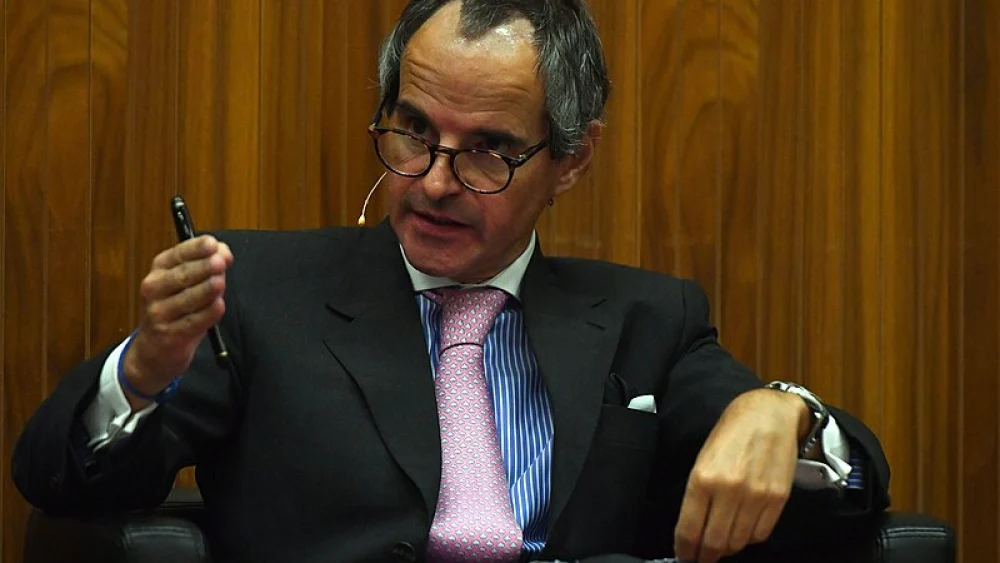
International Atomic Energy Agency Director-General Rafael Grossi in Vienna on Oct. 2, 2019. Credit: Dean Calma/IAEA via Wikimedia Commons.

International Atomic Energy Agency (IAEA) Director-General Rafael Grossi confirmed on Tuesday that Iran has begun construction on an underground centrifuge-assembly plant after a previous one exploded in what the regime claimed was an act of sabotage.

The explosion in question took place in July at the Natanz nuclear site, previously the target of the Stuxnet cyber attack, reportedly a joint U.S.-Israel maneuver.

After the explosion in the summer, Iran said it would build a new site in the mountains.

“They have started, but it’s not completed,” Grossi said in an interview with AP in Berlin. “It’s a long process.”

Grossi said the IAEA doesn’t think that Iran has a “significant quantity” of uranium “to indicate amounts which could be theoretically used for the development of a nuclear weapon.”

However, he added, “all of these are projections, and the IAEA is not into speculation. What may happen? What could happen? We are inspectors, we say the amounts that we see.”

“It is in line with the U.N.’s attitude and obsession with Israel,” said the president of the World Jewish Congress-Israel.
Israel’s Home Front Command has implemented an advanced preliminary alert system for Lebanese rocket threats.
The completion of two new pipelines will enable Leviathan to maximize its production capacity for both domestic needs and exports.
The war with Iran strained the Gulf state’s relationship with Hamas, but the evidence points less to a real break than to a Qatari balancing act.
Developing technologies that can make a truck vanish from radar. The race to find a solution to the new drone threat.
“Only one president was willing to lay it out on the line and ensure after 47 years that Iran is not capable of having a nuclear weapon,” said the U.S. secretary of defense.