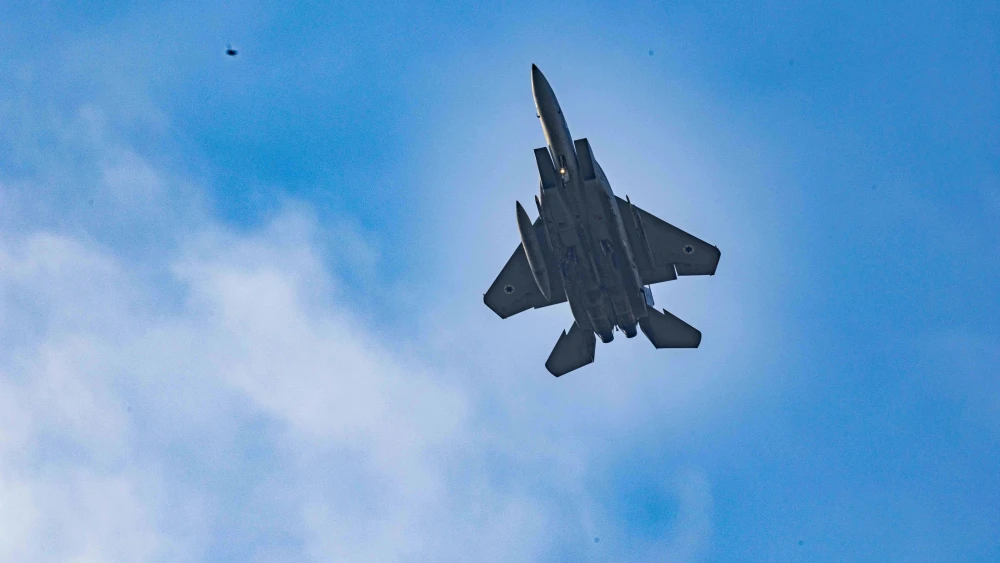
The Israel Defense Forces carried out airstrikes targeting underground terrorist infrastructure belonging to Iranian-backed Hezbollah in two areas across Lebanon, the military announced on Thursday evening.
The operation—conducted under the direction of the IDF’s Military Intelligence Directorate and with support from the Israeli Air Force—targeted weapons depots in the Beqaa Valley and Southern Lebanon.
The military accused Hezbollah of continuing efforts to rebuild its terror infrastructure across the Land of the Cedars, in violation of Jerusalem’s November 2024 ceasefire understandings with the official Beirut government.
Later on Thursday night, the military said IAF fighter jets struck more targets linked to the Iranian terrorist army and Green Without Borders, a Hezbollah-affiliated organization that poses as an environmental NGO.
Among the targets hit was a quarry where Hezbollah produced concrete used to rebuild terror infrastructure destroyed by Israel during the 13 months of cross-border fighting, according to the IDF statement.
“In addition, a site used by the Green Without Borders organization to conceal Hezbollah’s efforts to rebuild its infrastructure in Southern Lebanon under the guise of civilian activity was also struck,” it said.
The IDF has revealed in the past that Hezbollah uses the cover of Green Without Borders, a Lebanese NGO that claims to be dedicated to environmental goals, to gather intelligence in the border area.
The U.S. government sanctioned Green Without Borders on Aug. 16, 2023, with the U.S. Department of the Treasury claiming that the organization’s outposts are manned by Hezbollah terrorists and serve as cover for underground warehouses and munitions storage tunnels.
“The IDF will continue to act to remove any threat to the State of Israel,” Thursday evening’s Hebrew-language military statement concluded.
Lebanese President Joseph Aoun called on Monday for direct negotiations with Israel, signaling a possible historic shift with the southern neighbor Beirut classifies as an enemy state.
Aoun said his country “cannot be outside the current path in the region, which is the path of crisis resolution,” an apparent reference to Friday’s U.S.-brokered ceasefire agreement between Israel and Hamas in Gaza.
On Nov. 26, 2024, Jerusalem and Beirut signed a ceasefire deal aimed at ending more than a year of cross-border clashes between the IDF and Hezbollah. The Iranian-backed terror group began attacking the Jewish state in support of Hamas in the aftermath of the terrorist group’s massacre on Oct. 7, 2023.
Since the truce, the IDF has conducted frequent raids to stop Hezbollah from rebuilding terrorist infrastructure in Southern Lebanon, thereby violating the terms of the ceasefire agreement.
Hezbollah Secretary-General Naim Qassem has rejected demands to disarm in accordance with the truce, warning in July that the terrorist group was “rebuilding, recovering and ready now” to take on the IDF.