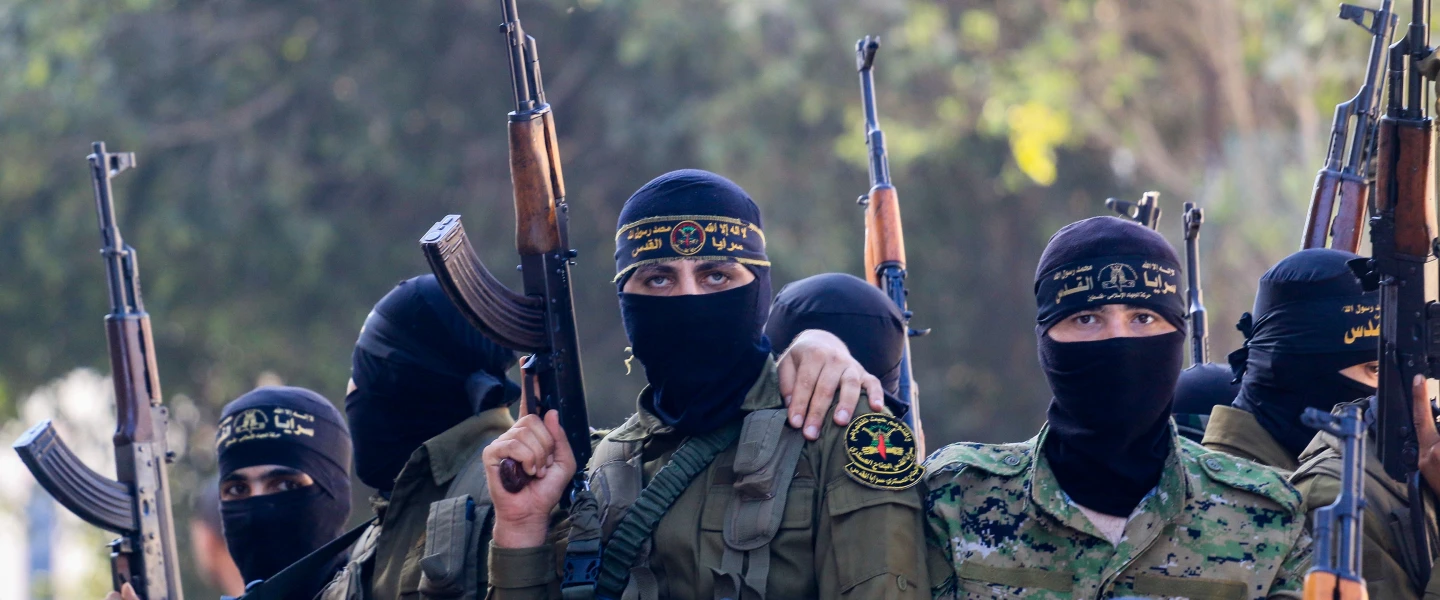
Heavy Iranian pressure on Hamas, Hezbollah and Palestinian Islamic Jihad to establish a “joint operational mechanism” to coordinate activities against Israel is reportedly causing internal divisions among the Iranian proxies.
The alliance of Iranian-backed terror groups known as the “Jerusalem Axis” is Iran’s counterweight to the Abraham Accords, and finds support in Syria, Lebanon, Iraq and Yemen.
Arab and Lebanese sources indicate that Iran has been actively working towards establishing a shared operational headquarters for Hezbollah, Hamas and PIJ in southern Lebanon. There are indications of plans to create a joint center to coordinate rocket attacks on Israel.
While the move seeks to strengthen the Jerusalem Axis’s military capabilities, the terror groups themselves are reportedly less than enthusiastic about the plan.
Yahya Sinwar, the leader of Hamas in Gaza, has expressed opposition to the initiative, preferring to maintain a more neutral stance. However, Saleh al-Arouri, an influential Hamas figure reportedly based in Turkey, supports closer ties with Iran and is leading the push for an “Iranian option.”
Hezbollah leader Hassan Nasrallah, too, prefers to maintain his status as an independent proxy rather than fully aligning with Hamas.
As for PIJ, it is directly funded by Iran to the tune of some $100 million annually. Tehran gave PIJ permission to pursue the Egyptian-brokered ceasefire which ended a five-day conflict with Israel.
The heightened coordination between Iran and its proxies was evidenced by a series of meetings involving high-ranking officials earlier this year.
In one meeting of note, Esmail Ghaani, the commander of the Quds Force of Iran’s Islamic Revolutionary Guards Corps, held discussions with Hamas leader Ismail Haniyeh, Hamas deputy Arouri and senior officials from PIJ and Hezbollah at the Iranian embassy in Lebanon. On April 6, shortly after Ghaani’s visit, a barrage of rockets was fired at Israel from Lebanon, strongly suggesting a coordinated effort.
Israel responded to the rockets by targeting Hamas-affiliated sites in southern Lebanon. The following day, Hassan Nasrallah held a meeting with Haniyeh, further indicating Hezbollah’s involvement and approval of the rocket fire.
These events underscore the close coordination that already exists between Iran and its proxies, which Tehran is now seeking to extend to the operational sphere.
The establishment of an operational mechanism in southern Lebanon aligns with Iran’s broader objective with regard to Israel. It also potentially aligns with the goals of Hezbollah, as by activating Hamas from Lebanese soil, the Lebanese terror group can shield both its own assets and those of Iran from Israeli retaliation.
However, Hezbollah faces internal political pressure in Lebanon, including from its own Shi’ite community, discouraging any action that could potentially cause a destructive conflict akin to the 2006 war. Hezbollah’s delicate position in Lebanon may lead the terror group to seek an alternative solution.
For Hamas, however, the situation is far more complex; Tehran’s proposed coordination mechanism would potentially turn Hamas into a de facto proxy of Hezbollah.
Senior Hamas leaders, including Sinwar, who maintains close ties with Egypt, and Khaled Meshaal, the Hamas leader associated with Qatar, find such an arrangement to be unacceptable.
This is reportedly causing tension with the pro-Iran group in Hamas led by al-Arouri.
Which camp ultimately gets the upper hand remains to be seen.