


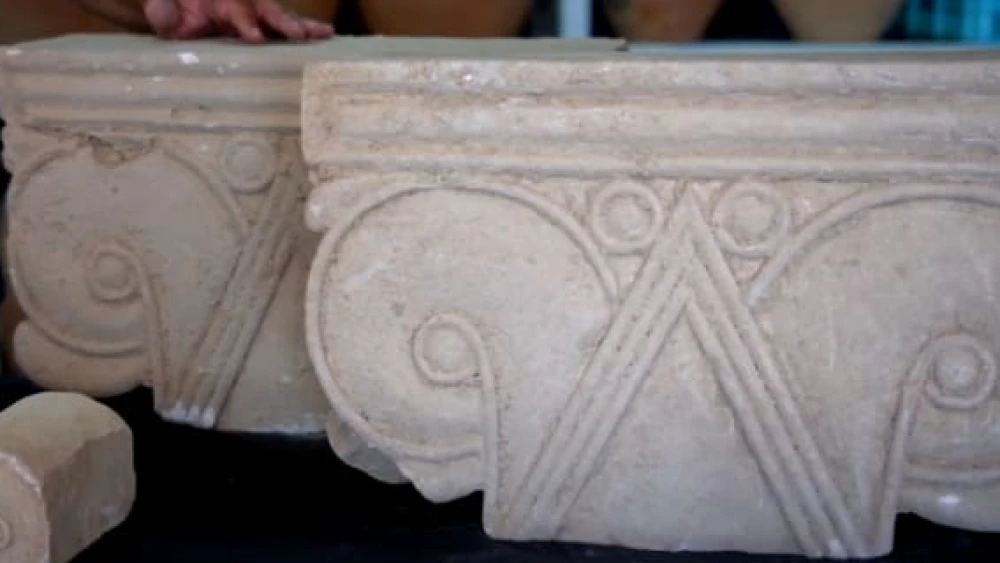
The Israel Antiquities Authority on Thursday unveiled the discovery of a number of artifacts that decorated a palace dating back to the First Temple Period and overlooking Jerusalem’s Old City.
“A rare, impressive, and very special collection of several dozen adorned architectural stone artifacts, which together were part of a magnificent structure, was discovered,” the IAA said in a statement. “These stone artifacts are made of soft limestone, with decorative carvings, and among them are capitals of various sizes in the architectural style known as ‘Proto-Aeolian’—one of the most significant royal building features of the First Temple period.”
According to the IAA, the discovery is significant due to the state the artifacts were found in and their prominent location within the palace.
“This is a very exciting discovery. This is a first-time discovery of scaled-down models of the giant Proto-Aeolian capitals of the kind found thus far in the Kingdoms of Judah and Israel, where they were incorporated above the royal palace gates. The level of workmanship on these capitals is the best seen to date, and the degree of preservation of the items is rare,” said Yaakov Billig, director of the excavation.
“This discovery, along with the palace previously uncovered in Ramat Rachel [near Jerusalem] and the administrative center recently uncovered by the Israel Antiquities Authority on the slopes of Arnona [another neighborhood of Jerusalem], attests to a new revival in the city and something of an ‘exit from the walls’ in the First Temple period, after the Assyrian siege. We reveal villas, mansions and government buildings in the area outside the walls of the city. This testifies to the relief felt by the city’s residents and the recovery of Jerusalem’s developments after the Assyrian threat was over,” said Billig.
It is unclear who lived in the palace, according to the IAA.
This article first appeared in Israel Hayom.



