


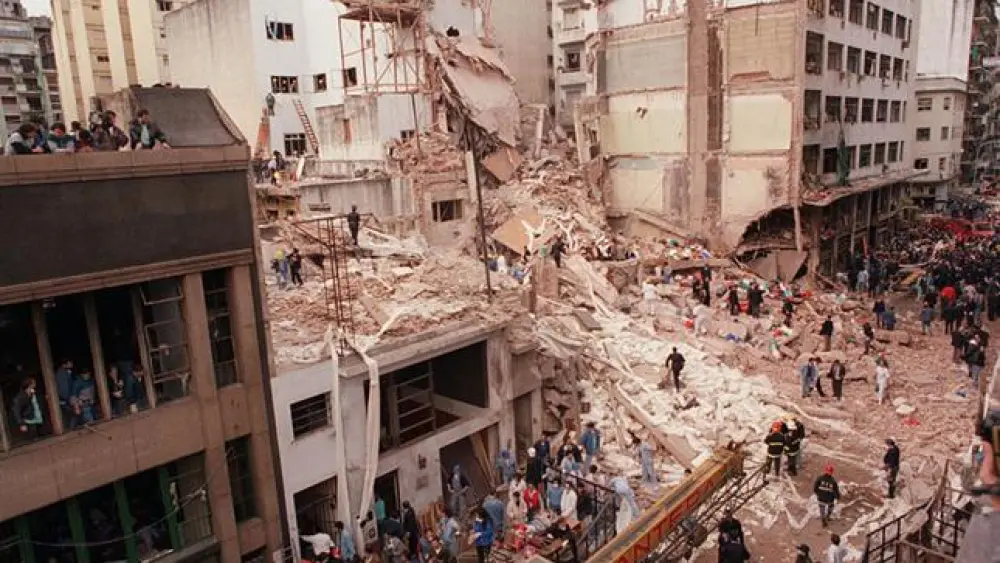
Argentina has asked Interpol to arrest Iranian Interior Minister Ahmad Vahidi due to his alleged role in the 1994 bombing of the AMIA Jewish community center in Buenos Aires that killed 85 people and wounded more than 300 others.
Argentina previously accused Vahidi, a former senior official in the Islamic Revolutionary Guards Corps, of being one of the masterminds of the terrorist attack, and sought his extradition.
Earlier this month, the Court of Cassation in Buenos Aires issued a ruling blaming Iran for bombing the Asociación Mutual Israelita Argentina on July 18, 1994, using its terrorist proxy Hezbollah.
In February, Argentine President Javier Milei arrived in Israel for a wartime visit, reiterating his pledge to move his nation’s embassy to Jerusalem and opening a new chapter in bilateral relations.
The three-day solidarity trip, one of his first tours abroad since taking office two months ago, signaled a major shift in Argentina’s foreign policy towards the United States and Israel after decades of backing Arab countries.
Milei has said that he would work to designate Hamas as a terrorist organization, noting that Argentines were among the 1,200 people taken hostage by Hamas on Oct. 7.
In March, the Jewish state and people worldwide marked the 32nd anniversary of the Iranian-sponsored Hezbollah bombing of the Israeli embassy in Buenos Aires.
At 2:15 p.m. on March 17, 1992, a powerful explosion rocked the building housing the diplomatic mission, killing 29 people, including three Israeli embassy personnel and six local embassy employees, and wounding 242 other civilians.
In May 1999, the Argentine Supreme Court finally accused Hezbollah of that attack and issued an arrest warrant for top terrorist commander Imad Mughniyeh (who would be assassinated in Damascus in 2008). An Israeli probe, whose findings were made public in 2003, showed that the highest levels of the Iranian regime had authorized Hezbollah to carry out the bombing.
In February, U.S. Sen. Marco Rubio (R-Fla.) visited the Asociación Mutual Israelita Argentina building to honor those killed and wounded in the summer of 1994.
Rubio also memorialized prosecutor Alberto Nisman, the Argentine attorney and chief investigator of the 1994 terrorist attack, who was found dead at his home in Buenos Aires in 2015, reportedly murdered, before he could reveal his findings.


