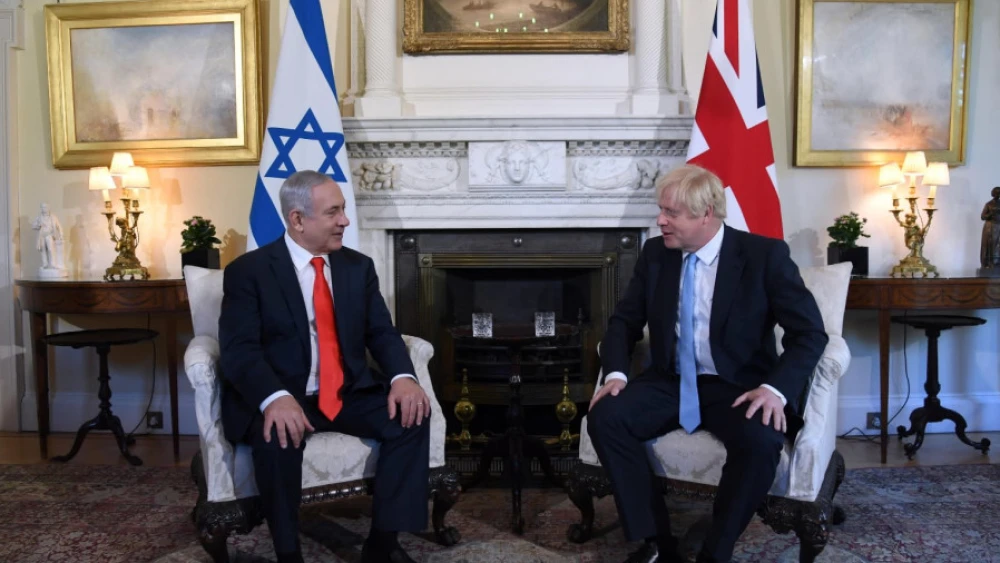
British Prime Minister Boris Johnson called on Israel not to extend its sovereignty to Judea, Samaria and the Jordan Valley in a front-page Hebrew op-ed published by Israeli daily Yediot Ahronot on Wednesday.
Calling himself a “passionate defender of Israel,” Johnson said that for Israel to follow through with its sovereignty plan would represent “a violation of international law” and would also be “a gift to those who want to perpetuate the old stories about Israel.”
“I profoundly hope that annexation does not go ahead,” he wrote. “If it does, the U.K. will not recognize any changes to the 1967 lines, except those agreed between both parties.”
“We must now use the energy of this moment once more to come back to the table and strive to hammer out a solution,” he wrote.
He did not make any mention however of the Palestinians’ refusal to negotiate with Israel.
“Few causes are closer to my heart than ensuring [Israel’s] people are protected from the menace of terrorism and anti-Semitic incitement. The U.K. has always stood by Israel and its right to live as any nation should be able to, in peace and security,” he wrote.
“As a life-long friend, admirer and supporter of Israel,” he continued, “I am fearful that these proposals will fail in their objective of securing Israel’s borders and will be contrary to Israel’s own long-term interests.”
Israeli sovereignty in the Jordan Valley, and parts of Judea and Samaria, he said, would “put in jeopardy the progress that Israel has made in improving relationships with the Arab and Muslim world” and would “inevitably set back these opportunities and constrain potential Arab partners.”
Johnson highlighted the United Kingdom’s support for Israel, saying it “often stood in a small minority at the U.N. in defending Israel against unwarranted and wholly disproportionate criticism.”
“The only way it can be achieved is for both sides to return to the negotiating table,” he concluded. “That must be our goal. Annexation would only take us further away from it.”